1950’s AM Transmitter Is Fun But Dangerous

[Mr. Carlson] bought a Globe Scout Model 40A ham radio transmitter at a hamfest. The 40A was a grand old transmitter full of tubes, high voltage, and a giant transformer. It is really interesting to see how much things have changed over the years. The transmitter is huge but has comparatively few parts. You needed a crystal for the frequency you wanted to talk. There were two little modules that were precursors to hybrid circuits (which were precursors to ICs) that were often called PECs or couplates (not couplets) but other than those, it is all tubes and discrete components beautifully wired point-to-point.

The really surprising part, though, is the back panel. There’s a screw terminal to drive the coil of an external coaxial relay that has line voltage on it. There’s also a plug on the back with exposed terminals that has plate voltage on it which is considerable. In the 1950s, you assumed people operating equipment like this would be careful not to touch exposed high voltage.

Continue reading “1950’s AM Transmitter Is Fun But Dangerous”

Using a Tile as a car tracker

Turning A Tile Into A Car Tracker

A Tile is a small Bluetooth device which you can put on your keychain, for example, so that you can find your keys using an app on your phone. Each Tile’s battery life expectancy is one year and after that year you’re expected to trade it in at a discount for a new one. Right away your hacker senses are tingling and you know what’s coming.

Hacked tile with buck converter

[Luis Rodriguez] had switched to Samsung SmartThings and had accumulated box of these Tiles with dead batteries. So he decided a fun project would be to put a Tile in his wife’s car to track it. Given that it’s using Bluetooth, the range isn’t great for car tracking, but the Tile’s app can network with other user’s apps to widen the search area.

Since the Tile’s battery was dead, he cracked it open and soldered wires to its power terminals. He then found a handy 12 volt source in the car and added a DC to DC buck converter to step the voltage down to the Tile’s 3 volts. Finding a home for the hacked tracker was no problem for [Luis]. He was already using an ODB-II dongle for a dash cam so he tapped into the 12 V rail on that.

You’ll be surprised what you can find by hacking these small tracking devices. Here’s an example of hacking of a fitness tracker with all sorts of goodies inside.

Our thanks to [Maave] for tipping us off about this hack.

This Clock Is Hard: No Arduino Needed

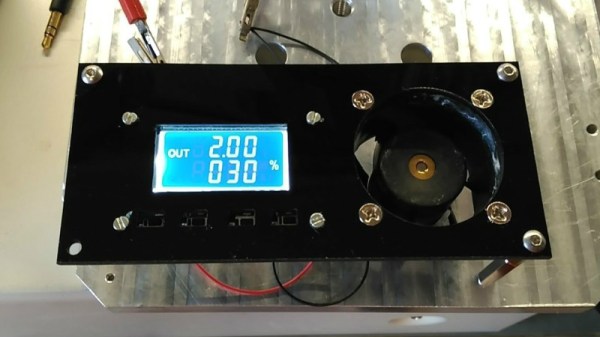
You always hear that people talk about the weather. But it seems to us we see more clocks than we do weather stations. A case in point is [frank_scholl’s] clock made from an old hard drive. We found it interesting that the clock has no microcontroller at all. The custom PCB is all digital and uses the line frequency to drive counters which, in turn, drive the motors.

The one catch is that you have to have a hard drive that uses a very particular motor scheme for this to work. The platter rotation shows the hour and the head’s track position counts off the minutes from 0 to 59. Two buttons can speed up either rotation for the purpose of setting the clock. You can see it all in the video below.

Continue reading “This Clock Is Hard: No Arduino Needed”

H2gO Keeps Us From Drying Out

The scientific community cannot always agree on how much water a person needs in a day, and since we are not Fremen, we should give it more thought than we do. For many people, remembering to take a sip now and then is all we need and the H2gO is built to remind [Angeliki Beyko] when to reach for the water bottle. A kitchen timer would probably get the job done, but we can assure you, that is not how we do things around here.

A cast silicone droplet lights up to show how much water you have drunk and pressing the center of the device means you have taken a drink. Under the hood, you find a twelve-node NeoPixel ring, a twelve millimeter momentary switch, and an Arduino Pro Mini holding it all together. A GitHub repo is linked in the article where you can find Arduino code, the droplet model, and links to all the parts. I do not think we will need a device to remind us when to use the bathroom after all this water.

Another intrepid hacker seeks to measure a person’s intake while another measures output.

Continue reading “H2gO Keeps Us From Drying Out”

The Apocalypse Bicycle

It seems to be a perennial among humans, the tendency among some to expect the End Times. Whether it was mediaeval Europeans who prepared for a Biblical Armageddon at the first sight of an astronomical phenomenon, 19th-century religious sects busy expecting a Noah’s flood, cold-war survivalists with bunkers under the lawn, or modern-day preppers buying survival gear, we have a weakness for thinking that Time’s Up even when history shows us repeatedly that it isn’t. Popular culture has even told us that the post-apocalyptic world will be kinda cool, with Mad Max-style rusty-looking jacked-up muscle cars and Tina Turner belting out ballads, but the truth is likely to be a lot less attractive. Getting away from danger at faster than walking pace as a starving refugee would likely be a life-or-death struggle without the industrial supply chain that keeps our 21st-century luxury cars on the road, so something more practical would be called for.

[Don Scott] has written a paper describing an extremely straightforward solution to the problem of post-apocalyptic transport, which he calls the Apocalypse Bicycle. As you might expect it’s a two-wheeler, though it’s not the kind of machine on which you’d lead a break-away from the Tour de France peloton. Instead this is a bicycle pared down to its minimum,, without advanced materials and with everything chosen for durability and reliability. Bearings would have grease nipples, for instance, the chain would be completely enclosed for better retention of lubrication, and the wheels would be designed to have strips of salvaged tyre attached to them. Interestingly, the machine would also be designed not to attract attention, with muted matte colours, and no chrome. It occurs to us that many of the durability features of this machine are also those that appear on the rental bicycles owned by bike sharing companies that have been spread liberally on the streets of many cities.

You might wonder what use the idea might have, and why a prepper might consider one alongside their tins of survival rations. But it’s also worth considering that these machines have a real application in the here-and-now, rather than just an imagined one in an apocalyptic future. Many Hackaday readers are fortunate enough to live in countries unaffected by wars or natural disasters, but there are plenty of places today where an aid agency dropping in a load of these machines could save lives.

Apocalyptic cycling has featured little here. But we have brought you at least one bike made from wood.

Become The Rockstar Developer You’ve Always Dreamed Of Being

If you have ever worked in software-related industries, the chances are that the word “Rockstar” will elicit a visceral reaction. It’s a word used by a Certain Type Of Manager for an elite software developer who’s so 1337 they don’t play by the rules of ordinary mortals. In reality it’s use is invariably an indication of trouble ahead, either from clueless startups or troublesome rockstar developers making a toxic atmosphere for the mere members of the backing band. Hackaday has a team that brings together a huge breadth of experience, and we’ve been there.

Would you like to be a rockstar developer, but without the heartache? No silly incentives, or even guitars required! [Dylan Beattie] can help, because he’s come up with a specification for the Rockstar programming language, a Turing-complete programming language whose syntax follows the conventions of 1980s rock power ballads. Of course, it’s a joke, and an excuse of some “Certified Rockstar Developer” laptop stickers, but it’s also an entertaining journey into lyrical language and compiler parsing, and the discovery that yes indeed, a singable set of classic rock lyrics can also be a compilable program.

Our particular favourite comes from the scheme used to represent numbers, as sentences in which a decimal is built from the lengths of the sentence words, and poetic licence can be employed to the fullest. The example is

 My dreams were ice. A life unfulfilled; wakin' everybody up, taking booze and pills

which line of code places the value 3.1415926535 into a variable called “my dreams”.

There does not appear to be a working Rockstar compiler at the time of writing, but we are sure that the amazing community of Rockstar developers will shortly create one. And we would be hugely disappointed were we not to hear some performative coding from spandex-clad guitar-wielding developers as a result. After all, how else will they get their work noticed!

Esoteric languages have featured before here, but they have usually been far more challenging ones.

The Undead Remote

In the very late 1990s, something amazing was invented. White LEDs. These magical pieces of semiconductors first became commercially available in 1996, and by the early 2000s, you could buy a single 5mm white LED for less than a dollar in quantity one. A year or two later, an astonishing product showed up on infomercials airing on basic cable at 2 a.m. It was a flashlight that never needed batteries. With a small white LED, a few coils wrapped around a tube, and a magnet, you could just shake this flashlight to charge it. It’s just what you needed for when the Y2K virus killed all electronics.

Of course, no one uses these flashlights now because they suck. The early white LEDs never put out enough light, and charging a flashlight by shaking it every twenty seconds is annoying. There is another technology that desperately needs a battery-less solution, though: remote controls. They hardly use any power at all. That’s exactly what [oneohm] did for his Hackaday Prize entry. He created the Undead Remote.

The dream of a battery-less remote control has been dead since your parents got rid of that old Zenith Space Command, but here it is. This is really just a shake flashlight, a diode rectifier, a large capacitor, and some glue. Shake the remote, and you can change the channel. Is it useful? Certainly. Does it look weird and is it slightly inconvenient? Also yes. But there you go. If you want an easy way to deal with batteries in your remote control, this is a solution.