Custom Designed Keyboard Needs A Custom Made Metal Case

It’s hardly news that mechanical keyboard users love their keyboards.  When it comes to custom keyboards, though, [Cameron Sun] has taken things to the next level, by designing his own keyboard and then having the case custom milled from aluminum.  If a Macbook and an ErgoDox had a baby, it would look like this!

[Cameron] had been using a 60 percent keyboard (a keyboard with around 60% of the keys of a standard keyboard) but missed the dedicated arrow keys, as well as home/end and pgup/pgdown keys. Thus began the quest for the ultimate keyboard! Or, at least, the ultimate keyboard for [Cameron.]

Keyboards begin and end with a layout, so [Cameron] started with keyboard-layout-editor.com, a site where you can create your own keyboard layout with the number of keys you’d like. The layout was a bit challenging for [Cameron] using the online tool, so the editing was moved into Adobe Illustrator. Once the layout was designed, it was time to move on to the case. Wood was considered, but ultimately, aluminum was decided upon and the basic shape was milled and then the key holes were cut using a water jet.

An interesting addition to the keyboard were three toggle switches. These allow [Cameron] to choose a modified layout for use when gaming, and also to move some of the keys’ locations so that one side of the keyboard can be used for gaming.

Custom keyboard layouts are getting more and more popular and there are lots of DIY cases to hold those layouts. [Cameron] has upped the ante when it comes to cases, though. If you’re interested in building your own keyboard, we have you covered with articles like The A to Z of Building Your Own Keyboard. If you’re looking for more custom cases, perhaps a concrete one is what you want?

Via Reddit.

Teardown Of A Fingerprint Padlock

We wouldn’t mind tearing down a fingerprint scanner, but we hate to bust up our expensive laptop or cell phone. [Julian], however, got a hold of a fingerprint scanning padlock and was willing to tear it apart for our benefit. The video appears below.

The padlock is a simple enough little device with a cable lock instead of a solid metal shackle, although we have seen similar devices with traditional shackles. Initially, the lock’s fingerprint storage is empty and it will open for any fingerprint. The first task is to set an administrator fingerprint. You’ll need that fingerprint to set up other fingerprints or to reset the unit. Of course, what we are really interested in is what’s inside.

Continue reading “Teardown Of A Fingerprint Padlock”

How Much Current Does That Thing Draw?

If you ask us how to measure the current draw from something, we’ll break a power lead and put a multimeter in series with the power supply. If that’s not handy, we’ve been known to take the fuse out of the power supply and replace it with the meter. Crude, but effective. But if you have about $8,000 sitting around, you could go grab a Keithley 2460 SourceMeter.

What’s a SourceMeter? Well, as far as we can tell it is a power supply with very accurate built-in current monitoring and a microprocessor that can display lots of interesting statistics and graphs. In all fairness, this looks like a souped up model, but they start at about half the price which is still a lot more than most hacker budgets.

Continue reading “How Much Current Does That Thing Draw?”

Cheap PSoC Enables Electrochemistry Research

You may think electrochemistry sounds like an esoteric field where lab-coated scientists labor away over sophisticated instruments and publish papers that only other electrochemists could love. And you’d be right, but only partially, because electrochemistry touches almost everything in modern life. For proof of that look no further than your nearest pocket, assuming that’s where you keep your smartphone and the electrochemical cell that powers it.

Electrochemistry is the study of the electrical properties of chemical reactions and does indeed need sophisticated instrumentation. That doesn’t mean the instruments have to break the grant budget, though, as [Kyle Lopin] shows with this dead-simple potentiostat built with one chip and one capacitor. A potentiostat controls the voltage on an electrode in an electrochemical cell. Such cells have three electrodes — a working electrode, a reference electrode, and a counter electrode. The flow of electrons between these electrodes and through the solutions under study reveal important properties about the reduction and oxidation states of the reaction. Rather than connect his cell to an expensive potentiostat, [Kyle] used a Cypress programmable system-on-chip development board to do everything. All that’s needed is to plug the PSoC into a USB port for programming, connect the electrodes to GPIO pins, and optionally add a 100 nF capacitor to improve the onboard DAC’s accuracy. The video below covers the whole process, albeit with a barely audible voiceover.

Still not sure about electrochemistry? Check out this 2018 Hackaday Prize entry that uses the electrochemistry of life to bring cell phones back to life.

Continue reading “Cheap PSoC Enables Electrochemistry Research”

Memristors On A Chip Solve Partial Differential Equations

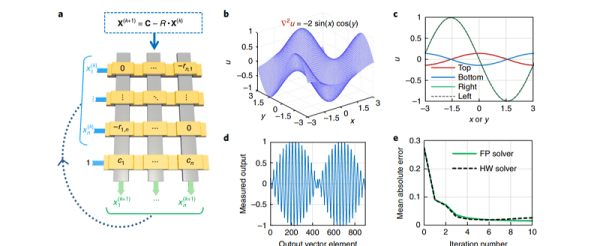
We were always taught that the fundamental passive components were resistors, capacitors, and inductors. But in 1971, [Leon Chua] introduced the idea of a memristor — a sort of resistor with memory. HP created one in 2008 and since then we haven’t really had the burning need to use one. In a recent Nature article, [Mohammed Zidan] and others discuss a 32 by 32 memristor array on a chip they call a memory processing unit. This analog computer on a chip is useful for certain kinds of operations that CPUs are historically not efficient at, including solving differential equations. Other applications include matrix operations used in things like machine learning and weather prediction. The paper is behind a paywall, although the usual places to find scholarly papers will probably have it soon.

There are several key ideas for using these analog elements for high-precision computing. First, the array is set up in a passive crossbar arrangement. In addition, the memristors are quantized so that different resistance values represent different numbers. For example, a memristor element that could have 16 different resistance values would allow it to operate as a base-16 digit.

Continue reading “Memristors On A Chip Solve Partial Differential Equations”

Help Save Some Of Australia’s Computer History From The Bulldozers

When multiple tipsters write in to tell us about a story, we can tell it’s an important one. This morning we’ve received word that the holding warehouse of the Australian Computer Museum Society in the Sydney suburb of Villawood is to be imminently demolished, and they urgently need to save the artifacts contained within it. They need Aussies with spare storage capacity of decent size to help them keep and store the collection, and they only have a few days during which to do so.

The ever-effusive Dave from EEVblog has posted a video in which he takes a tour, and like us he’s continually exclaiming over the items he finds. An EAI analog computer, a full set of DEC PDP-11 technical documentation, a huge Intel development system, Tektronix printers, huge DEC racks, memory cards for VAXen, piles and piles of boxes of documentation, and much, much more.

So, if you are an Aussie within reach of Sydney who happens to have a currently-unused warehouse, barn, or industrial unit that could house some of this stuff, get in touch with them quickly. Some of it may well be junk, but within that treasure trove undoubtedly lies a lot of things that need to be saved. We’d be down there ourselves, but are sadly on the other side of the world.

Continue reading “Help Save Some Of Australia’s Computer History From The Bulldozers”

Looking At Wind Turbines From A Different Angle

When we think of wind turbines, the first thing that usually comes to mind is the typical Sim City-esque type – 3 blades, gigantic, and wired into the municipal power grid. In truth, the world of wind power generation is far more varied indeed – as [Vittorio]’s vertical-axis wind turbine shows us.

So what exactly is a vertical-axis wind turbine, you ask? Well, rather than the typical setup with blades rotating about a horizontal axis, as in typical utility turbines or a classic electric fan you might use to cool off on a sunny day, instead a vertical axis is used. This necessitates a very different blade design due to the orientation of the rotational axis relative to the flow, so such turbines can be quite visually striking to those unfamiliar with such designs.

[Vittorio]’s design is a great way to get to grips with the type. The blades and supports were initially created out of PVC gutter channel, though 3D printed versions have also been developed. The motion is turned into electricity by using a simple brushed DC motor as a dynamo.

While the scale is small and the output only in the tens of watts, it goes to show that there’s always more than one way to do things.  We’ve seen some vertical-axis wind projects before, too. Video after the break.

Continue reading “Looking At Wind Turbines From A Different Angle”