Working On A Startup? New Fund Is Building Portfolio From Hard Technology

Root Ventures just announced it has raised a second fund and is in search of startups to invest the $76,726,900 they now have burning a hole on their balance sheet. Their first fund of $31,415,926.53 went to some very cool hardware companies like Shaper, Particle, Plethora, and Prynt. For those keeping score, the first fund is Pi and the second is the speed of sound — it’s a geeky engineer thing.

This is a seed fund, and founding partner Avidan Ross described their role in your company as being the world’s “greatest sherpa to take you on a really tumultuous path”. That path is one of building a product around which a great company can arise. Repeatedly during the conference call with Hackaday, Avidan stressed that what makes Root Ventures stand out is that the partners in the firm are themselves engineers and have hardware backgrounds. For instance, Avidan spoke at the 2016 Hackaday Superconference about his 45-second pizza oven and other food/automation hacks. Partner Chrissy Meyer was an engineering manager at Apple and led hardware programs at Square, before founding a vehicle technology startup. Their point is that if you’re going to entrust part of your company to someone, it’s nice if they have the background to understand it.

Whether or not you have a startup in the works, it’s interesting to know what the keepers of the cash are looking for. Avidan described this as a engineering-heavy seed fund, but stopped short of calling it a hardware seed fund, using the more coy term “hard-tech fund”  although more than half of the portfolio companies already on board are building new, original hardware. It’s impossible to nail down exactly what the fund is seeking — they’ll know it when they see it — but we had a nice conversation of some of the future trends he has in mind.

While economies of scale in the smartphone industry delivered low cost sensors such as accelerometers, GPS, and cameras, along with connectivity, the next wave may be from the self-driving industry. Avidan foresees rising availability of ASICs, specialized GPUs, and the sensing hardware currently under heavy R&D in the automotive industry. His take is that not only will this be a hardware boon for startups, but the machine learning aspects of it will produce both talent and opportunity for new companies.

Pull together those proofs of concept and get your presentation decks ready. That $76 million is just waiting for a great idea to come along. If you make it big, Hackaday still wants an early look at your awesome new hardware!

Radar In Space: The Gemini Rendezvous Radar

In families with three kids, the middle child always seems to get the short end of the stick. The first child gets all the attention for reaching every milestone first, and the third child will forever be the baby of the family, and the middle child gets lost in-between. Something similar happened with the U.S. manned space program in the 60s. The Mercury program got massive attention when America finally got their efforts safely off the ground, and Apollo naturally seized all the attention by making good on President Kennedy’s promise to land a man on the moon.

In between Mercury and Apollo was NASA’s middle child, Project Gemini. Underappreciated at the time and even still today, Gemini was the necessary link between learning to get into orbit and figuring out how to fly to the Moon. Gemini was the program that taught NASA how to work in space, and where vital questions would be answered before the big dance of Apollo.

Chief among these questions were tackling the problems surrounding rendezvous between spacecraft. There were those who thought that flying two spacecraft whizzing around the Earth at 18,000 miles per hour wouldn’t work, and Gemini sought to prove them wrong. To achieve this, Gemini needed something no other spacecraft before had been equipped with: a space radar.

Continue reading “Radar In Space: The Gemini Rendezvous Radar”

Grbl Ported To The ESP32

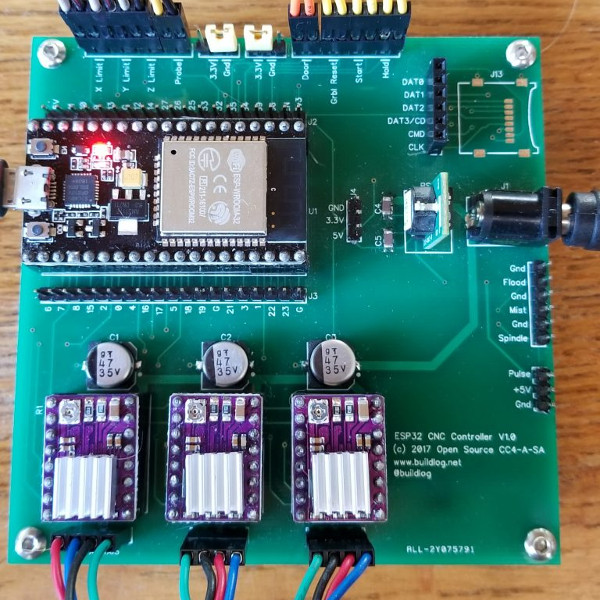
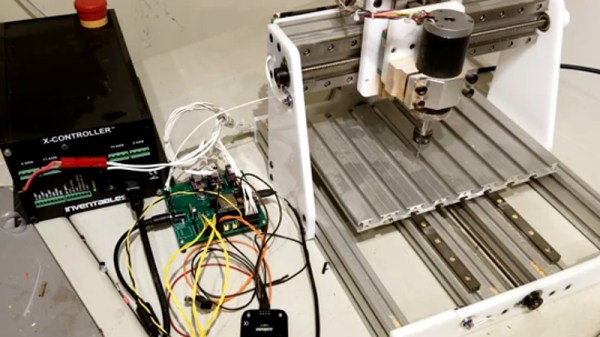
If you’re building a CNC or laser, there’s an excellent chance you’ll be using Grbl to get moving. It’s also a pretty safe bet you’d end up running it on some variation of the Arduino sitting in a motor controller breakout board. It’s cheap, easy to setup and use, and effectively the “industry” standard for DIY machines so there’s no shortage of information out there. What’s not to love?

Well, quite a few things in fact. As [bdring] explains, Grbl pushes the capability of the Arduino to the very limit; making it something of a dead-end for future development. Plus the Arduino needs to be plugged into the host computer via USB to function, a rather quaint idea to many in 2018. These were just some of the reasons he decided to port Grbl to the ESP32 board.

Price wise the Arduino and ESP32 are around the same, but the ESP does have the advantage of being much more powerful than the 8-bit Italian Stallion. Its got way more flash and RAM as well, and perhaps most importantly, includes Wi-Fi and Bluetooth out of the box. It still needs to be plugged into a board to hold the motor drivers like the Arduino, but beyond that [bdring] opines the ESP32 is about as close to the perfect Grbl platform as you can get.

[bdring] reports that porting the code over to the ESP32 wasn’t terrible, but it wasn’t exactly a walk in the park either. The bulk of the code went by without too much trouble, but when it came to the parts that needed precise timing things got tricky. The ESP32 makes use of a Real Time Operating System (RTOS) that’s not too happy about giving up control of the hardware. Turning off the RTOS was an option, but that would nuke Bluetooth and Wi-Fi so obviously not an ideal solution. Eventually he figured out how to get interrupts more or less playing nicely with the RTOS, but mentions there’s still some more work to be done before he’s ready to release the firmware to the public.

If you’ve been browsing Hackaday for a while you may remember [bdring]. He’s got a real knack for making things move, and has created a number of fantastic little CNC machines recently which have definitely caught our eye.

[Thanks to Jon and Craig for the tip.]

Continue reading “Grbl Ported To The ESP32”

Data Logging Like It’s 1982

If you want to log voltages or resistance these days, no problem. You can buy a multimeter with Bluetooth for a hundred bucks, and if you’re really fancy you can spring for the Fluke with a graphical display that will log values automatically. Things weren’t always this cheap and easy, but there was always a way to do it.

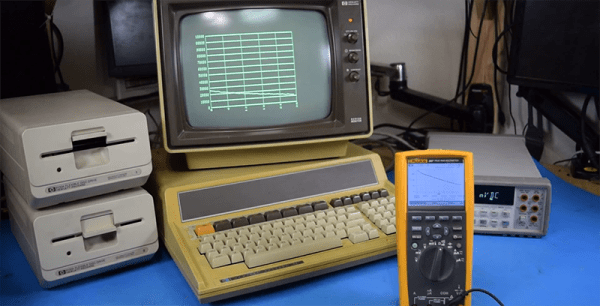
Back in the 80s, HP had GPIB, or HP-IB, or IEEE-488 connectors on the back of their benchtop equipment. This was an 8-bit interface not unlike a parallel port that allowed for remote control of test equipment. In a great demonstration of what this was actually like, [AkBKukU] posted a video of connecting an old benchtop multimeter to a vintage computer over GPIB.

The computer used for this feat of retrotechtacularness is an HP Series 80, a footnote in the history of desktop computers, but it does have a custom CPU and BASIC in ROM. As you would expect from vintage HP gear, there are a few slots on the back of the computer for connecting interface boxes, including a modem, a speech synthesizer, and of course, an HP-IB interface that can speak IEEE-488.

With the multimeter connected to the computer over the daisy-chainable parallel interface, it was a simple matter of writing a little bit of BASIC to read a potentiometer and a thermistor. With a little bit more code, this computer can even produce a graph of the resistance over time. This is data logging like it’s 1982, and it’s a fantastic example of exactly how far we’ve come.

Continue reading “Data Logging Like It’s 1982”

Talking To Alexa With Sign Language

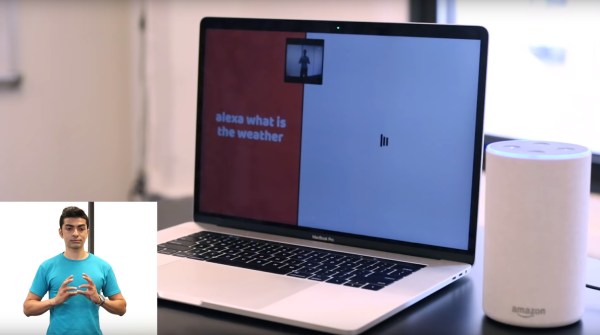
As William Gibson once noted, the future is already here, it just isn’t equally distributed. That’s especially true for those of us with disabilities. [Abishek Singh] wanted to do something about that, so he created a way for the hearing-impaired to use Amazon’s Alexa voice service. He did this using a TensorFlow deep learning network to convert American Sign Language (ASL) to speech and a speech-to-text converter to interpret the response. This all runs on a laptop, so it should work with any voice interface with a bit of tweaking. In particular, [Abishek] seems to have created a custom bit of ASL to trigger Alexa. Perhaps the next step would be to use a robotic arm to create the output directly in ASL and cut out the Echo device completely? [Abishek] has not released the code for this project yet, but he has released the code for other projects, such as Peeqo, the robot that responds with GIFs.

[Via FlowingData and [Belg4mit]]

Continue reading “Talking To Alexa With Sign Language”

GTA: San Andreas Radio Earns Six-Star Wanted Level

[Raphaël Yancey] wanted to be able to jam to Bounce FM and Radio:X all the time, without having to steal a car or a street sweeper in San Andreas. As people who like to put on the sad piano building music from The Sims and write Hackaday posts, we can totally relate.

But this isn’t just another one of those jam-a-Pi-into-a-vintage-radio-and-call-it-a-sandwich projects (not that there’s anything wrong with those). This thing acts like a real radio. All the stations play continuously whether you’re tuned in or not, and they bleed into each other as you go up and down the dial.

After much trial and error, [Raphaël] found a Python mixer that would work, but it was no longer maintained. He forked it, squashed a bug or two, and wrote a module for KY040 rotary encoders to make them play nice with the Pi. The snake charming doesn’t stop there: the rock star of this project is [Raphaël]’s virtual radio software, which handles the audio blending as he tunes between stations. A step-by-step tutorial is coming soon, so watch [Raphaël]’s site for updates. Tune past the break to give it a listen.

Adventures in Raspi radio-ing don’t have to be one-way. Here’s how you can turn one into an AM/FM+ transmitter using a DVB-T dongle and SDR.

Continue reading “GTA: San Andreas Radio Earns Six-Star Wanted Level”

Juggling Machine Listens To The Bounce To Keep Ball In The Air

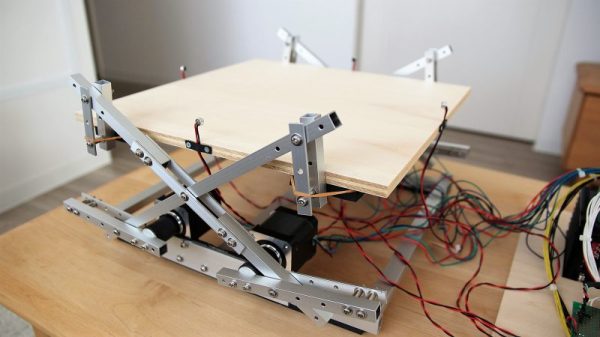
It’s a seemingly simple task: bounce a ping-pong ball on a wooden paddle. So simple that almost anyone can pick up a ball and a paddle and make a reasonable job of it. Now, close your eyes and try to do it just by the sound the ball makes when it hits the paddle. That’s a little tougher, but this stepper-driven platform juggler manages it with aplomb.

That’s not to say that the path to the finished product in the video below was a smooth one for [tkuhn]. He went through multiple iterations over the last two years, including a version that surrounded the juggling platform with a fence of phototransistors to track where the ball was at any time. That drove four stepper motors through a cross-linkage that popped the platform up at just the right moment to keep the ball moving, and at just the right angle to nudge it back toward the center of the platform. The current version of the platform does away with the optical sensors in favor of four small microphones. The mics pick up the sharp, well-defined sound of the ball hitting the platform, process the signal through an analog circuit, and use that signal to trigger a flip-flop if the signal exceeds a setpoint. An Arduino then measures the time delay between arriving signals, calculates the ball’s position on the platform, and drives the steppers through a PID loop to issue the corrective bounce.

The video below is entrancing, but we found ourselves wishing for a side view of the action too. It’s an impressive build nonetheless, one that reminds us of the many maze-runner and Stewart platform robots we’ve seen.

Continue reading “Juggling Machine Listens To The Bounce To Keep Ball In The Air”