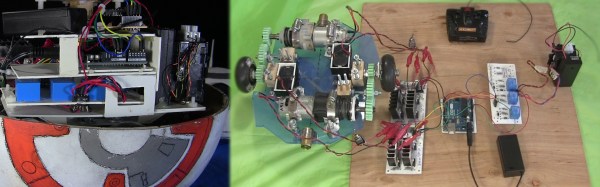
Power Wheels engine compartment

Power Wheels Rescued, Restored And Enhanced

It seems power wheels are like LEGO — they’re handed down from generation to generation.  [Nicolas] received his brand-new Peg-Perego Montana power wheels in 1997 as a Christmas present. After sitting in a barn for a decade, and even being involved in a flood, it was time to give it to his godchildren, though not without some restoration and added features. His webpages have a very good write-up, just shy of including schematics, but you’ll find an abbreviated version below.

Continue reading “Power Wheels Rescued, Restored And Enhanced”

New Part Day: Smoothie For RAMPS

When it comes to 3D printer controllers, there are two main schools of thought. The first group is RAMPS or RAMBo which are respectively a 3D printer controller ‘shield’ for the Arduino Mega and a stand-alone controller board. These boards have been the standard for DIY 3D printers for a very long time, and are the brains for quite a few printers from the biggest manufacturers. The other school of thought trundles down the path of ARM, with the most popular boards running the Smoothie firmware. There are advantages to running a printer with an ARM microcontroller, and the SmoothieBoard is fantastic.

Re-ARM for RAMPS — a Kickstarter that went live this week — is the middle ground between these two schools of thought. It’s a motherboard for RAMPS, but brings the power of a 32-bit LPC1768 ARM processor for all that smooth acceleration, fine control, and expansion abilities the SmoothieBoard brings.

Continue reading “New Part Day: Smoothie For RAMPS”

RC receiver to arduino converter for BB-8

Ask Hackaday: How Do You Convert Negative Voltages To Positive?

I have a good background working with high voltage, which for me means over 10,000 volts, but I have many gaps when it comes to the lower voltage realm in which RC control boards and H-bridges live. When working on my first real robot, a BB-8 droid, I stumbled when designing a board to convert varying polarities from an RC receiver board into positive voltages only for an Arduino.

Today’s question is, how do you convert a negative voltage into a positive one?

In the end I came up with something that works, but I’m sure there’s a more elegant solution, and perhaps an obvious one to those more skilled in this low voltage realm. What follows is my journey to come up with this board. What I have works, but it still nibbles at my brain and I’d love to see the Hackaday community’s skill and experience applied to this simple yet perplexing design challenge.

The Problem

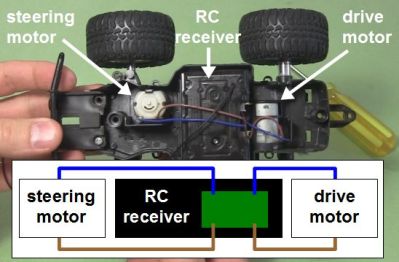
RC toy truck and circuit with no common

I have an RC receiver that I’ve taken from a toy truck. When it was in the truck, it controlled two DC motors: one for driving backwards and forwards, and the other for steering left and right. That means the motors are told to rotate either clockwise or counterclockwise as needed. To make a DC motor rotate in one direction you connect the two wires one way, and to make it rotate in the other direction you reverse the two wires, or you reverse the polarity. None of the output wires are common inside the RC receiver, something I discovered the hard way as you’ll see below.

Continue reading “Ask Hackaday: How Do You Convert Negative Voltages To Positive?”

Supermoon? Or Just Another Perigee Syzygy?

The moon’s orbit is not circular. According to Wikipedia, the moon is closest at around 357,000 kilometers and farthest at 406,000: a difference of something like 13%. That’s a freakishly egg-shaped orbit compared to the earth’s orbit around the sun, for instance. And it moves between these extremes every month.

Tonight, the perigee (the close approach) corresponds with a full moon (a syzygy — when the earth, moon, and sun are all in a line). What does that mean? A brighter-than-average full moon! If you were around for the last “supermoon” in 2011, you’ll have heard that it was the closest/brightest since 1992, or something. Well, this one’s brighter.

But don’t freak out if the clouds are hanging in the sky wherever you live; there’s a perigee full moon every 411.8 days, and there’s going to be one next year too. Unless you’re taking repeated photographs with the same lens, you won’t be able to detect the size difference with your current wetware anyway, due to the aptly named moon illusion. You already perceive the moon varying in size by a factor of 1.5 when it’s on the horizon versus hanging overhead, so an extra few percent is going to be lost in the noise floor. And the difference between a hazy and clear night will easily swamp the difference in brightness.

superm_nAs usual, XKCD sums it up nicely. The “supermoon” is a perigee when the moon happens to be full. It’s a fairly frequent event, by celestial standards, and it’s underwhelming. If you want to see something really freaky, keep your eyes peeled for the total eclipse of the sun in August 2017.

Don’t get us wrong, we think that the moon is super! And there’s nothing wrong with going outside to have a peek at it. Just please, during this year’s perigee syzygy, spare us the hyperbole.

“Supermoon” versus “micromoon” comparison image courtesy [Stephan Sciarpetti].

Path To Craftsmanship: Don’t Buy Awful Safety Gear

A while back I tried to make a case for good safety disciple as a habit that, when proactively pursued, can actually increase the quality of your work as a side effect. In those comments and in other comments since then I’ve noticed that some people really hate safety gear. Now some of them hated them for a philosophical reason, “Ma granpap didn’t need ’em, an’ I don’t neither”, or ,”Safety gear be contributin’ to the wuss’ness of the modern personage an’ the decline o’ society.” However, others really just found them terribly uncomfortable and restricting.

In this regard I can help a little. I’ve spent thousands of terrible long hours in safety gear working in the chemical industry. I was also fortunate to have a company who frequently searched for the best safety equipment as part of their regular program. I got to try out a lot.

Continue reading “Path To Craftsmanship: Don’t Buy Awful Safety Gear”

Electronica 2016: Too Much Electronics

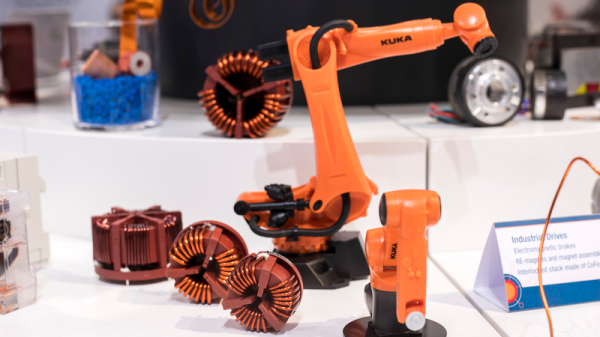
The Electronica trade show in Munich is so big that it only takes place once every two years. Every manufacturer, distributor, and maker of anything electronic is there. To get a feel for the scale of things, Electronica is spread out over twelve large exhibition halls and is served by two separate subway stations, one on either end. You wouldn’t think there would be so many inductor manufacturers in the world, but you’d be wrong.

dscf9020It’s a hardware geek’s paradise, even if it is aimed more at facilitating industry contacts than at serving the humble hacker. But it’s great to see what is out there, quiz reps of all our favorite chip manufacturers about what they’ve got going on, and just generally wander around. You might not get to play with the multi-gigahertz scopes on a day-to-day basis, but you can get hands-on with them at Electronica. And as cool as it is to talk directly to the representatives of our mega-manufacturers, it’s maybe more fun to check up on the creative fringe of companies that you’ve never heard of before, but who nonetheless have great ideas.
Continue reading “Electronica 2016: Too Much Electronics”

Fun With Fire: Oxy-Acetylene Basics

If generations of Hollywood heist films have taught us anything, it’s that knocking off a bank vault is pretty easy. It usually starts with a guy and a stethoscope, but that never works, so the bad guys break out the cutting torch and burn their way in. But knowing how to harness that raw power means you’ve got to learn the basics of oxy-acetylene, and [This Old Tony]’s new video will get your life of crime off on the right foot.

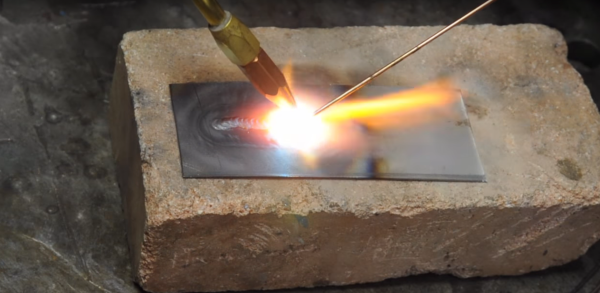
In another well-produced video, [Tony] goes into quite a bit of detail on the mysteries of oxygen and acetylene and how to handle them without blowing yourself up. He starts with a tour of the equipment, including an interesting look at the internals of an acetylene tank — turns out the gas is stored dissolved in acetone in a porous matrix inside the tank. Working up the hoses, he covers the all-important flashback arrestors, the different styles of torches, and even the stoichiometry of hydrocarbon combustion and how adjusting the oxygen flow results in different flame types for different jobs. He shows how oxy-acetylene welding can be the poor man’s TIG, and finally satisfies that destructive urge by slicing through a piece of 3/8″ steel in under six seconds.

We’ve always wanted a decent oxy-acetylene rig, and [Tony] has convinced us that this is yet another must-have for the shop. There’s just so much you can do with them, not least of which is unsticking corroded fasteners. But if a blue wrench is out of your price range and you still want to stick metal together, you’ll want to learn how to braze aluminum with a propane torch.

Continue reading “Fun With Fire: Oxy-Acetylene Basics”