Raspberry Pi Radio Streaming Service Guts Yamaha Shelf System

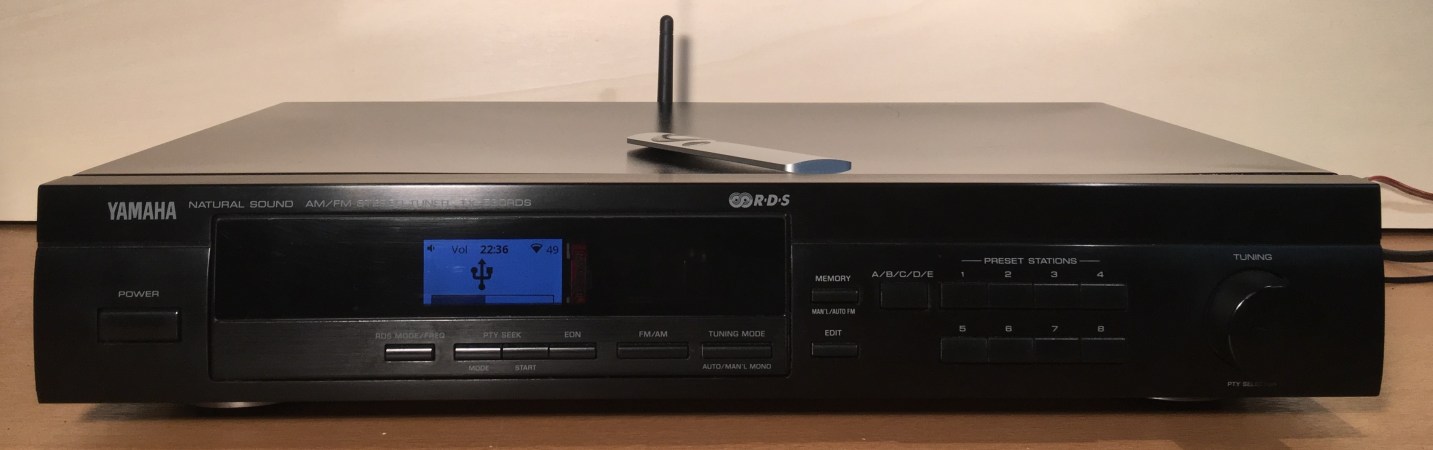
There are dozens — dozens! — of options to meet your music and streaming needs these days.  Looking to make something of his own that retains that 90’s vibe of having a dedicated stereo system but with modern wireless integration, [thk4711] turned an old Yamaha hifi into a Raspberry Pi streaming client.

As far as the case goes, a few modifications allowed [thk4711] to use all of the existing buttons, and a quick-swap of the back-plate and screen gave him a better enclosure than one he could fabricate himself. The power supply proved to be the most difficult part of the project due in part to some “digital noise” interference between the digital and analog components while they were wired to a common ground. This was solved by implementing two transformers, a LM2596 voltage regulator and a LT1084 low-noise power supply to smooth things out.

The Raspberry Pi 2-centered device supports internet radio, Spotify connect, Airplay, USB and auxiliary inputs.

Continue reading “Raspberry Pi Radio Streaming Service Guts Yamaha Shelf System”
Overhauling The ESP8266’s Flash Memory Handling

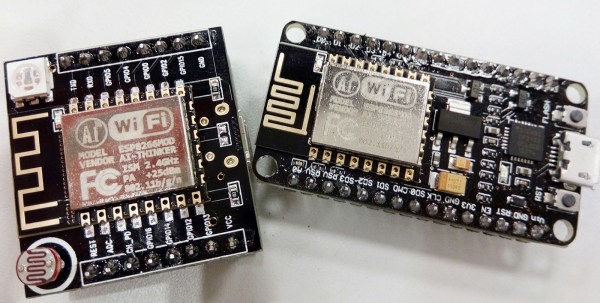
If you’ve ever corrupted a flash memory on a power failure, you’ll be glad to hear that the ESP8266 SDK implements a very secure and almost infallible read/write management for its flash memory. The catch: It’s also very wasteful. For a single memory block of stored data, three memory blocks of physical flash memory are occupied. [Peter Scargill] enlightens us with a better solution.

Continue reading “Overhauling The ESP8266’s Flash Memory Handling”

Hackaday Prize Entry: Boots And Cats And Boots And Cats

Electronic drums are pricey, but the drums themselves are actually very easy to make. By simply putting a few piezos on some rubber mats, you can make a set of electronic drums. The real trick, and the expensive bit, is in the drum module. This module has inputs for the high hat, snare, toms, and bass drum to turn the repetitive thwaking of a stick on a rubber mat into drum sounds.

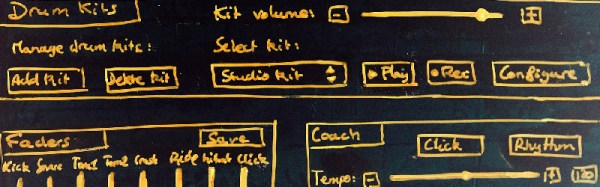
For his Hackaday Prize entry, [Jeremy] isn’t building a set of electronic drums. He’s building a drum module, complete with touchscreen interface and a GUI.

This isn’t [Jeremy]’s first go at building a drum module – his first implementation was RaspiDrums, an add-on for the Raspberry Pi that used accelerometers instead of piezos. The software works well enough with a USB sound card to serve as a set of real electronic snare.

Now [Jeremey] is moving up to a full kit, and the power of the Raspberry Pi means he can easily add a touch screen to his device. Right now the efforts are going into building a GUI using Gtkmm, and wrapping everything up into a front panel that makes sense and is easy to use. The drums themselves are a solved problem, making this Hackaday Prize entry a fantastic polish on an already great project.

Cityscape Infinity Table

Redditor [ squishy0eye] lacked a coffee table and wanted an infinity mirror. So, in a keen combination of the two, she built an infinity mirror table the resembles a nighttime cityscape.

Skimming over many of table’s build details, [squishy0eye] paused to inform the reader that an MDF base was used underneath the mirrors, with a hole drilled for the future power cable. For the top pane, she overlaid privacy screen mirror film onto tempered glass, turning it into a one-way mirror. The bottom pane is acrylic plastic due to the need to drill holes to hide the cables for each ‘building’ — the same mirror film was applied here as well. Wood was cut into rectangles for the building shapes and super glued around the holes and in the corresponding spots underneath to prevent any bowing in the acrylic. A small gap was left in each ‘building’ to run the 5050 non-waterproof LED strips around and back into the hole for power.

Continue reading “Cityscape Infinity Table”

31415926 (That’s Roughly Π Times 10 Million Raspberries)

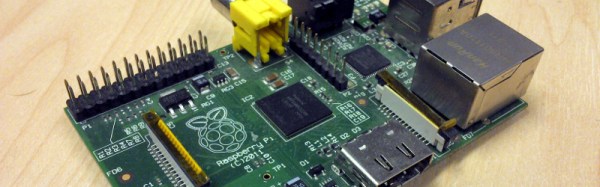
The Raspberry Pi Foundation founder Eben Upton has announced that their ten millionth eponymous single-board computer has been sold since their launch back in February 2012. It’s an impressive achievement, especially so since their original sales expectations were for a modest ten thousand. For those of us who watched the RS and Farnell websites crumble under the strain of so many would-be purchasers on that leap day morning four and a half years ago their rapidly exceeding that forecast came as no surprise, but still, it’s worth a moment’s consideration. They passed the Sinclair ZX Spectrum’s British record of 5m computers sold back in February 2015, leaving behind the Pi’s BBC Micro spiritual ancestor on 1.5m sold long before that.

Critics of the Pi will point out that its various versions have rarely been the most powerful small single board computer on the market, or even at times the cheapest. They will also point to the closed-source nature of the Broadcom binary blob that underpins Pi operating systems, and even the sometimes unpredictable nature of the Pi Foundation with respect to its community, product availability and launches. But given that the Pi Foundation’s focus is not on our side of the community but on using the boards as a tool to introduce young people to computing, it’s fair to say that they’ve done a pretty good job of ensuring that a youngster can now get their hands on a useful and easily programmable computer much more easily than at any time in the past.

Would we be in the same position of being able to buy a capable Linux computer for near-pocket-money prices had the Raspberry Pi not been released? Probably so, in fact certainly so. The hardware required to deliver these products has inevitably fallen into a more affordable price bracket, and we would certainly have plenty of boards at our fingertips. They would probably have Allwinner or maybe Mediatek processors rather than the Pi’s Broadcom part, but they would be very likely to deliver equivalent performance at a similar cost. Where the Raspberry Pi’s continued success has come from then has not necessarily been from its hardware but from its community and software. The reliability and ease of use delivered by the Raspbian Linux distribution that Just Works for the parent putting a Pi in front of their child, and the wealth of expert information on the Raspberry Pi forums to get them through any Pi-related troubles are what has given the Pi these sales figures. The boards themselves are almost incidental, almost any hardware paired with that level of background information would likely have met with similar success. Comparing the Pi software experience with for example one of their most capable competitors, it’s obvious that the software is what makes the difference.

It’s likely that Raspberry Pi sales will continue to climb, and in years to come we’ll no doubt be reporting on fresh milestones on ever more powerful revisions of their product. But it’s also likely that their competition will up their software game and their position in the hearts and minds of single board computer users might be usurped by a better offering. If this increased competition in the single board computer market delivers better boards with more for the hardware developer community, then we’re all for it.

Reverse Engineering And Networking The A/C Remote Control

IoT has become such an polarizing, overused term. But here it is in its essence: [zeroflow] had a thing (his airconditioner) and he needed to put it on the Internet.

For his contribution to this modern vernacular atrocity, he first had to build an IR debugging tool and reverse engineer the signals coming from the air conditioner’s remote. He wrote up a really good summary of the process, and worth reading. He loads up an IR library onto an Arduino and dumps the resulting 32 bits of information to his computer. In a process much like filling in the blanks on a word puzzle, he eventually determines which blocks of the data correspond to the remote’s different buttons.

Next he throws an array of IR LEDS and an ESP8266 onto a bit of protoboard. After writing some code, available on GitHub, he could set the temperature of his room from anywhere on the planet. We take it on faith that [zeroflow] has a compelling reason for doing so.

Bolstered by this success, he didn’t stop there. [Zeroflow] admits to having more than one thing on the Internet. Boom! Internet of things.

Top Ten Reasons Not To Buy A Fake MacBook Charger. Number Eight Will Shock You.

Yesterday, Apple showed the world how courageous they are by abandoning their entire PC market. It’s not time for a eulogy quite yet, but needless to say, Apple hardware was great, and the charger was even better. It had Magsafe, and didn’t start fires. What more could you ask for?

When it comes to fake MacBook chargers, you can ask for a lot more. [Ken Shirriff] has torn apart a number of these chargers, and his investigations allowed for an obvious pun in this post. The fake ones will make sparks thanks to the cost-saving design, and shouldn’t be used by anyone.

A genuine Apple MacBook charger is a phenomenal piece of engineering, but the fake one is not. In fact, it’s almost the simplest possible AC to DC converter. The mains power comes in, it’s chopped up into pulses, and these pulses are turned into a high-current, low-voltage output in a flyback transformer. This output is converted into DC with a few diodes, filtered, and wired into a MagSafe adapter.

The genuine MacBook charger is much more complicated. Like the cheap copy, it’s a switching power supply, but has a few features that make it much better. The genuine charger does power factor correction, uses quality caps, has real isolation on the PCB, and uses a microcontroller that’s almost as powerful (and a direct architectural descendant) as the CPU in the original Macintosh. It’s this microcontroller that kept you safe that one time you decided to lick a Magsafe connector not allowing the full 20 Volts to go through until the connector has connected. Until then, the Magsafe connector only outputs 0.6 Volts. The fake charger doesn’t do this, and when you poke the connector with a paper clip, sparks fly.

This isn’t [Ken]’s first teardown of genuine and not Apple products. He’s done iPad chargers, iPhone chargers, and other small, square, white switching power supplies. The takeaway from these teardowns is that cheap chargers are a false economy, and you probably should pony up the cash for the real version.