Safely Remove Drill Chuck; Receive Motor, Gearbox, And Clutch

There’s a treasure trove of usefulness inside of an electric drill. [Steven Dufresne], Hackaday writer and the mad scientist behind Rimstar.org, kindly documented how to safely and reliably remove the chuck from a drill motor. You may think this is easy, but once in a while you’ll come across a drill determined to hold onto all its bits. We certainly were entertained by the lengths [Steven] went to in the video below to get a Black and Decker to give up its chuck.

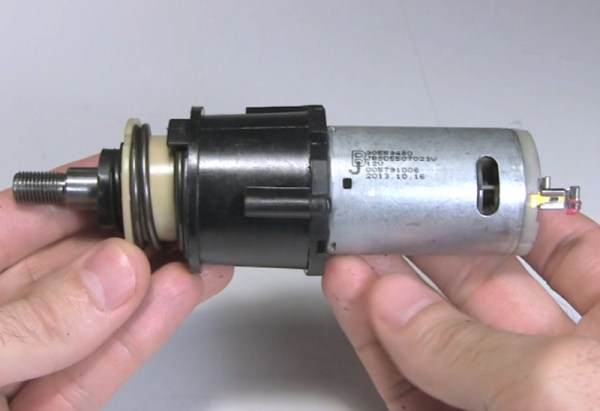
An understanding of how the chuck and gearbox are connected, combined with the right tools and a bit of force, gets you a motor, gears and gearbox, and a clutch. There’s not much left in the drill after that, and you can put some or all of those components to new use — like using them for the drive system of a BB-8 Droid.

Many projects (like this walking scooter) make use of cordless drills as motor sources. Being able to skip the chuck in order to interface directly to the shaft is useful for those projects where the drill is at least a semi-permanent part of the build. Ask your friends, neighbors, and at work. Cheap cordless drills and screw guns have been around for a long time. It’s usually the batteries that go and many people have the drills lying around and will be happy to part with them knowing you’re going to do something awesome with them.

Continue reading “Safely Remove Drill Chuck; Receive Motor, Gearbox, And Clutch”

Ducklings Raised By Remote

We’re not sure that it’s absolutely necessary to raise ducks using a remote-control animatronic duck decoy, but people have stranger hobbies.

This YouTube video (embedded below) from [Imaginative Guy] chronicles an impressive feat of RC animatronics, sparing no effort to make the RC duck “parents” realistic. There’s a ton of detail in the videos, from the machining of small necessary bits to the liberal application of hot glue where necessary. Continue reading “Ducklings Raised By Remote”

Hackaday Prize Entry: An Electric Bike And A Dashboard

Over the last few years, powerful brushless motors have become very cheap, batteries have become very powerful, and the world of quadcopters has brought us very capable electronic speed controls. Sounds like the perfect storm for a bunch of electric bike hacks, right? That’s what [bosko] is doing for his Hackaday Prize Entry. He’s building an e-bike with a big motor and an electronic dashboard, because a simple throttle switch would never do.

There are two parts to [bosko]’s bike, with the front brain box consisting of GPS, an OLED display, analog throttle, and a few wireless modules to connect to the other half of the system under the seat.

The drive section of this e-bike is as simple as it gets. It’s just a big brushless outrunner motor suspended directly above the rear tire, without any other connection. [bosko] has gone with the simplest power transmission system here, and is slightly wearing out the rear tire in the process. It works, though, and a few of the commentors over on Hackaday.io say it reminds them of the French Solex bike. We’re thinking this bike is more of what a riquimbili would be if Hobby King had a Cuban warehouse, but it seems to work well for [bosko] and is a great entry to the Hackaday Prize.

Octobot soft body robot

Soft Robot With Microfluidic Logic Circuit

Perhaps our future overlords won’t be made up of electrical circuits after all but will instead be soft-bodied like ourselves. However, their design will have its origins in electrical analogues, as with the Octobot.

The Octobot is the brainchild a team of Harvard University researchers who recently published an article about it in Nature. Its body is modeled on the octopus and is composed of all soft body parts that were made using a combination of 3D printing, molding and soft lithography. Two sets of arms on either side of the Octobot move, taking turns under the control of a soft oscillator circuit. You can see it in action in the video below.

Continue reading “Soft Robot With Microfluidic Logic Circuit”

Water-Cooled LED Light

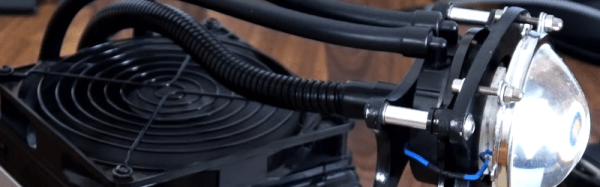
[Matt] wanted to drive a Yuji LED array. The LED requires 30 V and at 100 watts, it generates a lot of heat. He used a Corsair water cooling system made for a CPU cooler to carry away the heat. The parts list includes a microphone gooseneck, a boost converter, a buck converter (for the water cooler) and custom-made brackets (made from MDF). There’s also a lens and reflector that is made to go with the LED array.

This single LED probably doesn’t require water cooling. On the other hand, adding a fan would increase the bulk of the lighted part and the gooseneck along with the water cooling tubes looks pretty cool. This project is a good reminder that if you need to carry heat away from something with no fans, self-contained water cooling systems are fairly inexpensive now, thanks to the PC market.

Continue reading “Water-Cooled LED Light”

Tracking Airplanes From An Autonomous Boat

Airplane tracking systems like FlightRadar24 rely on people running radios that receive the ADS-B signal and forward the data on to them. That doesn’t work so well in the middle of the ocean, though: in spots like the mid-Atlantic, there are no islands to speak of.

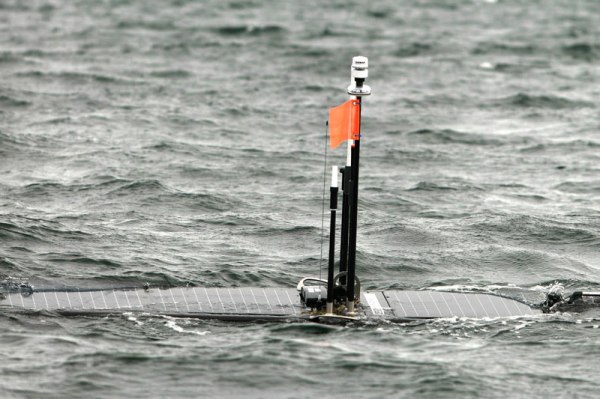
So, the service is now experimenting with a new approach: putting an ADS-B radio onto an autonomous boat. The boat is a Wave Glider from Liquid Robotics, an autonomous boat that harvests the power of the waves to run propulsion, guidance, and its payload. In this case, that payload includes an ADS-B receiver and a satellite transmitter that uploads the plane data to the service, where it is added to their mix of data sources. The boat is planned to spend the next six to eight weeks cruising about 200 miles off the coast of Norway, listening to the broadcasts of planes flying overhead and relaying them back to HQ. They will then be plotted on the live map in blue.

If you’re interested in building your own plane-trackers, we’ve got you covered, at least on land.

Amazing Meccano Pinball Machine Fully Functional Before Meeting Its Fate

[Brian Leach] of the South East London Meccano Club has put an impressive amount of ingenuity into making his pinball machine almost entirely out of Meccano parts. He started in 2013 and we saw an earlier version of the table back in 2014, but it has finally been completed. It has all the trappings of proper pinball: score counter, score multiplier with timeout, standing targets, kickouts, pot bumpers, drop targets, and (of course) flippers and plunger.

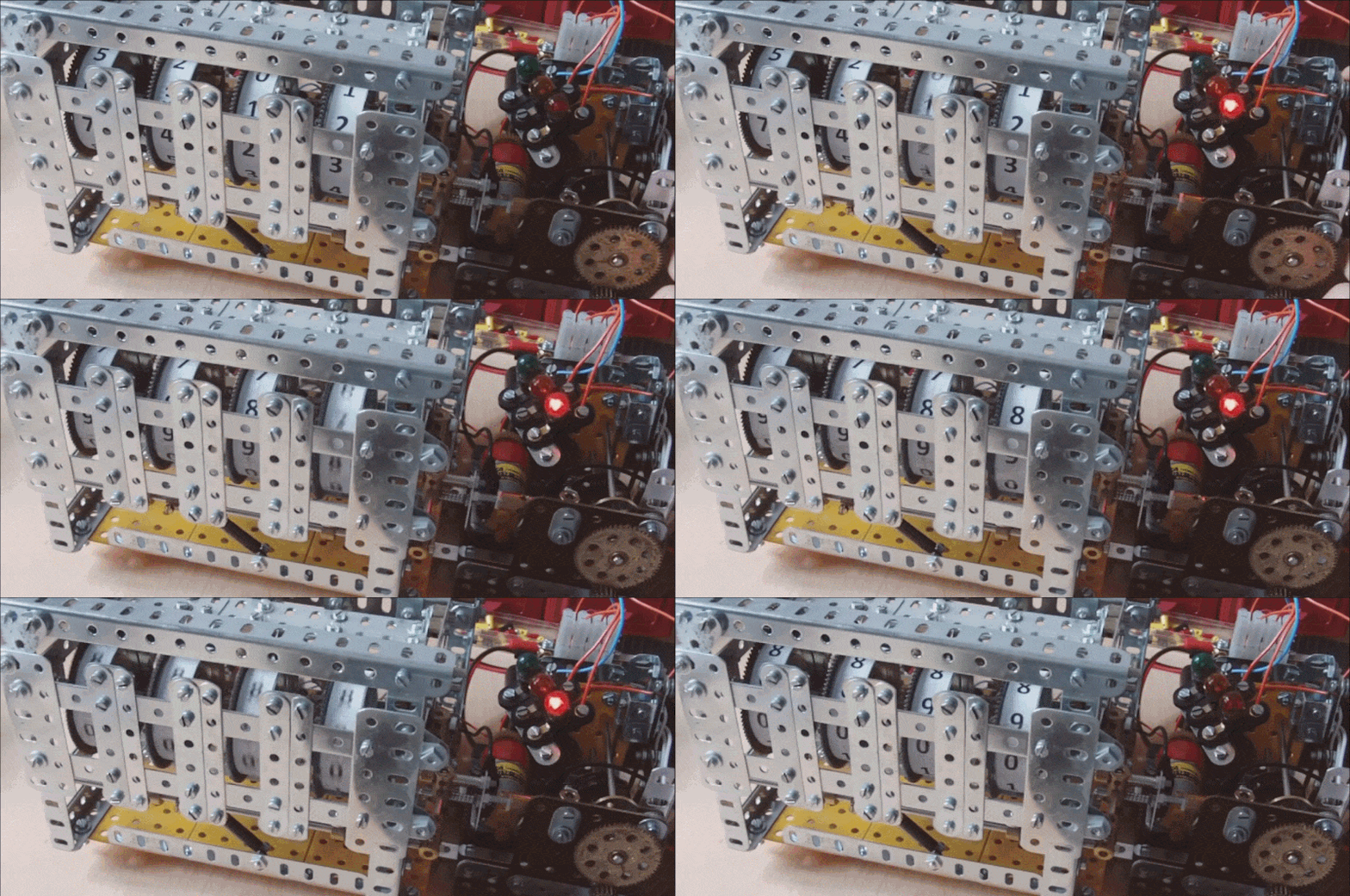
The video (embedded below) is very well produced with excellent closeups of the different mechanisms as [Brian] gives a concise tour of the machine. Some elements are relatively straightforward, others required workarounds to get the right operation, but it’s all beautifully done. For example, look at the score counter below. Meccano electromagnets are too weak to drive the numbers directly, so a motor turns all numbers continuously with a friction drive and electromagnets are used to stop the rotation at specific points. Reset consists of letting the numbers spin freely to 9999 then doing a last little push for a clean rollover to zero.

meccano-pinball-anim-wide

Continue reading “Amazing Meccano Pinball Machine Fully Functional Before Meeting Its Fate”