Kenyan Teen’s Invention Protects Cattle And Lions

Lion Scarecrow

[Richard’s] community in Kenya had a problem. The people depended on local livestock for survival, but the local lion population had started consuming that very same food source. The result was that people suffered from loss of the livestock, but the lions also suffered when the people killed them to protect their source of food. [Richard] knew he could do something to help both his community, and the lion population. He ended up building a lion attack prevention system.

He first tried a sort of scarecrow, to keep the lions away from the cattle. Unfortunately the lions proved to be too “tricky” and quickly realized that the scarecrows were no threat. Then one day, [Richard] was working with a flashlight. This led him to realize that the lions seemed to be afraid of moving light. That gave him the idea for his invention.

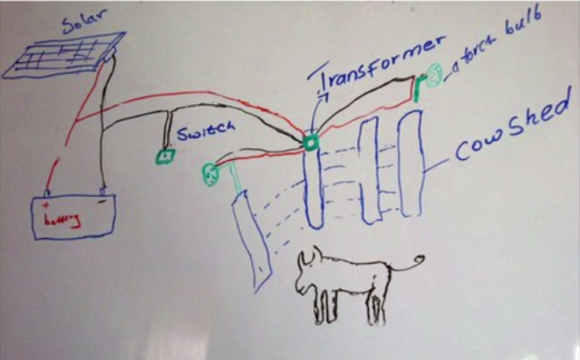
He had previously taken apart his mothers new radio, much to her dismay. He learned a lot about electronics in the process. He combined his electronics knowledge with this new knowledge about lions, to create his lion attack prevention system. The core component is the turn signal circuit from a motorbike. The circuit is hooked up to a rechargeable battery and a solar cell. This all runs through a switch so [Richard] can turn it on only when needed. The circuit is switched on at night to keep the lions away. [Richard] claims that they have experienced no lion attacks since the system was put in place two years ago!

This protects both the local cattle as well as the lions themselves. The whole thing is powered from the sun, so it’s likely to last a very long time. This kind of project may seem simple to many readers, but it’s a great example of the good ideas and ingenuity that can grow out of necessity. Oh, did we mention that [Richard] is only 13 years old? His invention is now reportedly being used all over Kenya and has led [Richard] to receive a scholarship to what he calls “one of the best schools in Kenya”.

While this hack has clearly changed the lives of many people in [Richard’s] region. You don’t have to make something overly complicated to change the world.

Continue reading “Kenyan Teen’s Invention Protects Cattle And Lions”

800+ LED Wall With Diffuser Panel Is A Work Of Art

LED Wall

What happens when you take over 800 individually addressable super bright RGB LEDs and house them in a giant diffused panel? You get awesome. That’s what you get.

[Epoch Rises] is a small electronic music and interactive technology duo who create cool interactive projects (like this wall) for their live shows and performances. They love their WS2812B LEDs.

The cool thing about this wall is that it can take any video input, it can be controlled by sound or music, an iPad, or even generate random imagery by itself. The 800 LEDs are controlled by a Teensy 3.0 using the OctoWS2811 library from Paul Stoffregen which is capable of driving over 1000 LEDs at a whopping 30FPS using just one Teensy microcontroller. It works by using Direct Memory Access to send data over serial into the Teensy’s memory and directly out to the LEDs with very little overhead — it is a Teensy after all!

Continue reading “800+ LED Wall With Diffuser Panel Is A Work Of Art”

Printing Text With A Chart Recorder

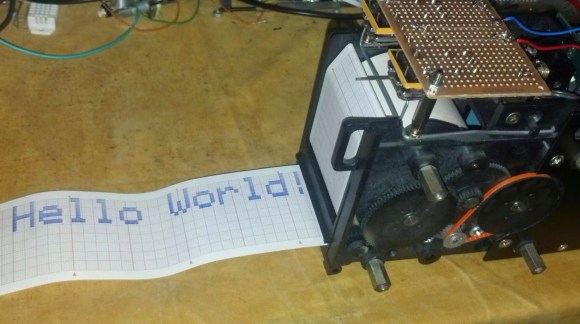
A chart recorder printing 'Hello World'

Chart recorders are vintage devices that were used to plot analog values on paper. They’re similar to old seismometers which plot seismic waves from earthquakes. The device has a heated pen which moves across a piece of thermally sensitive paper. This paper is fed through the machine at a specified rate, which gives two dimensions of plotting.

[Marv] ended up getting a couple of discontinued chart recorders and figured out the interface. Five parallel signals control the feed rate of the paper, and an analog voltage controls the pen location. The next logical step was to hook up an Arduino to control the plotter.

However, once the device could plot analog values, [Marv] quickly looked for a new challenge. He wanted to write characters and bitmaps using the device, but this would require non-continuous lines. By adding a solenoid to lift the pen, he built a chart recorder printer.

After the break, check out a video of the chart recorder doing something it was never intended to do. If you happen to have one of these chart recorders, [Marv] included all of the code in his writeup to help you build your own.

Continue reading “Printing Text With A Chart Recorder”

The CryptoCape For BeagleBone

[Josh Datko] was wandering around HOPE X showing off some of his wares and was kind enough to show off his CryptoCape to us. It’s an add on board for the BeagleBone that breaks out some common crypto hardware to an easily interfaced package.

On board the CryptoCape is an Atmel Trusted Platform Module, an elliptic curve chip, a SHA-256 authenticator, an encrypted EEPROM, a real time clock, and an ATMega328p for interfacing to other components and modules on the huge prototyping area on the cape.

[Josh] built the CryptoCape in cooperation with Sparkfun, so if you’re not encumbered with a bunch of export restrictions, you can pick one up there. Pic of the board below.

Continue reading “The CryptoCape For BeagleBone”

The Radius T-T Velomobile

The Radius T-T Velomobile human powered vehicle


Over the past year, [Dave] has been hard at work on his human powered vehicle. One year and six hundred hours of build time later, the Radius T-T Velomobile is complete. This 80 lb. vehicle features a custom body, mirrors, and integrated lights.

The Radius T-T started out as a TerraTrike recumbent tricycle. [Dave] built the body by laying up fiber glass on a foam mold. To that he added a variety of 3D printed accessories such as lights and mirrors. Inside the cockpit, the driver can control turn signals and flashers.

[Dave]’s blog provides a massive amount of documentation on the build. Everything from 3D modelling of the vehicle in Blender to the rear view mirror design is discussed. This great looking build should move along quickly with its lightweight design, but we’re still waiting to hear how fast it goes. Either way, it should be a fun mode of transport which will definitely turn some heads.

Is Your Wearable Tech Too Subtle?

wrist

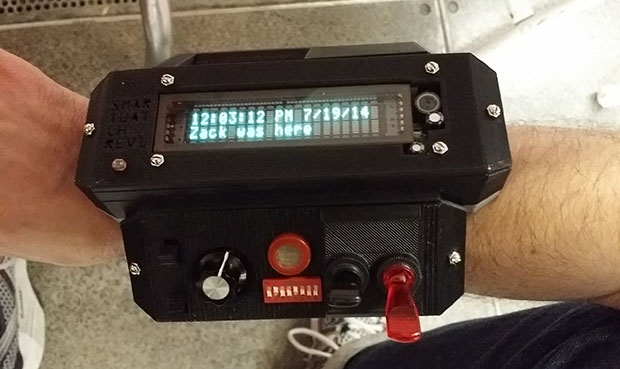
With any con, you’re going to have people walking around with things they’ve built. It’s the perfect venue for wearable tech, and the cream of the crop for HOPE X is [Zack]’s SmarTwatCh. Billed as a 3D printed big ass smart watch, it’s anything but subtle and has enough gadgets and gizmos to make even the biggest tech aficionado blush

The front of the SmarTwatCh is an authentic 2×20 glass encapsulated VFD running at 160 Volts, chosen for its danger and character. Inside the 3D printed enclosure is a Teensy 3.0, pots, knobs, and switches, a laser, LEDs, and an alcohol sensor because, “the future is quantified drinking”.

‘Apps’ for this smart watch include a TV-B-Gone, laser pointer, breathalyzer, flashlight, and just about anything else [Zack] can think of that would involve a Bluetooth adapter and a text display. Video of [Zack] demoing the watch at HOPE below.

Continue reading “Is Your Wearable Tech Too Subtle?”

Long Range Wireless Sensors For The Home-Area-Network

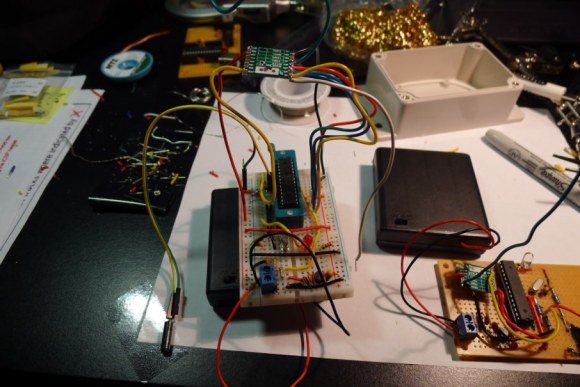
7785441404784533190 In the near future, we will all reside in households that contain hundreds of little devices intertwingled together with an easily connectable and controllable network of sensors. For years, projects have been appearing all around the world, like this wireless sensor system that anyone can build.

[Eric] hopes his work will help bring the truly expansive Home-Area-Network (HAN) into fruition by letting developers build cheap, battery-powered, long-range wireless sensors. His method integrates with the pluggable OSGI architecture and home automation platform openHAB along with using an Arduino as the lower power, sensor node that is capable of utilizing many types of cheap sensors found online.

[Eric]’s tutorial depicts a few examples of the possibilities of these open-source platforms. For instance, he shows what he calls a ‘Mailbox Sentinel’ which is a battery-powered mail monitoring device that uses a Raspberry Pi to play the infamous, and ancient AOL sound bite “you’ve got mail.” It will also send an email once the postman cometh.

In addition, he lists other ideas such as a baby monitoring sentinel, a washer/dryer notification system, water leak detectors, and security implementations that blast a loud alarm if someone tries to break in. All of this potential for just around $20.

The key to making this project work, as [Eric] states, is the MQTT binding that ties together the Ardiuno and openHAB platform. This allows for simple messages to be sent over the Ethernet connection which is often found in IoT devices.

So all you developers out there go home and start thinking of what could be connected next! Because with this system, all you need is a couple of ten-spots and an internet plug, and you have yourself a strong foundation to build on top of. The rest is up to you.

This open, connected device is [Eric’s] entry for The Hackaday Prize. You can see his video demo after the break. We hope this inspires you to submit your own project to the contest!

Continue reading “Long Range Wireless Sensors For The Home-Area-Network”