Detecting Galactic Rotation With Software Defined Radio

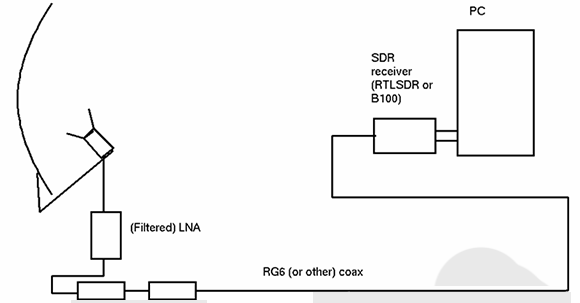
Last summer in the heyday of software defined radio via USB TV tuners we asked hackaday readers a question: Is anyone using everyone’s favorite method of SDR for radio astronomy? It took nearly a year, but finally there’s an awesome project to turn a USB TV tuner into a radio telescope. It’s from the fruitful mind of [Marcus Leech] (PDF warning), and is good enough to detect the rotation of the galaxy with a three-foot satellite dish.

News of [Marcus]’ work comes to us from [Carl] over at RTL-SDR.com who has been keeping tabs on the advances of building a radio telescope in a backyard. He’s been collecting a lot of interesting tidbits including this gif showing an arm of the galaxy entering and leaving [Marcus]’ telescope’s field of view over the course of a few hours.

Not only can [Marcus]’ telescope record continium measurements – basically, a single-pixel camera sensitive to only one frequency – it can also produce spectral plots of the sky. Combine the ability to measure multiple frequencies at the same time with the Doppler effect, and [Marcus] can measure the rotation of the galaxy with a USB TV tuner. That’s just awesome in our humble opinion.

If you already have an RTL-SDR TV tuner and a largish satellite dish, [Marcus]’ project should be fairly inexpensive to replicate; the feed assembly is made out of a coffee can, the amplifiers are repurposed satellite television equipment, and all the software – [Marcus]’ own simple_ra tool for GNU Radio – is open source. Of course with a 3 foot diameter dish, it will be impossible to replicate the data from huge radio telescopes. Still, it’s an impressive piece of work that leaves us searching craigslist for an old C-band dish.
Update: Live Video Played On LED Strip Display

update-live-video-on-led-strip-display

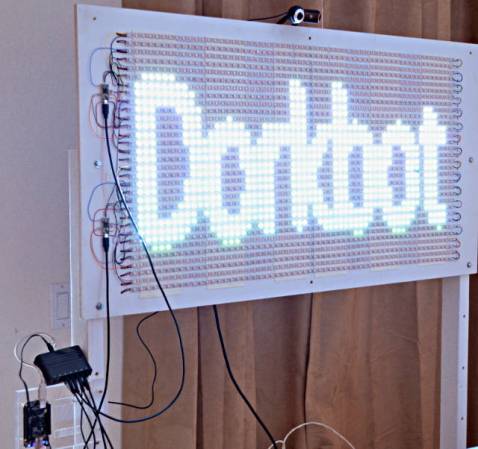
[Paul] took this LED display along with him to Maker Faire. To give it some interactivity he figured out a way to make it play live video. It is also activated using some stomp actuators built from piezo speaker elements and rubber floor mats.

This moves his original project in new directions. Back in February he was showing off the RGB LED strip display. He had it playing video but that was all dependent on using previously processed files. This upgrade uses a BeagleBone Black (the newest rendition of the ARM-based development board). [Paul] had tried using a Raspberry Pi board but had trouble with the webcam (mounted above the LED display) dropping frames. With the new board he is able to use the Video4Linux API to capture 30 frames per second and push them out to the display.

So far he’s had five out of the 1920 LEDs die on him. This shows off a couple of good things about using strips like this. A dead pixel doesn’t affect its neighbors. And replacement is as easy as cutting the ribbon on either side of the bad component, then soldering a new segment in place.


Add External Power To Any USB Hub

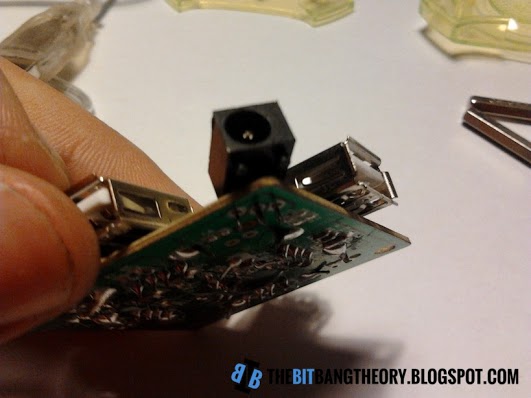
[Andrew] was getting some poor performance from a couple of USB devices he had connected through an unpowered hub. This is a problem because the hub prevents devices from negotiating with the host controller for more current. He fixed it by adding an external power supply to his USB hub.

In this case the PCB already had a footprint for a power connector. The manufacturer uses one board for several different models and just leaves the supply components unpopulated. [Andrew] managed to find a barrel jack in his parts bin that matched the footprint.

One important thing to do before hooking up the source is to disconnect the 5v wire from the incoming cable from the computer. The other tip we can give you is to use a good regulated 5v source to ensure you don’t damage the stuff you’re trying to power. That means avoiding deals that are too good to be true.

Alert Tube Monitors All Aspects Of Your Digital Life

alert-tube

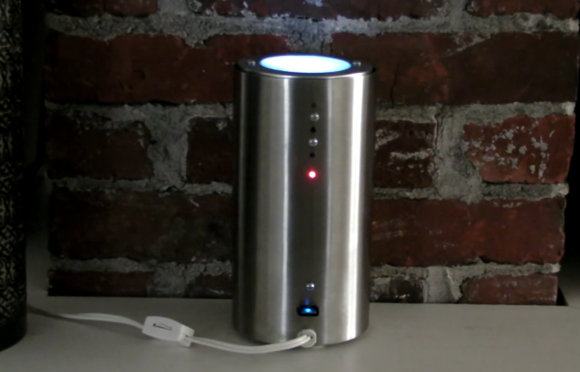
This futuristic appliance can keep you apprised of all you social network goings on and much more. [Mike Watson] calls the device the Alert Tube because of its functionality and shape. The hardware depends primarily on a Raspberry Pi board which seems tailor-made for this type of use. The information gathering side of this shows off the power of a fledgling services called If This Then That.

We’ve heard of IFTTT only because [Chris Gammel] and [Dave Jones] covered it on an episode of The Amp Hour. [Dave] dismissed it as have little to no practical use. But this project shows how it can be leveraged to make quick work of pulling your desired data from the Internet. Think of it as a collection of APIs for many sites like Twitter, Facebook, as well as local weather, etc. This project sets up IFTTT to monitor your accounts, alerting you with colors of like, sound, and even text-to-speech.

The project explanation is several pages long but you can get a quick look at it by watching the demo video.
Continue reading “Alert Tube Monitors All Aspects Of Your Digital Life”

Use Your Ears As An Oscilloscope

image

When work on an engine control circuit [Scott] found himself in need of a way to compare the performance of two control circuits at once. The hobby quality oscilloscope he owns wasn’t up to the task. After thinking about it for a bit he ended up using his ears as the oscilloscope.

The signals he was measuring are well suited for the challenge as they fell within the human range of hearing. He used some wire wrapped around each of the three conductors on the jack of his headphones in order to connect them to a breadboard. Then he simply connected each channel to one of the motor driver circuits, and connected the common ground. Listening to the intonation of the pitches in each ear he was literally able to tune them up.

If he had been looking for a specific frequency he could have used his sound card to take and analyze a sample. But balance was what he needed here and you must admit that this was an easy and clever way to get it!

RPi Control Your Server PSU Over The Internet

remote-server-psu-control-via-RPi

Here’s an interesting use of a Raspberry Pi to control the PSU on a server. [Martin Peres] is going to be away for a few months and still wants access to his PC. This isn’t really all that tough… it’s what SSH is made for. But he also wants lower-level access to the hardware. Specifically he needs to control and get feedback on what the PSU is doing, and even wanted to have access to the serial console without having to go through the computer’s NIC.

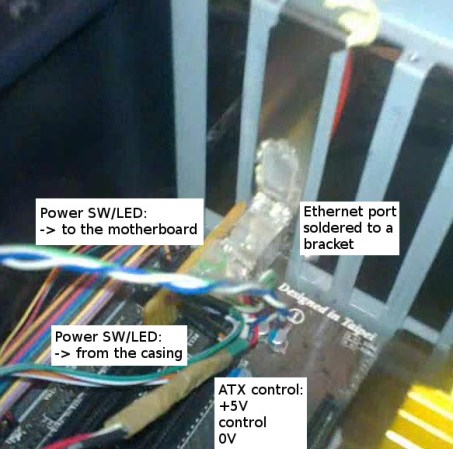
The image above shows one part of his solution. This is a custom Ethernet port that connects to his Rasberry Pi header breakout board. Inside the computer the jack is wired to the motherboard power LED to give feedback about the current state of the power supply. It also patches into the green wire on the PSU, which lets him turn on the power by pulling it to ground. After working out the cable routing he developed a web interface that makes it easy to interact with the setup.

As with other hacks along these lines letting an embedded computer run 24/7 is a lot less wasteful than leaving a PC on. That’s a concept we can really get behind.

Continue reading “RPi Control Your Server PSU Over The Internet”

3W Handheld Laser Raises Hope For A Real Lightsaber Someday

That banner image may seem a little bit theatric, but it’s a good representation of what this 3W handheld laser can really do. Turn the thing on in a slightly smoky room and it looks exactly like a thin beam Lightsaber.

What kind of tricks would you expect this thing to perform? Perhaps it’ll pop some black balloons? Prepare to be shocked because it’s orders of magnitude more powerful than that. The video below shows it burning and igniting a collection of items almost instantly. [Styropyro] tested his creation by igniting paper, cardboard, flash paper, flash powder, burning through a stick of wood, and igniting an undisclosed substance at the end of the video. But one of our favorites is when he drives a solar powered toy car with the intense beam.

He pulled the diode from a DLP projector, and drives it with a pair of 18650 Lithium Ion batteries which are commonly found in laptops. He made the enclosure himself. It looks great but we can’t help but wonder if the components would fit in a painstakingly made replica.

Continue reading “3W Handheld Laser Raises Hope For A Real Lightsaber Someday”