O Christmas Tree Of Digital Logic

tree

[Chris] over at PyroElectro is getting into the swing of the holidays with a LED Christmas tree build. Unlike the other electrical Christmas trees we’ve seen this holiday season, [Chris] designed his tree entirely with digital logic – no microcontrollers included.

The tree [Chris] constructed on a piece of perf board is a beautiful spiral arrangement of 64 green LEDs.While we’re sure getting all the LEDs soldered to the right height, [Chris] makes it look so easy to create 3D structures with circuits.

The LEDs are driven with a set of eight shift registers, themselves clocked by either a predictable 555 timer chip or a pseudo-random pattern generated with a circuit built from a few hex inverters. By setting the tree to the sequential mode, a pair of lights travel slowly down the spiral of the Christmas tree. If set to random mode, an random number of LEDs light up and walk down the array of LEDs.


Continue reading “O Christmas Tree Of Digital Logic”

Man Proposes To Girlfriend With An Arc Reactor

arc

Thinking long and hard about how to propose to his girlfriend, [Ed] hit upon a great idea: use an arc reactor as the ring box, with enough LED lights to outshine all but their love, and servos to present the ring and tug at the heartstrings.

[Ed] set about giving his now-fiancé from his arc reactor heart by building a simple circular arrangement of adafruit RGB LED strip and an Arduino. There are two modes for this arc reactor: a light up mode that simply looks awesome, and a ‘ring mode’ that uses two servos to open the front cover and bring the engagement ring into view.

After [Ed]’s fiancé said yes, the cover in the center of the arc reactor closes for its continued use as a desk ornament. You can check out [Ed]’s proposal contraption in action after the break.

Continue reading “Man Proposes To Girlfriend With An Arc Reactor”

Building Pong For An 8-pin Micro

pong

For playing around with video signals and trying to create a an interesting microcontroller project, you can’t do better than the classic Pong. We’ve seen our share of microcontroller-based pong builds, but rarely have we seen an 8-pin microcontroller recreate every part of the first video game.

[Tim] started his PIC12F1840-based Pong build with just a few buttons for controls and a video output. This in itself is somewhat of an achievement, as [Tim] used all the data memory and every GPIO pin on this small microcontroller.

He had time to optimize his build and ended up adding the bleeps and bloops of the original Pong to his build. He’s got an interesting design on his hands, and also what is probably the smallest Pong clone in existence.

Manuel The Scottish Moose Speaks Your Tweets

tod1

The folks over at Torchbox needed a Christmas card this year. Previously, the most poplar holiday card was a web page that gave their visitors a chance to activate a ‘snow machine’ and spray confetti on a random employee, all while being streamed online. They wanted to replicate this bridge between virtual and real life interactions this year, and Manuel the talking moose was born.

Manuel needed a personality and interaction from random people on the Internet so the Torchbox team decided to make the fake moose head speak tweets in real-time with the help of a Raspberry Pi. The code running on the Raspi gets tweets with a #tbxmoose hashtag, sends that through a node.js script, and finally sent to the Festival speech synthesis system.

A few modifications needed to be done to Manuel before he was presented to the Internet. His jaw was chopped in half and a servo and animatronic controller were added for a proper presentation on Torchbox’s stream of Manuel’s random musings.

Heavy Metal Computer Case Desk

heavy-metal-computer-case-desk

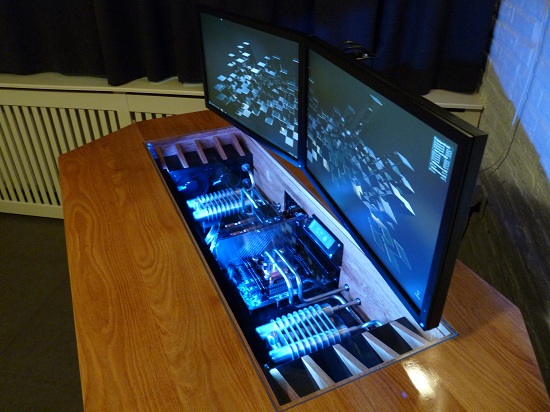
This desk is also a computer case. From this view it may not seem like much, but the build log has hundreds of images which could be called metal fabrication porn. The desk surface is made of wood, but all of the other parts were crafted from stainless steel.

The three components that weren’t fabricated by [Paslis] are the pair of legs and the column supporting the screens. These pieces are actually lifting columns that allow you to adjust desk and screen height at the touch of a button. The build starts off with a sub-surface to house the computer guts. After careful cutting, bending, welding, and polishing this comes out looking like the work surface in a commercial kitchen. After attaching the lifting legs to that assembly a foot for the desk takes shape from square pipe which is then skinned with stainless steel to match the finished look of the sub-surface. After spending countless hours on brackets, trim pieces, grills, and wood accents he sent everything off for painting before the final assembly.

Certainly this is in a different realm than the case desk from yesterday. But a mere mortal can pull that off while this is surely the work of an experienced tradesman.

[Thanks Andreas]

Hacked Together NAS In A Box

hacked-together-nas-in-a-box

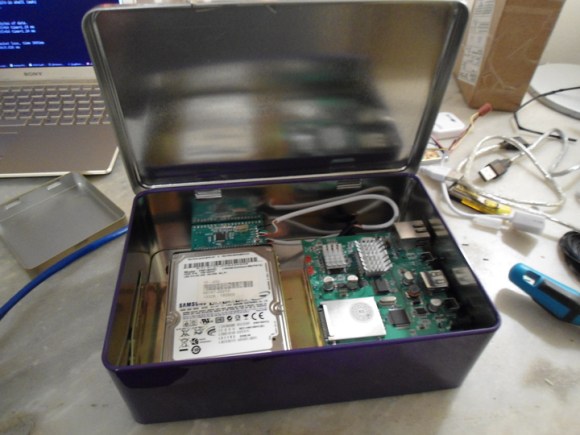
[David] is serving up files on his home network thanks to this Frankenstein’s monster of a Network Attached Storage device. It looks like he raided all the good bits from his parts bin to bring it all together.

The case is a tin box which may have been for a card/board game or some holiday treats. The hardware started with an NS-K330 server which he picked up from Deal Extreme. It has a NIC and a couple of USB ports but it tends to run really hot so he added a heat sinks to the board’s main chips. The hard drives are both 2.5″ form factor from old laptops. He uses some 2.5″ to 3.5″ mounting adapters to attach them to the tin box. A pair of USB to IDE adapters shed their cases and were solder directly to the wires which make a connection with the server’s USB ports.

There is a Linux distro specifically for this hardware but [David] wasn’t impressed with it. He ended up compiling OpenWRT for it and is satisfied with the functionality that provides.

Using Newlib With Stellaris Launchpad

using-newlibc-with-stellaris-launchpad

[Brandon] is taking us further down the rabbit hole by demonstrating how to use newlib with the TI Stellaris Launchpad. This is a nice continuation of the framework he built with his post about using GCC with ARM hardware. But it is most certainly one level of complexity deeper than that initial article.

Using newlib instead of glibc offers the option of compiling C code that includes system calls common when coding for computers but which are rare in embedded systems. Using something like printf is generally avoided because of the overhead associated with it. But these processors are getting so fast and have so much RAM that it may be useful in certain cases. We briefly thought about implementing malloc for creating a linked list when working on our STM32 snake game. [Brandon’s] work here makes the use of that command possible.

The process starts by adding labels for the beginning and end of the stack/heap. This makes it possible for functions to allocate memory. After taking care of the linker script changes you must implement a few system call functions like _sbrk.