Hijinks At 50,000 Amps

http://youtu.be/uXEPy6Za6cI

So you happen to have a really beefy transformer sitting around in your living room. What are you going to do with it? Short stuff across it to watch it glow of course!

This video is exactly that. While we flip flopped between “what is this guy doing?” and “ooooh, look at it glow!”, we thought you would surely enjoy this video. If you’re in a hurry, jump to around 5:30 to see a crowbar lit up completely.

[Alan] from HackedGadgets pointed out an interesting thought. Often the government pinpoints marijuana grow houses by their electricity usage. Though he’s not using this on a regular enough schedule to realistically get raided, the thought of that misunderstanding is quite humorous.

[via HackedGadgets]
Vodafone USB 3G Modem Driver From Mbed

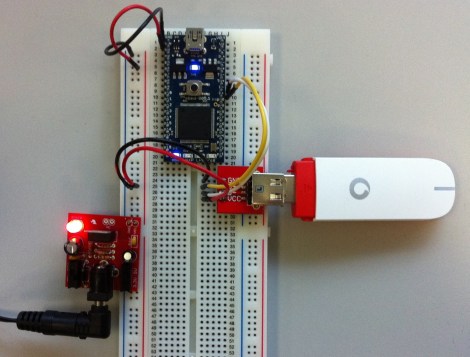
Wow, that’s a really simple hardware setup to supply your device with a 3G Internet connection. Better yet, the software side is just as simple thanks to the Vodafone USB Modem library for mbed. It will work for any of the cell data plans offered by Vodafone. The only problem you may have is not living in one of the 30 countries serviced by the telco.

The dongle seen at the right is sold by Vodafone and is meant to be used for Internet data, so you won’t be doing anything that might get your SIM banned. Connecting to the network is a one-liner thanks to the previously mentioned library. From there, gets and posts can be done with your favorite package. The  Hello World example uses HTTPClient. And since the mbed is simply an ARM platform it shouldn’t be hard to use the library with the ARM chip of your choice.

Nixie Clock That Doesn’t Skimp On The Number Of Tubes

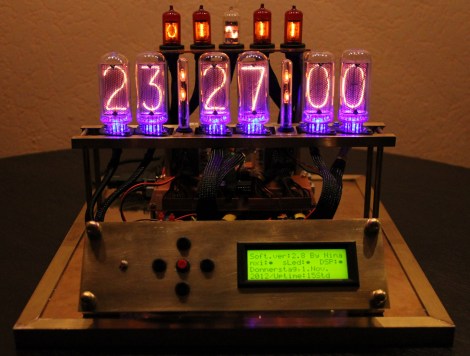
[Nina Blum] figures that if you’re going to the trouble of driving Nixie tubes you might as well use a lot of them. The details about this clock, which were sent directly to our tips line, lists a total of thirteen tubes used. There are six Russian IN-8 tubes (large digits), four Z573M tubes (small digits), but the colon tubes and the sine wave tube part numbers were not specified.

An ATmega8 controls the segments via a set of transistors. To operate the display [Nina] included a user interface made from five buttons and a four line character LCD. There is a video showing off the menu system that includes a way to set the time, date, and toggle the various illuminated bits. We’re waiting for permission to post that clip on our YouTube channel as [Nina] only included a Rapidshare link to the movie. Right now you’ll find more images after the break and we’ll embed the video if we get to okay.

Continue reading “Nixie Clock That Doesn’t Skimp On The Number Of Tubes”

Computers Not Candy With The Geek Group

This year for Halloween, The Geek Group, decided to take a very different approach to outreach. Instead of making animatronics, or converting their giant (seriously HUGE) space into a haunted house, they held an event called “Computers Not Candy” where they teamed up with a large local company to bring 100 tablet computers to 100 youths.

If you’re not already familiar with the Geek Group, you should check them out. They’re a huge hackerspace that really seems to have their act together. They put out really cool videos regularly, our favorite being the equipment autopsies.

While we really do admire the work they did to introduce these kids to hackerspaces, we also love candy and silly spooky projects. Next year how about Computers AND Candy!

Pull-string Most Useless Machine

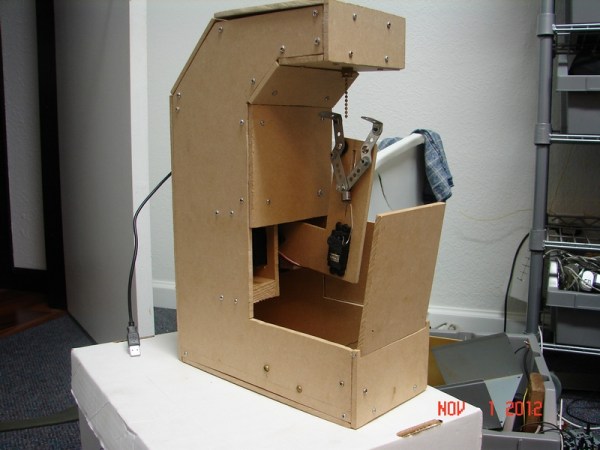
The mechanical simplicity of this pull-string controlled most useless machine is delightful. You can see the metal gripper which is reaching up to tug on a light-fixture-style pull chain. This is how it turns itself off after you’ve pulled the string to power it up.

The device is [Alex555’s] entry in the 7400 Logic competition. We do hope that he ends up posting a schematic because we’d love to see the gritty details of how it works. After the break you can watch two doors open, allowing the arm to raise up and the gripper to grab the chain. This takes just four servo motors, which are controlled by the signal from a 555 timer and some accompanying hardware.

Apparently the chain is a fake, as the servos didn’t provide enough force to actuate that type of switch. It’s not a surprise as those pull chains do require quite a tug. An optical sensor was used to trigger the movement when your hand reaches for the chain.

Continue reading “Pull-string Most Useless Machine”

ATmega1284 As An 8-voice 32 KHz Synthesizer

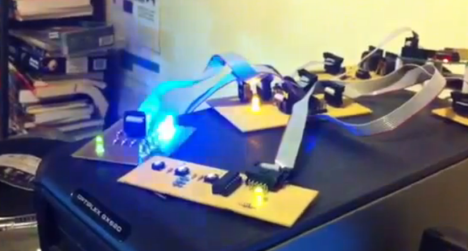
A couple of things strike us about this 8-voice 32 kHz synthesizer. First is the cleanliness of the prototype. As you can see, each part has plenty of room on its own board and all are interconnected by 10-pin IDC ribbon connectors. But you’ll have to see the video after the break to enjoy the impressive sound that this puts out. You’ll hear it play the Super Mario Bros. theme; it does it with passion!

To get audio from the digital microcontroller [Mike] built his own R2R digital to analog converter. The resistor ladder is built from sixteen resistors, which feed a rail-to-rail amplifier. The sound is mono but the playback is polyphonic thanks to the work done by the ATmega1284. It is reading MIDI commands coming in from an external controller (we assume it’s the computer on which the hardware is sitting). The chip’s 128 KB of Flash memory leave plenty of room to store samples, which are selected from a lookup table based on the MIDI data. If more than one sample is to be played the chip averages the data and sets the 8-bit output port accordingly.

Continue reading “ATmega1284 As An 8-voice 32 KHz Synthesizer”

Building A 100 MHz Frequency Counter

The great thing about building with gates is the crazy speeds you can achieve by using hardware directly (as opposed to working with simple microcontrollers). This 100 MHz frequency counter is a great example. [Michael] just finished building it using a Papilio board.

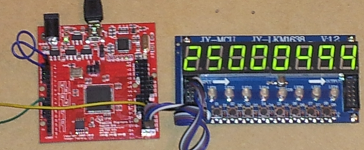
Of course we’re not talking about discreet chips here. The Papilio is an FPGA development board which means he is building with hardware gates, but that is still done by writing code. Above, the rig is measuring a 25 MHz being generated by a second FPGA board. Using the Papilio’s on board 32 MHz clock the device is capable of counting a frequency up to 100 MHz. You can see it measuring a 96.875  MHz signal in the video after the break. One interesting thing about that clip is that near the end he touches the crystal’s case with his finger and the Hertz really jump for a moment.

If the 8-digit display looks familiar that’s because [Michael] recently published a library to use it with an FPGA.

Continue reading “Building A 100 MHz Frequency Counter”