PIC-based USB Conversion For An NES Controller

[Andres] wrote in to share his USB for NES controller project (translated). It enumerates as a USB keyboard and is easily mapped on most emulators. Over the weekend we looked in on an AVR programmer used for this purpose. [Andres] went a different direction, using a PIC microcontroller and eventually incorporating his circuit into the body of the controller.

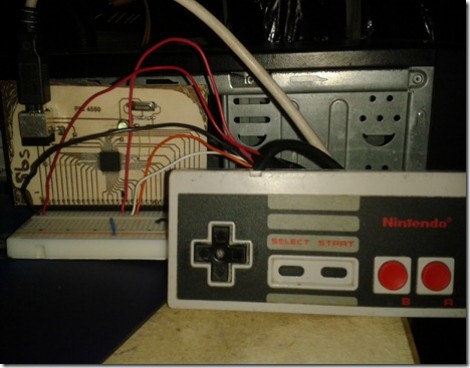
The prototype circuit can be seen above. [Andres] uses a breakout board for the PIC 18F4550 to test the circuit. The chip has native USB support, and reading the button states from the controller’s shift register is a snap. You can see him using this test rig to play Super Mario Bros. on an emulator in the video after the break.

The second iteration of the project moves from breadboard to a soldered circuit. A 18F2550 is used as it comes in a rather small DIP package. If the legs are flattened there’s room inside the controller case for it, along with a few capacitors and a crystal. The original controller cord is removed to make way for a USB cable.

Continue reading “PIC-based USB Conversion For An NES Controller”
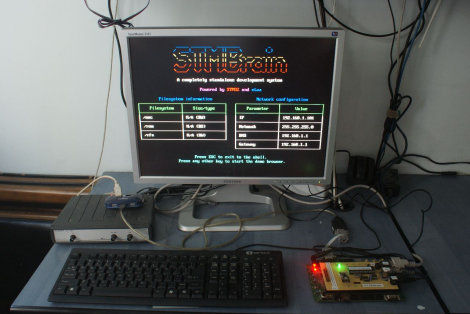
An STM32 Processor Powers This PC

This 32-bit computer is a project [Bogdan Marinescu] built as a contest entry. Sadly he didn’t win, but he did do an excellent job of documenting the build. Having seen several other home built PC projects we’re familiar with the challenges that go into such a thing, and he found some great solutions to each of them.

He started with an STM32F103ZET6 chip. This is an ARM Cortex-M3 processor which brings a lot of power to the playing field. That being said, generating a VGA signal would pretty much zap the usefulness of the chip for other processes so he offloaded that work on a separate Propeller chip. A microSD card serves as storage for the machine, which runs eLua (embedded Lua programming language). There is 1 MB of external RAM and a PS/2 port for keyboard interface. The system is networked thanks to an ENC28J60 Ethernet controller. Don’t miss the video after the break where you can see several demos running on the system.

Continue reading “An STM32 Processor Powers This PC”

Steam-powered Hexapod

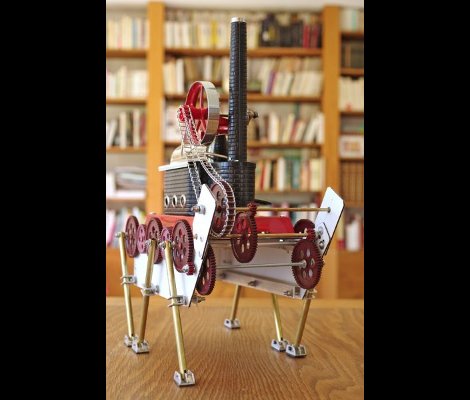
This all-mechanical hexapod (translated) was meticulously planned and beautifully constructed. It’s not craning its neck to see what’s ahead. That’s a smoke stack for the steam engine which propels the machine.

Mechanically the legs were the hardest part. That’s only because the steam engine was not built from scratch. It’s a Wilesco D14 which is powered by solid fuel tablets. It puts out high RPM but low power so the gear ratio was set at 286:1 to make the most of its output.

The legs themselves are made of brass rods. These are anchored on one side of a larger gear, with a pivot point that allows the leg to slide vertically. The result is best seen in the clip after the break. As the drive wheel rotates, the pivot point moves the body forward until the foot is lifted by the sliding motion of the rod. It ends up looking more elegant than some of the more dexterous hexapods, but it lacks the ability to turn.

Continue reading “Steam-powered Hexapod”

Displaying Images On The Surface Of Bubbles

The image you see above isn’t a simple photograph of our blue marble from thousands of miles above. No, that image is much cooler than a satellite because it’s a projection of the Earth onto a soap film screen. Yes, we can now display images on the surface of bubbles.

Instead of a the soap bubbles you’d normally give a small child, this project uses a mixture of sugar, glycerin, soap, surfactant, water, and milk to produce a film much more resistant to popping than your standard soap bubble. Shining an image through these films doesn’t result in much of an image, so the researchers used ultrasonic speakers to vibrate the film and make it possible to display a picture.

With a small projector, this system makes it possible to display an image on the surface of bubble. Of course, the display area is tiny right now, but the size will most likely increase as the experimentations continue.

You can check out a whole bunch of videos demoing this tech after the break.

Continue reading “Displaying Images On The Surface Of Bubbles”

Simulating LED Cubes In Blender

[youtube=http://www.youtube.com/watch?v=bl-kvfJxYwM&w=470]

The Jyväskylä, Finland hackerspace hacklab-jlk was lucky enough to work on a public arts project for their home town. They had the opportunity to design, build, and install a trio of LED cubes in Jyväskylä’s central Church Park. As such a high-profile project, the hacklab-jlk team decided to take their time and ended up implementing a lot of very cool features for their LED cubes, including simulating the light show in Blender.

The LED cube is similar to all the other LED cube builds we’ve seen before; it’s an 8x8x8 cube controlled by an ATMega328. The Elovalo project, as it is called, is a trio of LED cubes – one using red LEDs, one using green LED, and a blue LED cube each mounted on a pedestal in a Jyväskylä park.

Because the Elovalo is a permanent installation, the team needed a way to verify new firmware for the LED cubes. They came up with a LED cube simulator for Blender that allows them to write a new display function in C and render either single frames or a full animation of the lighting pattern.

A very cool build, and nearly too awesome for a public arts project. We look forward to a video of the complete installation, but until then we’ll make do with the short preview video available after the break.

Continue reading “Simulating LED Cubes In Blender”

Hacking Your Grill For Performance And Features

Summer is winding down, which means that sales will be beginning on grills at stores all over the place. For those that enjoy the outdoor cooking experience, a nice new grill is always tempting. If you’re anything like me though, it can be hard to justify the expense. All you need is some fire right? Well, not if you want to smoke foods, or do long controlled jobs, basically anything but quickly searing something.

[Joe Brown] over at Gizmodo found himself wanting to upgrade from simple coals/wood to something fancier, but really didn’t want to shell out the $2,000 that he found would be necessary to get the mic features he wanted. So, he set out to find a good platform to mod and added the features he wanted separately. The end result was a nicely performing out door cooking appliance that only cost him $540.

This hack is on the simpler side, but his modification really did add some great features. Many of you could build the addons from scratch, which makes me wonder, how would you improve a grill, dear Hackaday Reader?

For Vacation On Hoth: Snow Speeder Sleds

Next time you’re taking a vacation anywhere that resembles the planet Hoth, you might want to take the time to build a snow speeder sled before you go. As you can see in the video above (at around the 1:00 mark), the sled looks great, even as it “flies” down the slopes. We were fairly surprised to find it was made entirely out of cardboard. We were also fairly surprised at how large the person was that unfolded from the cockpit when it stopped!

You can see pictures of the build process over at Dvice.