Static Testing Hybrid Rockets For A Flight To Space

A team of rocketry enthusiasts at Boston University have been working on a small hybrid rocket motor that serves as a test bed for a larger, yet-to-be-designed power plant that will hopefully launch a rocket into space.

The static tests of the BURT Mk. II began last April with a series of tests using HTPB solid fuel and Nitrous Oxide as the oxidizer. The team had a series of failures – mostly due to the JB Weld seal on the igniter leads blowing out – but managed a 10 second burn on April 21st.

For later tests, a vector drive system built by a complimentary Boston University engineering group was used to control the direction of the thrust up to 12 degrees away from the axis of the engine. That’s an impressive bit of kit, especially considering the exhaust from the rocket reaches over 5000 degrees Fahrenheit.

Even though it’s summer now and the Boston University team is on a much deserved break, we can’t wait to see what the BURT team comes up with next year. Hopefully we’ll see a flight test that reaches the team’s goal of the Karman line.

Continue reading “Static Testing Hybrid Rockets For A Flight To Space”
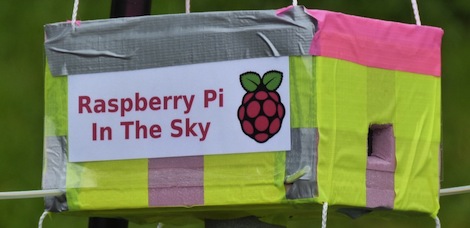
Sending A Raspberry Pi To 130,000 Feet

We knew this wouldn’t take long. [David] sent a high altitude balloon into the upper atmosphere last weekend using a Raspberry Pi as the brains of the payload.

[David]’s payload consisted of a Raspberry Pi, natch, with a Logitech webcam, GPS receiver, and six AA batteries wired into a LDO regulator with a monstrous heat sink to keep everything in the EPX foam enclosure relatively warm in the frigid rarefied air of near space.

A high altitude balloon isn’t much fun without some real-time data coming down from the upper atmosphere, so [David] used a Radiometrix NTX2 transmitter module (anyone know of an equivalent part for the USA?) that transmits a measly 10 milliwatts. Even though the transmitter has an ‘official’ range of 500 meters, [David] got word of image data being received in Northern Ireland, over 500 km away.

We’re pretty impressed with [David]’s flight  – and the fact that his flight is now 12th place on the list of UK balloon altitude records – but now we’re wondering what could be done with another Raspi flight to near space. [David] had a lot of computing horsepower up there, enough to get images from a webcam and send them down to earth. Now we’re wondering what else could be done with a Raspberry Pi in space.

You can check out the GoPro video of the very fast decent after the break, or check out the received images on [David]’s Flickr.

Continue reading “Sending A Raspberry Pi To 130,000 Feet”

Hackaday Links July 18, 2012

Apollo 13 DJ controller Follow Up

apollo13 DJ controller

[Adam] had a really impressive DJ controller build featured here recently. Many of you had more questions about the internals and such, so this post should clarify a few things. He’s still got a few more updates to make, but promises to reveal all if given enough time!

Noise Absorbing Headphones from Shooting Earmuffs

earmuffs-ipod

If the circuitry on your microphone-enabled shooting earmuffs has gone bad, the actual speakers may still be good. Why not convert them into some noise-blocking headphones? For that matter, if you’ve broken a pivot, there’s a simple solution for that too!

Help Choosing your CNC Router

cnc-kits

If you’re in the market for a CNC router, but aren’t sure where to start, Ponoko has put together a handy pricing guide to several of the more popular DIY routers available.

DIY AC Unit

ac-unit

It’s very hot out, so what is one to do when your shop or garage is burning up?  Why not build your own “AC unit?” Sure you have to supply your own ice, but at under $20 for this cooler-based unit, maybe it’s worth it. Here’s the Reddit thread explaining it as well as a picture of the finished product.

3D Topo Map on a CNC Router

3d-topo-map

Once you’ve purchased your CNC router using the above guide, why not make your own 3D top map? This tutorial features a map of Ross Island off of Antarctica. Why Ross Island? It was the first vector-format topo map found off of Wikimedia.

DMG Lib: Digital Mechanism And Gear Library

Reader, [klemens], suggested DMG Lib to us when we posted about a similar site. DMG-Lib is an amazing source of information. It’s primary downside is that a great portion of the text is in a language other than English, though in some ways this is a plus. Latin, Italian, German, and many other languages held the position of being the chief scientific language of the world long before English, and this repository holds entire books about mechanisms in those languages. Some of the books range all the way back to the 1500s. The mechanism animations are very good on this site and play smoothly. While it’s a little harder to search than KMODDL due to the language oddities, it’s still an extremely useful and interesting site to add to the hacker’s information toolbox.

Kegerator Tallies Your Pints On Untappd While You Sit Back With A Cold One

untappd-auto-checkin

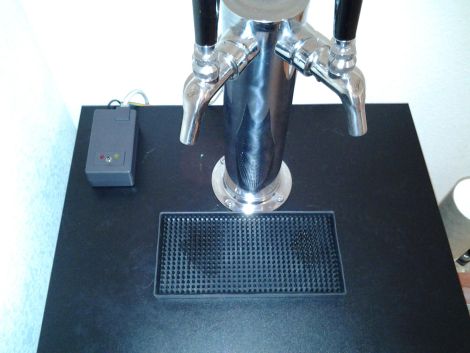
[Jeff] admits that he’s pretty well addicted to Untappd, a site he describes as a Foursquare for beer. Like his fellow beer nerds, he enjoys reporting the pints he’s had, even if they happen to be from his own stash of homebrew kegs. Untappd certainly supports this level of dedication, but it seemed silly to [Jeff] that he needed to grab his phone each time he poured himself a cold one in the comfort of his own home.

He took a look around the room and spied an Arduino doing a whole lot of nothing, so he set off to build a system that would allow him to automatically record his drinking habits without the use of his smartphone. The system is not overly complex, and measures pours using flow sensors, uploading the results to Untappd using their “check-in” API. [Jeff] was sure to include several other useful features into his build, including a lockout timer that prevents multiple check-ins when simply topping off a pint, as well as “neighbor mode” which lets you pour a round for friends without recording the pour.

Be sure to check out the build in its entirety on [Jeff’s] site, and let us know if you’re doing something equally cool with your keg setup at home.

Repurposing Server PSU For Your Charging Needs

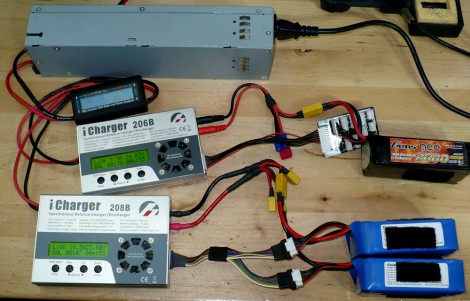
That grey box at the top of the photo is a modular power supply unit for a rack-mounted server system. [Sebastian] decided to repurpose it as a charging source for his RC batteries. He chose this HP DPS-600PB because of its power rating, efficiency, and you can get them at a reasonable price.

This is an active power factor corrected (APFC) PSU, which he says draws 40% less current than the non-APFC variety. Since he sometimes charges batteries in the field from a generator this is a big plus. But a bit of modification is necessary before it can be used as a source.

Since this is a rack device it has a set of connectors on the back. For power there are spade connectors which mate with a fin on the rack. He soldered positive and negative leads between the spades to interface with the battery chargers. The PSU won’t fire up if it’s not in the rack, so some jumper wires also need to be added connecting three of the interface pins.

With his modding all worked out he went on to use two PSUs for a 24V source, housing them to a nice carrying case while at it.

High Speed Photography Controller Built To Catch Water Droplets

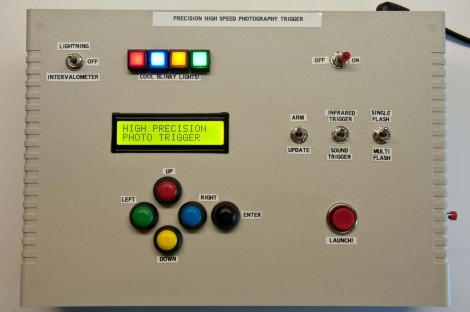
One high-speed photography controller to rule them all. If you’re looking to photograph droplets of water splashing on a still reservoir this is the ticket. But if you’re not, it still offers an incredible amount of flexibility for other high-speed needs. Inside you’ll find an Arduino Mega, which has plenty of room to bend to your will.

[Michael Ross] is the man behind this box. He wanted a system that did it all; timings, droplet control, camera shutter, etc. What you can’t see in the image above is the interface panel on the back of this enclosure (this shot shows the top of the box). The video after the break will give you a look at the overall setup. It has ports to control two different light sources, detectors to snap the images using an infrared sensor or via sound (we’re thinking bullet photography), and four ports to control solenoid valves.

He produced a mammoth PDF tutorial which will guide even the biggest noob through the entire build process. Find it at his site linked above.

Continue reading “High Speed Photography Controller Built To Catch Water Droplets”