Hackaday Links: June 22, 2012

For when you want something huge machined
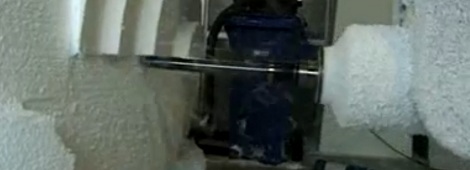
Turn your volume down for this video. It’s the HSM-Modal CNC mill carving a full-sized car out of styrofoam, applying clay to the foam core, and machining the clay at 50 meters per minute. Yes, we’ve seen this machine before, but never in action. It only took a little over 24 hours to make this full-size model car.

Microscope into a drill press
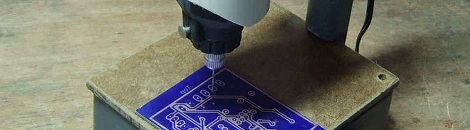
If you need to drill some PCBs, [wotboa] has a neat build for you. He built a micro drill press out of a microscope. It’s a damn good idea if you can find a quality microscope base; those things usually have exceptionally high precision. The ‘hack’ part is a $7 Harbor Freight rotary tool, some PVC pipe, and a PWM control for the motor – home-made, natch.

I’m telling you, they need to get [River] out of the library. Work on it [Moffat].

[Alan] made a TARDIS book case, and he decided to share the plans with us. Just the build to combat the severe lack of woodworking and Whovian stuff on Hackaday. Vashta Nerada hopefully not included.

Money can’t buy happiness, but you sure can sell it

[Greg] sent in some info on Disney’s ‘glow with the show’ hats they sell at the California Adventure park. For $25, you get a hat with RGB LEDs in the mouse ears that synchronize with the World of Color show every night. There’s a better description of the hats here, but we’re thinking these are very similar to the Coldplay Xylobands we saw at this year’s Grammys. Anyone want to tear some mouse ears apart?

An exceptionally low-tech radio telescope

[Impulse405] found a poor man’s radio telescope on Instructables and decided to share it with us. [Z0rb] found a 10-foot dish in the garbage and quickly absconded with this retro hardware. After adding a power supply and a meter-based total power receiver, [Z0rb] had a radio telescope that covered wavelengths from 850 to 2200 MHz.


Gooseberry Is The Latest ARM Linux Board

It looks like we’re finally seeing the proliferation of single board computers take off. The latest is called the Gooseberry. While it will cost about £40/$62 USD at release, it greatly outperforms the current crop of tiny Linux boards.

As the latest in what will be a long line of these ARM-ified single board computers, the Gooseberry hugely outperforms the VIA APC and Raspberry Pi with a Allwinner A10 CPU running at 1.2 GHz, 512 MB of RAM, and built-in WiFi. Basically, the Gooseberry has all the features you would expect from an Android tablet; the reason for this is because the Gooseberry actually is the board found in a few Chinese tablets.

There’s a few very nice features like an LVDS output to add LCD displays without hogging the HDMI output, and the form factor is incredibly thin making it perfect for building a small portable device.

After the break you can check out a walkthrough of the Gooseberry board along with evidence of it running Ubuntu.

Continue reading “Gooseberry Is The Latest ARM Linux Board”

Bringing Chromium To The Raspberry Pi

If you’re in possession of a Raspberry Pi, you may want to check out the new Chromium support for your tiny pocketable computer. With its terrifically minimal hardware requirements, the Chromium OS seems like just the thing for this $35 computer.

The new Raspberry Pi supported Chromium build comes from the fruitful desktop of [Hexxeh], a.k.a. [Liam McLaughlin]. In the world of Chromium devs, [Hexxeh] has already made a name for himself by getting Chromium working on a Macbook Air, putting it in a VirtualBox, and generally being the resident wizard of the Chromium project

The Chromium OS should provide a much faster computing experience for the Raspi compared to the current Debian and Arch Linux-based builds.   Right now, the Chromium support for the Raspberry Pi is very much a work in progress but a slimmed-down, browser-only operating system may be just what the underpowered but useful 700 MHz ARM computer with 256 MB of RAM needs.

NC Maker Faire 2012: Hackaweek Display

[youtube http://www.youtube.com/watch?v=gjtH3iA1YrY&w=470&h=315%5D

[Dino] has been featured here at [HAD] on many occasions, so I was excited to see some of his inventions in person and meet the man himself. [Dino] didn’t disappoint, bringing a display that included a working demonstration of his upcoming cover story for Make Magazine – an automatic doggie ball-thrower. Also there were some crazy musical instruments, what appeared to be a cylindrical oscilloscope display, and a robot rolling around with the thrown balls (and kids).

As seen in the video, one thing to remember if you’re displaying at a Faire, kids will definitely be there, and will interact with anything they can. This can be good or bad, so make sure you design your display, like [Hackaweek]’s to be the former. [Dino] also had a projector pointed at the wall playing some video. This made for a great attention-getter!  Check out the short videos below of his ball thrower in action and a view of the show from one of his robots! Continue reading “NC Maker Faire 2012: Hackaweek Display”

Analog Soil Moisture Alarm

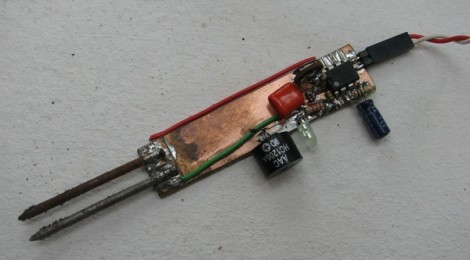
The lion’s share of soil moisture monitors we see are meant as add-ons for a microcontroller. So we’re glad that [Miceuz] tipped us off about this soil moisture alarm he built with analog parts. It’s really not hard to take the concept and build it in the analog world. That’s because you’re just measuring a resistance value. But for those of us who never really got started with analog parts this is a great project to learn from.

A high-efficiency op-amp is doing the brunt of the work. When the soil is moist the resistance is rather low compared to a reference voltage provided by a separate resistive divider. But when the plant gets thirsty and the soil dries out the resistance increases, triggering the op-amp to illuminate an LED and create some noise on the buzzer (we’re a bit confused on how that buzzer works).

Unfortunately this isn’t a viable long-term solution as the battery calculations show it lasting only about four months. That’s where a microcontroller-based circuit really shines, as it can put it self in low-power sleep and wake infrequently to take readings.

Safe-Sync Protects Your Camera From Older High-voltage Flash Modules

Since we’re not high-end camera aficionados it was a surprise to us that the hot shoe that allows a camera to interface with a flash module has changed rather dramatically over the years. Apparently the interface used to be mchanical-electrical in that the camera would use mechanical means to connect two electrodes from the hot shoe. It didn’t matter the voltages it was switching because the camera didn’t have an electrical system connected to the interface. The problem is that connecting a modern camera to what [David Cook] calls ‘legacy’ flash hardware could damage it. So he developed the Safe-Sync to interface modern cameras with older flash modules.

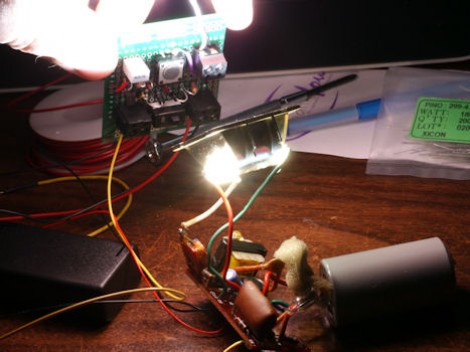
You can see the board which he’s holding up in the image. It includes a lot of nice features, like the ability to be powered from the external flash, or from a battery. There’s also an optional momentary push switch which can be used to test the flash control (or hack it for other purposes). In addition to providing protection with older equipment, this could also be used to interface flash modules from different manufacturers with your camera.

Hot Enough For Ya? Super-cold Cocktail-pops Will Help

The staff of Instructables know how to cut loose and cool off in this already-too-hot summer. They’re making their own popsicles out of cocktails. If only everyone were lucky enough to have employers who endorse these kinds of projects at work.

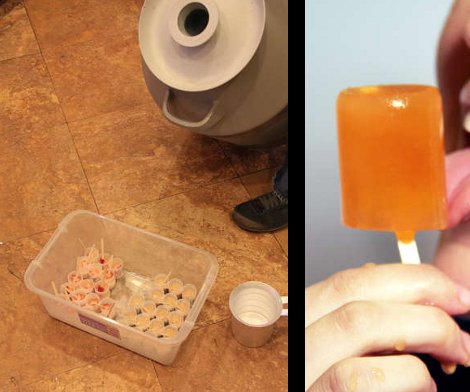
So the problem here is the the freezing point of liquor. Your margarita, daiquiri, strawberry with champagne, white russian and other favorites just aren’t ever going to solidify in a run-of-the-mill freezer because zero degrees Fahrenheit just won’t cut it. So the big guns were brought to bear. The cocktail-pops were lined up in a container and dowsed with liquid nitrogen.

The substance boils off at around -321 F, more than cold enough to quickly freeze these alcoholic goodies. But use caution. After they’ve been frozen you need to throw them in the freezer to warm them up. The first guinea pigs burned their tongues when trying to lick the pops too soon.

Don’t want to buy your liquid nitrogen? Why not just make your own?