Old Timey UAV Cameras

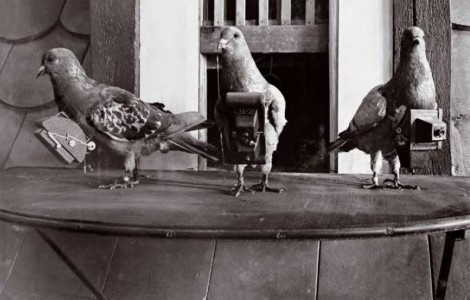
These brave birds are weapons of war. Well, not these actual birds… they’re just models used for this photograph courtesy of a taxidermist. But their living relatives were used to take spy photographs during World War I. [Dr. Julius Neurbronner] didn’t suddenly jump into the field of avian photography. He, like his father before him, used homing pigeons to deliver prescription drugs in loads of up to 75 grams. This makes us wonder if the birds are ever used in modern drug running?

The inspiration came when the doctor found out about subminiature cameras available at the turn of the twentieth century. Those cameras included a tiny roll of film, allowing for several images to be taken. He figured out a way to make a timer that used a pneumatic system to trigger the shutter in the camera. You can see a diagram of the timer mechanism here. The idea is that the birds will always be able to find their way home. So if you take them to a starting point that puts the enemy lines in between them and home base, they’ll fly over and get some juicy recon in the process.

That’s pretty old school. But we’re still tying things onto birds these days. Here’s some modern tech that uses sun-up/sun-down to track travel habits.

[Thanks F via The Atlantic]
Whistle Controls For You Home Electronics

You know how to whistle don’t you? You just put your lips together and blow. But do you know how to make the electronics around you react to your whistled commands? Well [Befi] figured out a system that allows him to assign a whistled command to various home electronics.

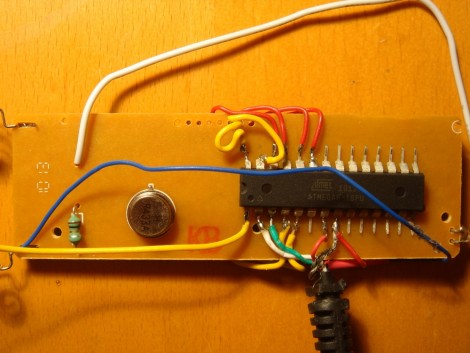
He’s using a set of RF remote control outlets to switch power to various devices like a desk lap, or a turn table. The board you see in the image above is the remote control that came with the system, but that chip is an ATmega8 which he added to give round-about USB connectivity using a serial-to-USB converter. The technique is simple enough that we’d bet you can get this to work with an ATtiny2313 and the V-USB project but that’s another story.

The additional piece is the use of embedded Linux to detect and process whistled commands. In the video after the break [Befi] explains that he’s using a Dockstar along with a microphone to capture audio input. It uses a Fast Fourier transform algorithm to process the clip and pushes commands to the remote control after processing is complete. Continue reading “Whistle Controls For You Home Electronics” →

Slide Rule For Musical Scales

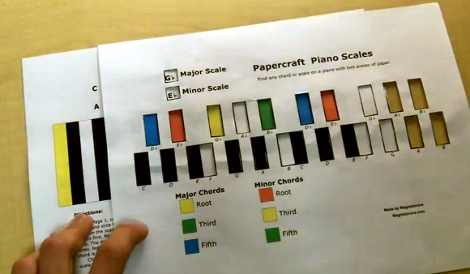
For all those engineers who dabble in music [Magnetovore] has your back. Musicians simply must know their scales and he came up with a papercraft slide rule for major and minor scales.

The system is very easy to use. He’s uploaded PDF files that let you print out the mask for the top layer and bar chart and directions for the bottom layer. The top layer is laid out like a piano keyboard, with windows for each key and a couple of windows to identify the major and minor scales being displayed. Just slide the mask until each key is a solid color. The color codes show the tonic, third, and dominant for each key so you know where to start. In the video after the break you can see how it works by playing all of the non-black keys in order. But wait, if you order now you’ll get the slide rule for Cello scales at the same low-cost; free!

This is a fun quick-reference, but you really should know your Circle of Fifths. Continue reading “Slide Rule For Musical Scales” →

The Trials Of Digital Design Class

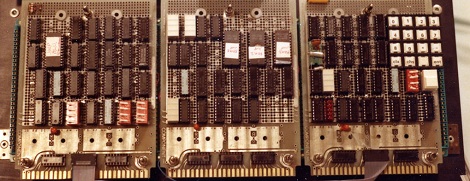
Late last week, we saw a rather clever combination lock build that used only a single 74xx logic chip. [J. Peterson] read this post, and in a battle royale of geek one upmanship sent us a write up of the logic chip computer he built nearly 30 years ago at the University of Utah.

Around 1982 or 1983, [J. Peterson] took the Digital Hardware Lab at the University of Utah. The class was split into two semesters; during the fall semester, students would build a four digit, stack-based calculator that could add and subtract. That may sound easy, but everything – including reading the keyboard, multiplexing LEDs, and performing the mathematical operations – was done with gates and latches.

After Christmas break, the poor souls who had just finished their calculator were presented with another challenge due in four short months. The calculator built during the fall would turn into a full-blown computer, functionally similar to a PDP-8.

After months of work, and seeing the 70 people who showed up on the first day of class in September dwindle down to a handful in late April, [J. Peterson]’s computer was complete. The test program ran through a couple iterations, and the computer was immediately disassembled.

An awesome tale of digital design from only a generation ago. And you thought Verilog was hard.

Building A Media Player With An MSP430

A media player based on an Arduino and SD card has been done to death several times over, but that doesn’t mean we can’t appreciate [Matt]’s MSP430 audio player. It’s a very nice piece of work that supports a FAT16 file system and only takes up 54 bytes of RAM.

To make his dream of a 430 media player a reality, [Matt] based his work on the DIY Life Talking MSP430 project. Unlike this previous attempt to play music with a ‘430 and SD card, [Matt] threw in a full FAT16 file system, allowing him to drag and drop audio files on his computer to the SD card.

Right now [Matt]’s build can play a stereo audio file through its speakers, but the sound quality over a mono file is greatly reduced. The maximum sample rate is 16kHz; a ‘good enough’ sample rate if you’re listening with terrible headphones. In the video after the break, [Matt] plays this awesome Symphony of Science on his homebrew media player. We’re guessing his camera doesn’t do his project justice, but it’s still impressive nonetheless.

Continue reading “Building A Media Player With An MSP430” →

Open Source Tracking System Gets A Kickstarter

open-source-tracker

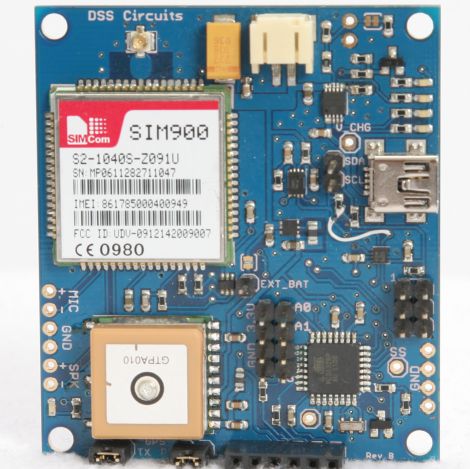
Many of the hacks featured here inspire others to build on the creator’s work, and on occasion the positive feedback brings the hack to market. Last year we told you about [Wayne’s] creation, a system aimed at tracking down would-be game console thieves. He received a bunch of requests to document the tracker in full, so he decided to revise his creation and release it as Open Source Hardware.

As you might remember, his original tracking device was powered by an Arduino, which monitored an accelerometer and GPS sensor, reporting coordinates and movements to his mobile phone on demand. He combined the disparate components together on a single board, and started a Kickstarter for the project.

Aside from his original purpose of tracking stolen goods, he lists off an array of other uses, such as tracking the driving habits of your newly licensed teen, geofencing objects in certain areas and more.

If an SMS controlled all-in-one tracking system is something you might be interested in, check out his Kickstarter, or take a look at the documentation and build one of your own.

We Don’t Need No Stinkin’ Packages!

DIP, SOIC, BGA, MLF or QFP?  None, so it seems.

This morning I received an email from Texas Instruments. Normally, these things go right into the spambox but this one was a bit unique. You can now buy some of TI’s IC’s without any packaging. Yup, just trays full of silicon squares. From TI’s point of view miniaturization has reached a point where that extra 0.1″ of PCB space is now too valuable to give to a piece of worthless plastic, and bonding micro-small wires to a silicon die is a feat that any manufacturer can preform with great accuracy, reliability and speed.

Whether this is a new paradigm in manufacturing or a premature April fool’s joke, if this process catches on smartphones just went from being almost unrepairable to 100% unrepairable, and ipod nanos might just start playing back 1080p video. It’s awesome and scary at the same time.

Now, are they crazy, or just ahead of their time? Tell us what you think.