Bluetooth Wristwatch Based On An Arduino

We hate to admit it, but we missed out on the TI Chronos watch deal last week. While we’re still a little bit burned over the fact that these watches sold out so fast, [Ahmet] sent in his Open Source Bluetooth Watch and we’re thinking this could eventually be a decent replacement.

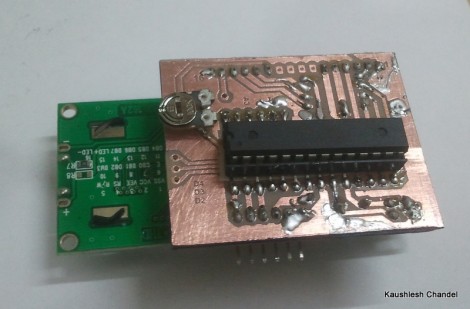
The watch is built around an Arduino Pro Mini, a scavenged Nokia LCD, and a BlueSMiRF Gold. The Bluetooth connects to a Nokia N900 with a little Bluetooth client app [Ahmet] wrote. He also wrote a small GUI for the watch’s LCD display. Afterwards, he was able to display missed calls, new email, and is now working on support for changing songs on his N900’s media player.

Admittedly, a little work needs to be done on the enclosure. Still, the potential for this watch is much greater than the iPod as a watch project we saw last year. Right now, we’re thinking about what could be added to [Ahmet]’s watch. An accelerometer would probably be on the top of our list, but if you have any ideas feel free to leave them in the comments.

Check out the walk through of the watch’s functions after the break.

Continue reading “Bluetooth Wristwatch Based On An Arduino”

Can A Dippy Bird Be Used As A Temperature Sensor?

Dippy birds are the toys that teeter-totter back and forth as the beak of  bird-shaped body dips into a container of water. The felt covering the beak and head picks up water and, through evaporation, cools that end of the glass tubing. The temperature changes cause the dichloromethane to either boil off, or condense, shifting the weight of the liquid thereby pivoting the glass body.

The real question is, does the temperature of the water cause the toy to move differently, and can that be measured to calculate the temperature of the water? [Craig] put that query to the test, by designing an apparatus to measure the motion of a Dippy Bird. A photointerruptor was used to measure the motion of the body, causing an interrupt each time the tail of the bird passes in between the sensor and the emitter. For control data a DS1820 temperature sensor was positioned near the felt on the head of the bird, and a relative humidity sensor captured readings at the same time. Data from the three inputs was collected over a two-day period. Although not a precise measurement, the motion of the bird did trend in the same ways that were recorded by the temperature and relative humidity sensors.

High Voltage: Lightning Simulator Can’t Send You Back To The Future

Continuing on with our high-voltage theme, today we have a page describing Marx generators by [Grenadier]. Marx generators are devices that produce pulses of very high voltage with fast rise times. For most of us, that means that they can make neat sparks. For the more serious types out there, that also means that they are great for driving some high-powered lasers, simulating lightning strikes, and even igniting the conventional explosives surrounding the core of a nuclear weapon! His page includes a video of his Marx generator producing some pretty sparks for those of us who aren’t so serious.

We have featured several of [Grenadier’s] projects in the past. This one doesn’t deviate from his normal style of taking a subject and clearly describing it with lots of well-taken pictures.

Recently, he has been working on improving one of his projects that deviates from what he normally does. He is calling it “The Junkbox”. The Junkbox is something like a free online swap meet where you can sell your electronic parts.

Barcode Tattoo Has A Lot Of Thought Put Into It

This bar code tattoo was sent into us by [Lifespan]. Before going under the needle, [Lifespan] didn’t care much for tattoos. After seeing this video he realized that a tattoo could have dynamic content through domain redirection.

[Lifespan] spent a lot of time going over the different styles of 2D bar codes. QR codes were deemed ugly because of the three large squares in the corners. An EZ Code, like the one in his YouTube inspiration, are a proprietary format that must be read with a ScanLife app. He eventually settled on a Data Matrix bar code because of its open format and ubiquity in business and industry. To make the tattoo dynamic, [Lifespan] made the tattoo point to 5id5.com. With a little bit of smart phone wizardry, that domain can be redirected to any URL in a moments notice.

Like all well-planned tattoos, he found himself a very good artist to do the piece. [Connor Moore] managed to ink some skin at 15 dpi, which was a little risky, but the results came out great. While it’s not scarification via a laser cutter, barring fading this tattoo is technologically future proof.

Building A Contact Mic Using Homemade Piezo Crystals

homemade_piezo_contact_mic

[Leafcutter] is big in to making music and has put together all sorts of musical instruments and tools over the years. Recently, he was inspired to make his own piezo crystals, and wrote in to share the results of his experiments with us.

[Leafcutter] is no stranger to messing around with piezo elements, and after seeing [Collin’s] tutorial on making your own piezo crystals at home, he knew he had to give it a try. He stopped by the grocery store to fetch all of the ingredients, then followed [Collin’s] instructions to the letter…well, almost. It seems that he might have cooled the solution too quickly, so he found himself with a jar full of tiny, barely usable piezo crystals instead of larger ones like [Collin] was able to produce.

Undeterred, he decided to see if the stuff was any good, and rigged up a makeshift contact microphone using some conductive foil and a clamp. He piped the output to his amplifier, and wouldn’t you know it…it worked!

He has a small sound clip of what the mic sounded like on his site, and it worked pretty darn well despite the crystal’s tiny size. He is going to give the whole process another go, so we hope to see more experiments with bigger crystals in the near future.

Setting It Straight About Science Fair Solar Energy Breakthrough

There’s been a lot of stories about arranging solar panels to mimic leaves on a tree, thereby boosting their efficiency. But before reading that story you might want to check out this blog post correcting some flaws in that breakthrough (page is down, here’s a cached version).

Before we go any further, we’d like to point out that the original work was done by a seventh grader. He looked at leaves on trees and postulated that the Fibonacci sequence can be found in the layout of leaves, and that by laying out solar cells in the same way you can capture more sunlight. Comments can get negative fast around here, so remember that trashing his work may discourage other kids from participating in science fair events.

Anyway, long story short: there were some issues with original assumptions, and about what was actually being measured during testing. The article linked at the top covers the fact that the cells were not measured under load, and that simple calculations can show why the tree-mimicking-cell-placement can be proven sub-optimal to 45 degree, south-facing solar farms.

[Thanks Jeffery and Steve for the original article and Brian for the follow-up article and cached link]

[Dino] Tells Us About Transistor-based On/off Switches

hackaweek_transistor_onoffswitch

You know them, you love them, you take them for granted – they are single push button on/off switches. As [Dino] explains in the most recent episode of his Hack a Week series, they are typically implemented in the form of IC logic switches nowadays, but it wasn’t always that way. When they first came on to the scene in the 70’s, the single button soft switches were built using a set of transistors and a capacitor to get the job done, so [Dino] decided to research push on/push off transistor switches a bit and build his own.

After reading through a short tutorial, he was ready to go. As he explains in the video, the operation of the switch is fairly simple, though he did run into some odd issues when he prototyped the switch on a piece of breadboard. He’s looking for someone to explain why the unstable circuit suddenly performs better with the addition of a small capacitor between the battery’s positive lead and the circuit’s output, so if you have some insight, be sure to speak up in the comments.

In the meantime, check out [Dino’s] exploration of push on/push off switches below.

Continue reading “[Dino] Tells Us About Transistor-based On/off Switches”