Open Source Laser Cutter (v2)

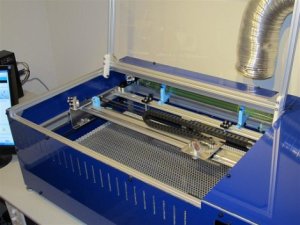
The Buildlog.net 2.x Laser is a second generation open source laser cutter that definitely improves the design of the first model. The 2 axis machine (optional vertical axis is manual or an upgrade is available) boasts a large 12” x 20” x 4” workspace while being smaller than its predecessor, fitting a table top design.

The older model had a goal of being self replicating, which limited the types of materials used, the new 2.x model drops that goal and uses stronger metal parts. Electronics are now modularized that allow easier and cleaner wiring, though you will still need a controller board.

There is an XMOS based controller provided on the main page of BuildLog.net, along with mechanical drawings, schematics, gerbers, instructions for both machines, and kit parts (for the first model) along with resources for the heavy items like laser tubes and power supplies.

DrunkenNES Makes A Game Out Of Getting Hammered

drunkenNES_cart

While handheld breathalyzers are pretty novel to have around while drinking with friends, there’s nothing exciting about a $50 off the shelf unit. If you really want to grab people’s attention, you have to get creative and built something like [Batsly Adams] and his friends did.

One evening, he was casually drinking with some friends and playing around with an electronic alcohol sensor. They quickly put together a NES ROM that would play sounds, changing the pitch depending on how much alcohol the sensor detected. It quickly became apparent to them that a full-fledged breathalyzer video game was in order. In no time, he and his friends had compiled graphics, a soundtrack, and the code to drive their game, DrunkenNES.

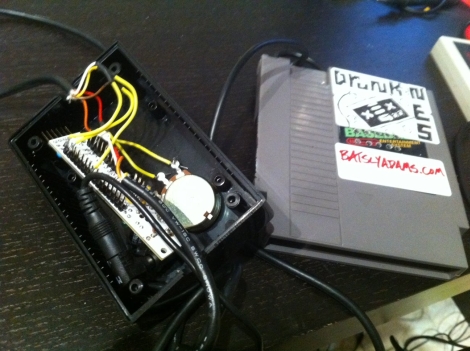
To play the game, each player must blow into a gutted NES cartridge that has been fitted with the alcohol sensor. The Nintendo computes the player’s BAC, reporting how intoxicated they are using simple graphics and cheesy animal puns. We don’t know when the code and schematics will be made available, but when they are, you can guarantee we will be building one for “research” purposes to pair with our Power Hour shot glass.

Keep reading to see some in game video of DrunkenNES

[Thanks Adam]

Continue reading “DrunkenNES Makes A Game Out Of Getting Hammered”

Gameduino

Gameduino is an FPGA based sound and graphics adapter for microcontrollers. Laid out as an Arduino shield, all it really takes is a microcontroller with SPI and some code to send commands to the board which lets you toggle registers, handle memory, and drawing functions.

Once the data gets there, it is greeted by a Xilinx FPGA which puts out a 800×600 72Hz SVGA sync signal, large 512×512 pixel character scrolling backgrounds, piles of 16×16 (up to 256 color) sprites, each with per pixel transparency, rotation, flip, and if that was not enough a 12 bit frequency synth that can do 16 independent voices.

All the resources to make one of these is listed on the site under the Making a Gameduino link, but if youre interested in getting a made board there is also a kickstarter page available. There are other ways to squeeze video out of micro controllers from the basic like hackvision to AVGA or even Lucidscience AVR VGA v2, and tons of propeller projects, but this one being stand alone and portable, has a certain appeal.

Join us after the break for a quick video.

Continue reading “Gameduino”

Old School LED Light Show

programmable_lightshow

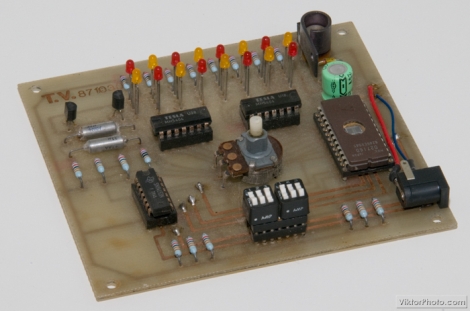
Building LED arrays that can display all sorts of different patterns is pretty easy these days. Hook up an Arduino, do some charlieplexing, and off you go. When [Viktor] was younger he didn’t have all those fancy schmancy microcontrollers and circuit simulation software you kids have these days. In fact, last we heard, he had to walk to school uphill both ways – in the snow.

That didn’t stop him from building this gem of a project back in 1987. His LED chaser/light show does not use any microcontrollers at all, rather it relies on an EPROM to store predefined display programs. A series of switches are installed on the front of the flasher, allowing him to easily switch between the programs, and a pot is mounted to the front of the device to control the speed of the LEDs.

His light show is pretty slick, even for a project built over 20 years ago. Sometimes you just can’t beat a good, old-school hack.

Continue reading for a video demonstration of [Viktor’s] programmable light show.

Continue reading “Old School LED Light Show”

Endless Fun With LED Dominoes

le_dominoux

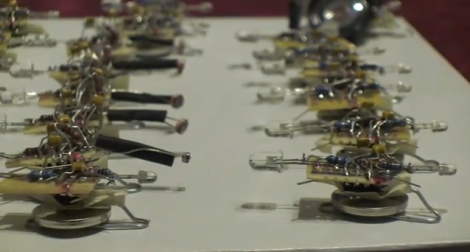
Toppling dominoes is great fun for about 30 seconds at a time, when you are not busy setting them up for another run. [Randy] thought it was about time they got an electronic makeover to allow for constant, immediate gratification. Armed with a few simple electronic components, he has created Le Dominoux.

These LED-based electronic dominoes are actually quite simple to build. Each basic Le Dominoux is constructed on a small square of protoboard and consists of either a photo cell or phototransistor, a 555 timer, and an LED, all powered by a coin cell battery. The 555 timer, which is configured as a one-shot, is triggered when the photosensitive component on the back side of the domino is exposed to a bright enough light. The LED on the front end of the domino is then illuminated one time. This process is the electronic equivalent of a single domino toppling over.

He has constructed several variants of the Le Dominoux to act as flashing triggers, for outputting sound, as well as for turning tight corners. These variants allow the dominoes to be configured in many different ways, creating self-sustaining light shows. If anyone is looking for a fun project to introduce kids to electronics, this would definitely be it. Stick around to see a video of Le Dominoux in action – we bet you can’t stop watching it.

This is of course [Randy’s] entry in the 555 Design Contest, which ends tonight at midnight EST.

[Thanks Jeri]

Continue reading “Endless Fun With LED Dominoes”

Fly Like Superman Using The Force

infinity_simulator

At one point or another, who hasn’t had a dream in which you could fly, simply by thinking about it? [Yehuda Duenyas, aka XXXY] is currently working on a project at Rensselaer Polytechnic Institute which can allow you to do just that.

As part of a thesis project dubbed the “Infinity Simulator“, he has constructed a system that allows people to fly about using the elaborate rigging system at RPI’s Experimental Media and Performing Arts Center. His project allows users to glide through the air, walk up walls, and otherwise live out their flying fantasies, with mere thoughts.

An EEG headset is placed on the user, along with other wearable sensors which enhance the audio and visual experience of the person in flight. With enough concentration, the rigging system sweeps people off their feet, sending them soaring anywhere their mind desires. It sounds a bit like pretending to be Superman while using The Force to us, however the installation is described on the EMPAC web site as a “live-action stunt show crossed with a video game.” Either way, sign us up!

Hopefully we will see some video of the completed project in the near future, but in the meantime keep reading to see a behind-the-scenes preview of the flying rig in action.

Continue reading “Fly Like Superman Using The Force”

Bluetooth Nixie Driver Lets You Go Almost-wireless

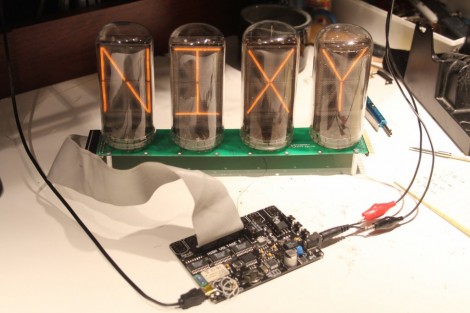
[Bob Coggeshall] has a nice Nixie tube driver board coming down the pipes. It’s not quite ready yet but you can see by the image above, it offers something that isn’t always easy to find; control for B7971 tubes which can display the full spectrum of alpha-numeric characters. This board is not limited to just one type of tube and it can be chained together with other boards to create longer displays. But perhaps the best development is the addition of a Bluetooth module. [Bob] has incorporated a Roving Networks RN-41 Bluetooth module which takes care of all aspects of the wireless protocol. This way the display is not tethered to a computer, or limited to data stored on a chip. We can’t really say that it’s wireless though, as we’d assume a set of these big tubes would rip through batteries pretty quickly. Keep an eye on this project, it will be open source once the bugs are worked out and [Bob] will also sell fully assembled and tested boards for those who choose not to roll their own.

We wonder if it would be easy to pair this with your phone and use it to display incoming call information?