Real Life Super Mario Coin Block

mario_coin_block

Instructables user [Bruno] recently constructed a fun little toy that brings a bit of the Mario nostalgia out of the video game universe and into ours. His Super Mario coin block is instantly recognizable from the first Mario game and performs just as you would expect it to. Punching or tapping the bottom of the block releases coins one at a time, complete with sounds straight from the game.

The coin block is constructed from thick cardboard and wrapped in color mock ups of the in-game block. Inside, a spring-loaded tube of coins is placed above a launch arm which is also connected to a spring. A servo actuated arm pulls the launch arm down, dropping a coin from its tube on to the launch arm which is then flung from the top of the box once the servo arm rotates far enough. When this occurs, the built-in MP3 player is triggered to play the “coin sound” from the game. A 555 timer is used to ensure the servo actuated arm rotates once per activation, and a LM386-based amplifier is used to increase the output volume of the MP3 player, both of which operate using rechargeable batteries.

Be sure to check out some of the inner workings as well as the final product in the videos embedded below.

[Thanks, Samjc3]

Continue reading “Real Life Super Mario Coin Block” →

Photographing Stuff That’s Not There By Using Stencils

This image was not made in post production, but captured during a long camera exposure. The method uses stencils to add components to a picture. [Alex] built a jig for his camera from a cardboard box. This jig positions a large frame in front of the camera lens where a printed stencil can be inserted. He printed two identical sheets of paper with black covering the area all around the 8-bit joggers. When properly aligned and inserted in the jig, the black parts of the stencil will act to mask the areas where he wants to capture the natural surroundings of the image. Once the camera shutter is triggered, he uses a flash to illuminated the stencil, then removes the the paper image from the jig and ambient light from the dark surrounding is captured during the remainder of the 20-30 second exposure time. The real trick is getting the light levels between the flash and the ambient light to balance and produce a result like the one seen above.

Is anyone else hearing the Punch Out cut-scene music in their heads right about now?

phone_mixer

Convert An Old Busted Phone Into A Voice-altering Prank Machine

Have you ever wanted to be someone else, at least over the phone? Do you dream of turning the tables on telemarketers, making them hurry to get off the line instead of you? If so, [Brad] over at LucidScience has the project for you.

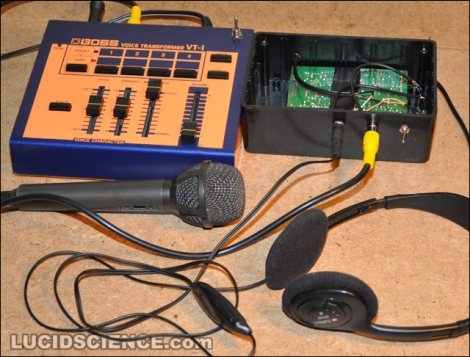
A bit of a prankster at heart, he walks through the conversion of a normal telephone into a Data Access Arrangement device (DAA), allowing you to interface it with either hardware or software-based audio mixers.

The process can be completed in a relatively short time period, and doesn’t require much more than an old telephone, a handful of tools, and some miscellaneous switches and jacks. He disassembled a telephone and trimmed off all of the unnecessary circuitry while retaining most of the original functionality. Line in and out jacks were then installed in place of the handset microphone and speakers, respectively. The final result is a compact box that relays altered audio from any kind of mixing device to person at the other end of the call. Since the majority of the phone remains intact, your calls still sound natural as they pass through the phone’s existing voice filter and preamp circuitry.

Once the DAA is complete, you can use any number of effects on your voice, limited only by your audio mixer. [Brad] says he has long-time friends that don’t even recognize his voice after he has run it through his effects machine, so get started on yours before April Fool’s day arrives!

Surplus Military Gear Keeps Your Hands Free, Calls Private

heli_helmet

[Julian] was rummaging through a military surplus store when he spotted a pair of old helicopter pilot helmets that he absolutely had to have. At $25 they were a steal, but pretty useless in their current state. He decided to modify one of the helmets for use while playing video games, but he didn’t stop there.

The helmet had two decent speakers built-in so he kept them, but tweaked the wiring from a mono-only configuration to accept stereo input. A RF wireless headset was disassembled and wired into the helmet so he could use it for playing video games while his wife is asleep. As an added bonus, the headset he used happened to have an AM/FM receiver built in, so he can enjoy music while sitting around with his helmet on as well. A Bluetooth cell phone headset was also torn down and wired into the helmet for gaming and handling phone calls. The Bluetooth mic was extended into the original mic stem built into the helmet, keeping things authentic-looking.

Overall it’s a quite a useful recycling of some old military junk. It’s a great idea though the helmet looks like it could be a touch cumbersome after awhile.

Real-time Wireframe Video Effect Overlay With Kinect

linedance

[Francois] over at 1024 Architecture has been working on a project we think you’ll be likely to see in a professional music video before too long. Using his Kinect sensor, ha has been tracking skeletal movements, adding special effects to the resulting wire frame with Quartz Composer. While this idea isn’t new, the next part is. He takes the QC tweaked video stream and then projects it back over the performer using MadMapper to match the video to the body movements, recording the resultant display.

The project started out with a few hiccups, including a noticeable delay between the body tracking and the display. It caused the performer to have to move more slowly than he would like, so things had to be tweaked. [Francois] first tested the latency between his computer and the projector by displaying a timecode representation on the screen as well as via the projector. He found the projector to have a latency of 1 frame at 60 fps, which wasn’t too bad. This led him to believe the culprit was his Kinect, and he was right.  There was a 6 frame delay, so he locked the video output to 30 fps in hopes of cutting that delay in half.

The effect is slightly reminiscent of Tron, but with more distortion. We can’t wait to see more projects similar to this one in the future.

The resulting video embedded below is pretty cool in our opinion, but you can judge for yourself.

Continue reading “Real-time Wireframe Video Effect Overlay With Kinect” →

Remote-controlled Tank Tread Robot Will Walk The Dog For You

remote_controlled_robot

Instructables user [IAMTHEBOT] recently finished building his robot which can be controlled by a human using an R/C transmitter, via a PC, or through its built-in object avoidance system. The robot doesn’t seem to have a name, though Johnny Five might be appropriate.

The robot was built using plenty of erector set parts, as well as a Lynx motion tank tread kit. The robot is crammed full of controllers, including a Propeller USB servo controller which operates the arms, and a pair of Parallax motor controllers to manage the tread movement. A pair of Parallax Stamp controllers are used to drive these controllers as well as to manage the remainder of the robot’s functions.

The robot’s head consists of a custom pan and tilt wireless camera system, which allows him to drive it around from the comfort of his home, while watching the video stream on his PC. The robot also has the ability to roam around autonomously, avoiding objects using a ping sensor that can be mounted where the camera is currently located. It seems all that’s missing is Steve Guttenberg.

As you can see in the videos below, the robot manages pretty well on all sorts of surfaces, and even walks this guy’s dogs.

Continue reading “Remote-controlled Tank Tread Robot Will Walk The Dog For You” →

High Voltage: How To Cook Your Goose In 62 Easy Steps

Prepare to learn. [Grenadier] has put together a collection of information about AC electricity that can safely be called a super-post. In 62 parts he covers a myriad of topics, some of them safe, many of them not so much. You may want to spend time reading through everything that he has to offer, but just in case you don’t, step one is a table of contents. In it you’ll find a listing of major points including transformers of every kind imaginable; from microwave ovens, neon signs, bug zappers, x-rays, and televisions. [Grenadier] covers the type of transformers that these items use, where to find them, and how to set up your own experiments. There’s plenty of pictures and several videos where the high-powered sparks fly. We feel like there’s enough here that we can be satisfied with vicarious AC interactions while safely in front of our monitor and far away from the heart-stopping action.

[Thanks Marcus]