Xbee Controlled, Granite-wrapped Clock Travels Into Future

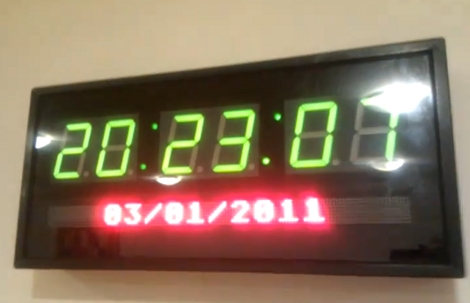
From the looks of it this clock is a couple of months ahead of its time. [Oscar] built the clock (translated) taking time to add a lot of goodies into the mix. First up, the parts you see include six large 7-segment displays for hours, minutes, and seconds as well as an LED marquee which can scroll messages. Inside there’s a temperature and humidity sensor for environmental feedback, and an Xbee module which allows for wireless computer control. Time is kept by a DS1307 real-time clock, which is read by an Arduino Uno, then pushed to the display by the pair of I2C addressable SAA1064 drivers. The whole thing was enclosed in four sheets of granite for the box, and a pane of glass for the front. We sure hope it’s well anchored to that wall. You can see it ticking away after the break.

Continue reading “Xbee Controlled, Granite-wrapped Clock Travels Into Future”

5/8″ Ball Bearing Playground

This kinetic sculpture is a ball bearing’s paradise. Not only do they get a cushy ride around two lift wheels but there’s a variety of enjoyable obstacles they can go down. The first is a vortex made from a wooden flower pot which sends the balls randomly down one of two possible exits. From there it’s on to enjoy a ride on a flip-flop, a divide-by-three (takes weight of three marbles before it dumps them all), a zig-zag track, or a divide by twelve mechanism. We’re sure this is a riveting read, but don’t miss the video after the break where [Ronald Walter] shows it in action and takes it apart to illustrate the various features.

If you’re wondering about the digital logic terms used, we’ve seen wooden devices that use these concepts in the past.

Continue reading “5/8″ Ball Bearing Playground”

Mitch Altman Hosts A Tour Of Noisebridge

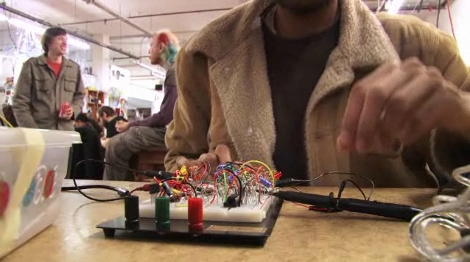
[Mitch Altman] just popped up once again (seriously, this guy is everywhere!) in a video tour of Noisebridge, and hackerspace he co-founded in San Fransisco. The space is 5200 square feet and they’ve managed to cram a lot of different uses into it.  There’s areas for computers and electronics, crafting and sewing, a dark room , a machine shop, a full kitchen, as well as classrooms and other gathering places.

He talks about what a hackerspace is and what goes on in San Fran before going off on a little tour of the hackerspace movement. His recollection pins the Chaos Communications Camp as the impetus behind an initial push for these community spaces popping up in the US. It’s a fun five-minutes to watch so check it out.

[via Boing Boing]

Conways’ Wall Of Life And Whiteboard Emporium

White board beats chalk board, LED marquee beats white board, and an LED white board trumps them all.

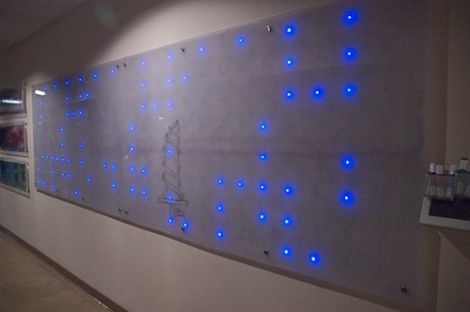
This hybrid lets you draw on the surface with dry erase markers while Conway’s game of life plays out underneath. [Bert] sent us this tip after seeing yesterday’s office marquee. This version is quite similar in appearance but the guts are very different. Inside you’ll find a Parallax SX28 microcontroller doing the heavy lifting. The display is multiplexed but they didn’t go with a common 595 shift register, but a beefier MAX6979 LED driver. We’re not too familiar with this part but it does have a lot of nice features like constant current, and automatic shutdown if serial data stalls for more than 1 second. This is a low-side driver so transistors are used to connect voltage to the rows; the opposite from the setup we looked at yesterday. This was built several years ago and is still working happily even though its permanent home is a breadboard. Source code can be found on this page.

Exploding An AVR

Unfortunately [manekinen] wrecked a couple of AVRs during his tinkering. Not letting this get him down he decided to blow them up to see what would happen. In exchange for their precious magic smoke the AVRs revealed a good portion of their silicon die.

While the details are a little sparse it seems like he hooked them up to a high (and possibly reverse) source to blow open the chips casing. From the pictures it looks like he was able to reveal some of the flash or SRAM (the big multi colored rectangles) and what could possibly be the power supply. Be sure to checkout the videos after the break for some silicon carnage.

Continue reading “Exploding An AVR”

Official Hackaday Forums

Yes, finally, we have a forum. We get regular requests, both in the comments and in our email for a hackaday forum.  We put it in operation a few days ago and started letting people trickle in and it hasn’t completely blown up in our faces. Please join us there and help build our community. Also, notice there is a button for it over on the right column now.

Some items of interest or common answers to common questions:

  • No illegal activities allowed. Yes, we have the word “hack” in our name. That does not mean that we will hack a website for you. (we get that request weekly).
  • Keep it moderately clean. Sure you can cuss, this isn’t a kids site, but no pronography/gore please.
  • No personal threats.
  • There will be google ads. We are trying really hard to balance the business with the fun, so bear with us. So far, they aren’t in the way. We have no plans on going overboard.
  • This will be readable without a login. You must register to post.
  • We’re working out the kinks. Please report any problems to caleb@

That’s it, enjoy and be civil.

Plug And Prey: Malicious USB Devices

This very informative talk given at Shmoocon 2011 has been posted over at IronGeek. Covering all kinds of angles that a person could attack someones computer through the USB port, this should be read by anyone who is security minded at all. No matter which side of the port you tend to be on, this article has great information. They cover some common attack methods such as keyloggers and fake keyboards as well as some common methods of securing your system against them. We’ve actually seen this in the news a bit lately as people have been using the keyboard emulation method in conjunction with android phones to hack into systems.

[thanks Adrian]