Vacuum Forming At Home

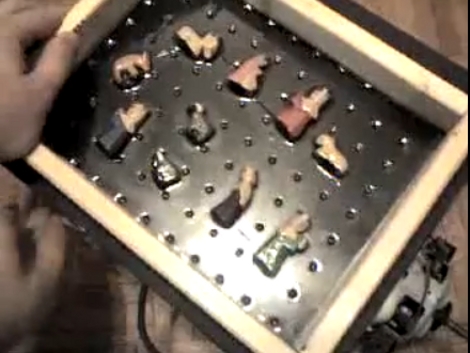
A little dumpster-diving let [Nick Skvarla] build his vacuum form machine for around $5. He pulled a vacuum cleaner out of the trash, which was tossed away because of a broken power plug. He put it into a box which had been sealed with spray foam and used a piece of pegboard for the top side of the enclosure. He takes a piece of 40 mil PETG plastic from the hobby shop and mounts it in a wooden frame. That goes into the oven on broil until the entire sheet is sagging, then onto the vacuum former. Above he’s making forms out of some figurines which he’ll walk you through in the video after the break.

There’s a whole world of manufacturing processes that use these forms as a starting point. What would you use this for?
Continue reading “Vacuum Forming At Home” →

Make Your Own Solenoids, Then Play The Xylophone

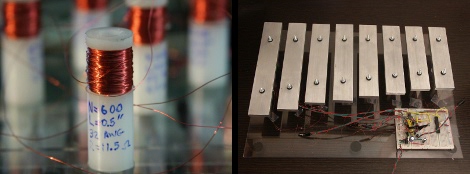
Learn to manufacture your own solenoids and then use them to play the xylophone by watching the tutorial video after the break. [Humberto Evans] and the team at Nerd Kits do a great job of not only manufacturing the coils, but the xylophone itself. The bars are machined from some aluminum stock and they take you down the rabbit hole with they why’s and how’s of engineering the keys.

We’re unlikely to replicate this machining process but the solenoids are another story all together. Starting at about 3:30 you can learn about designing, building, and using these little marvels. They’re basically an electromagnetic cuff with a metal slug in the middle. The solenoid seen above uses a body milled from HDPE and wrapped with magnet wire. The slug in the center is steel, with a few rare-earth magnets at the top. When you run current through the coil it repulses the magnets on the slug, witch then strikes the xylophone key. Using a MOSFET and a protection diode, actuating them is as simple as sending a digital high from your microcontroller of choice.

We’ve seen solenoids used to play a vibrophone before, but those were commercial units. Making your own hardware is far more hardcore.

Continue reading “Make Your Own Solenoids, Then Play The Xylophone” →

Heater For Bending Acrylic

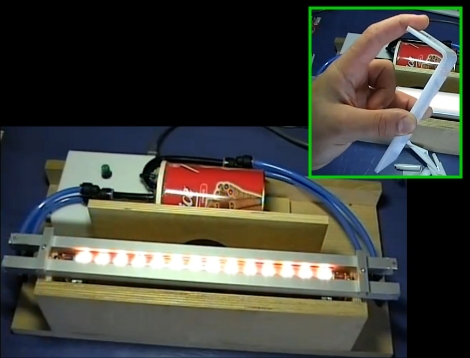
We like using acrylic in our projects but there are a couple of tricky techniques, particularly getting clean cuts for glued edges and bending the material into curves. [Giorgos Lazaridis] has a great solution to the latter, a dedicated acrylic heater. Instead of using an oven to warm the material for bending he’s using localized heat produced by a high-powered lamp pulled from an old laser printer. The next part of his solution is to keep the heated area of the acrylic as small as possible. This was achieved by creating heat sinks on either side of the bulb. The metal bars seen above have water running through them to help isolate the softening of the material to a narrow strip. See how well this system works in the video after the break.

Continue reading “Heater For Bending Acrylic” →

Steam-powered Rickrolling

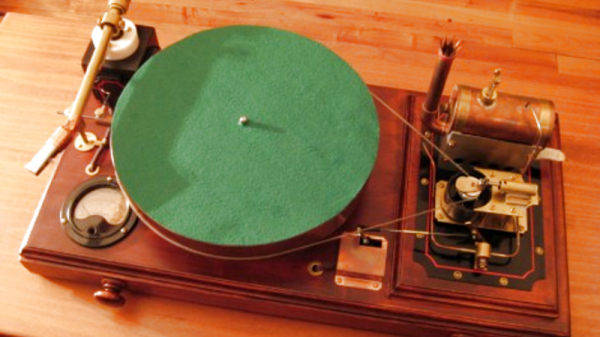
This is a steam-powered record player; awesome. But wait, that’s not all. Watch the video after the break for about two and a half minutes and you’ll realize that it’s also a Rickroll. No, you’re not getting baited into clicking through to Rick Astley’s music video, the LP that’s playing on the turntable is a copy of “Never Gonna Give You Up”; all kinds of awesome.

This all started with a steam engine machined from a stainless steel bolt and a brass cylinder. It was tested using compressed air before building the boiler. But what’s a steam engine without a purpose? The problem with using a steam engine as a turntable motor is speed control. This is where we move to modern technology, using an Arduino to measure the RPM and adjust the steam engine using a servo motor.

The builder makes a comment that this sounds terrible, but considering it’s steam-powered we think it sounds just fine.

Continue reading “Steam-powered Rickrolling” →

J1: A Small, Fast, CPU Core For FPGA

[James Bowman] of the Willow Garage published a paper on his J1 CPU core for field-programmable gate arrays. This was originally developed and used for the Ethernet cameras on the PR2 (you know, that incredibly expensive beer delivery system?) robot. It uses a 16-bit von Neumann architecture and lacks several processor features you’d expect a CPU to have such as interrupts, multiply and divide, a condition register, and a carry flag. None-the-less, its compact at just 200 lines of Verilog and it can run at 80 MHz. [James] compares the J1 to three different FPGA CPU Cores commonly used and discusses how the system is built in his 4-page paper that has the details you’re interested in but won’t take all day to dig through.

You Know That They Say About Guys With Big Lenses?

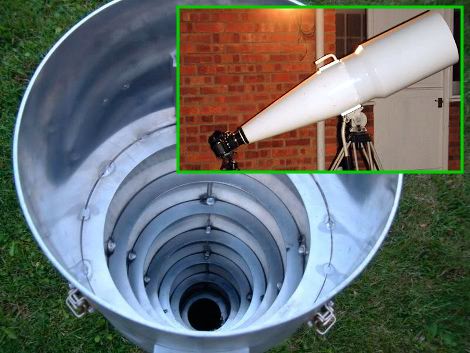
[Tony Lovell] and [dkpeterborough] built a sizable camera lens using optics from a flight simulator projector. What they ended up with is a 900mm lens that can make a beautiful photo of the moon, or capture distant landscapes in great detail. The body of the lens was designed in CAD and sent off for fabrication out of aluminum, as seen above. The concentric baffles help to prevent lens flare but it can’t be used in its bare-aluminum condition. The internals were coated using a stippling finish that leaves a sandy texture. That was covered with matte black barbecue paint, doing a great job of preventing optical interference, and the outside received a glossy white coat. Finished weight: 59 pounds, but once you see the pictures you’ll agree it’s worth lugging the bulky instrument around to grab that killer shot.

[via Make]

Developing An Animatronics Platform

This Predator costume has an animatronic element in the shoulder cannon. It tracks the movement of the mask, aiming wherever the Predator gazes. [Jerome Kelty] was asked by a friend to help develop the costume and he ended up with an animatronics platform which can be adapted for many different uses.

Starting with an Arduino Pro Mini [Jerome] designed a host board which would breakout the pins of the Arduino and make it easy to connect and drive multiple servo motors. The board is powered by a 3.3v Lithium Polymer battery with charging handled by a MAX1555 that was included in the design. Check out the video after the break which shows off the Predator suit. Looks like [Jerome] got it right, and he’s also put the platform to use with an Ironman suit that has an arm-mounted missle feature.

Need some inspiration for you next costume build? Take a look at this animatronic collection to get you started.

Continue reading “Developing An Animatronics Platform” →