Lots Of Spinning POV Goodness

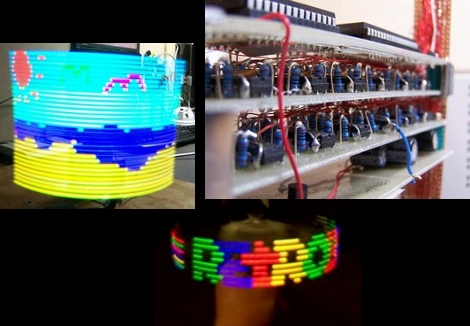
[Retrobrad’s] spinning POV display has long been our favorite. When it popped up on our radar again this morning we were surprise to see we never ran a feature on it! But now there’s so much more to share. Hit the projects icon at the top of his page and you’ll not only get the 8×85 RGB display’s build instructions, but he’s also built a 32×64 pixel spinning display.

Even if you’re not going to make one of these, he explains some pixel-graphics techniques that are useful in other instances. Check out his video on using spreadsheets for creating the hex arrays necessary for each frame the 8×85 display. It’s embedded after the break along with demos of the two displays.
Continue reading “Lots Of Spinning POV Goodness” →

Nixie Tubes Live In A Cool Box

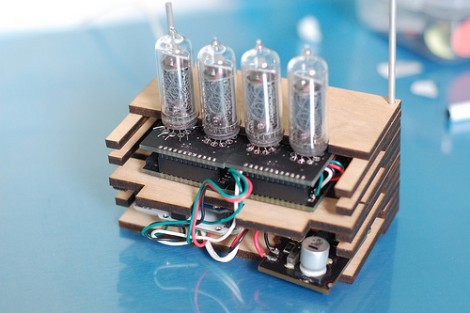
This set of four Nixie tubes display the number of people following bildr on Twitter. That’s neat; it uses an Arduino and some open source driver boards. But what caught out eye is the enclosure. The image above shows only half, but when assembled it’s a nice little cube that keeps the insides safe. This was laser cut using the Ponoko service and kicks off a design contest. Come up with the best idea for using 4 Nixies, their drivers, and $50 worth of Ponoko’s services and they’ll give you the materials to make it happen.

Lessons In Electric Circuits

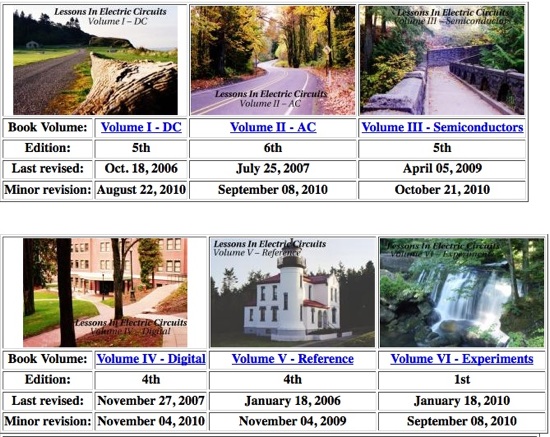
Are you looking for a good source of information to get started into making and hacking electric circuits? We would like to refer you to Lessons in Electric Circuits. Even if you have good knowledge of electronics, this is another tool you can use. The book is a work in progress and will have some incomplete and pending areas, but the basic theory parts to get started are all there. It has six volumes: DC, AC, Semiconductors, Digital, Reference, and Experiments. The DC and AC volumes are the most complete. If your eyes are already glazing over thinking you already know all of this stuff, then the most interesting volume for you may be the Experiments, which contains a number of sample circuits like transistor amplifiers and 555 timer circuits. The best part of this book it that it is free, but as with most free things, you can make it better by contributing.

Via Adafruit Industries.

Help Me Reverse Engineer An LED Light Bulb

hack LED bulb

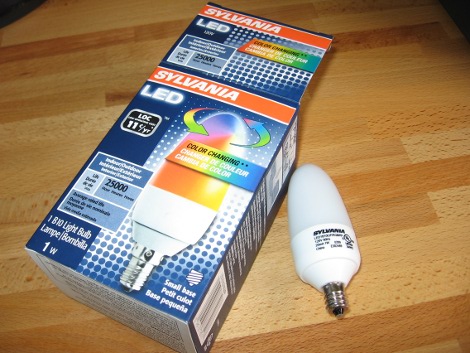
I went to the last monthly meeting of Sector 67, a hackerspace in Madison, WI. One of the things shown off was a color changing LED light bulb that Menards was clearing out for $1.99. Inside there’s two RGB LEDs controlled by an ATtiny13 and powered by an AC/DC buck converter. An ATtiny13 will run you around $1.25 by itself so this price is quite amazing. I grabbed a couple of these bulbs and set to work on them. Join me after the break to see what I’ve got so far.

Update: read a follow-up to this post.

Continue reading “Help Me Reverse Engineer An LED Light Bulb” →

Nixie Frequency Counter Gone Timepiece

nixie clock hack

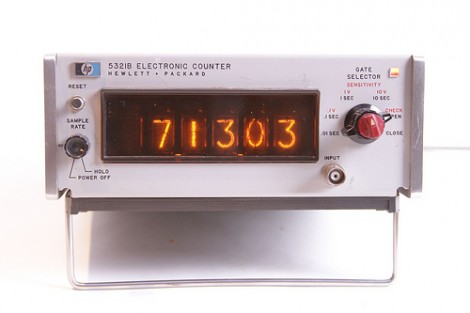
[Windell] of Evil Mad Scientist Laboratories took an ancient Nixie tube based frequency counter and converted it into a clock. The unit he got his hands on is an HP model that was still in great shape. He’s using an internally generated one second pulse as the clock signal, but some modifications are necessary to display time. That’s because the frequency counter is base 10 and clocks use a quirky combination of base 60 and base 12.

It wasn’t too much of a problem to rig up a system to track minutes and seconds. The tens digit for each is monitored by a couple of AND gates that he added to the mix. When they detect a ‘6’ the digit is reset and a pulse increments the next digit as the carry. This is more difficult to accomplish with the hours though. Minutes and seconds count from 0 to 59 but hours don’t start at 0. Instead of over-complicating the logic [Windell] used a bit of slight-of-hand. The Nixie tubes for the hours have been rewired so that when the counter is at 0, the filament in the shape of a 1 lights up. No difference in logic, just a translation that makes them display one digit higher than the actual count.

Helicopter POV Display Is A Masterwork

helicopter hack LED mod

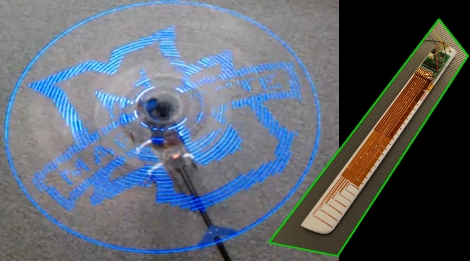
Yes! A radio control helicopter with a fairly high-resolution persistence-of-vision display is a beautiful thing. [Mziwisky’s] handiwork is the result of several steps along the prototyping path. He built up a POV test rig on a breadboard, designed his first PCB for the project, and then went to work building it. After initially being inspired by a POV ceiling fan [Mziwisky] looked around to see if anyone else had already added a display to a helicopter. Indeed, this has been done before but there were very few details on the build.

The helicopter has two blades and each have the same hardware on them and gobbled up about ten hours of assembly time each. He basically built a printed circuit board using the blades as a substrate by attaching adhesive copper foil. This makes up the matrix for the LEDs and connects to a small circuit board with an ATmega8 and some shift registers mounted on the inside end of the blade. There’s also a 180 mAh LiPo battery pack, and a hall effect sensor to synchronize the display on each. The results are spectacular, as you can see in the video after the break, but there’s a few bugs left to work out in order to fully tame the 32 LEDs on each rotor.

Kind of looks like the future is happening right now.

Continue reading “Helicopter POV Display Is A Masterwork” →

Building A Wooden Vespa

Scooter fans should start sharpening their chisels if they want to undertake this project. This Vespa is the work of a master carpenter and a lot of time. Through the build log photos you can see that it all started with a frame made by bending and laminating wood layers together. Veneer adds the stylish stripe and a lot of carving and turning brings the curves associated with the classic scooters. Even the hand grips, brake handles, and saddle are made out of wood. There’s springs for some shock absorption but we’d bet you don’t want to ride this for too long, or park it outside. Now it just needs an electric motor retrofit.

[Thanks Blair]