Bay Area Maker Faire Blasts Off Saturday

It’s crunch time at California’s San Mateo Event Center, where crews are busily assembling rocket ships, singing Tesla coils and animatronic giraffes and dragons in preparation for the 2010 Bay Area Maker Faire, taking place this weekend.

Returning for its fifth year, Maker Faire, if you’ve not had the pleasure, could be described as 50 percent science fair, 50 percent county fair and 50 percent Burning Man reunion. And if that doesn’t seem to add up, you’re right — it’s sensory overload, a hands-on, warranty-voiding explosion of futuristic technology, down-to-earth crafts and nine dollar pulled pork sandwiches.

If you’re planning on attending, hit up their web site for all the information on tickets and hours, recommendations for parking or — perhaps most importantly — public transit options. The event has been growing every year, even disrupting traffic on nearby U.S. Route 101, so you’ll want to set out early or research alternative options. We’ll be posting goings-on from the event as it unfolds, connectivity permitting.

Power Drill Solder Spooler

[youtube=http://www.youtube.com/watch?v=cF4cw41SMvY]

[Scott] over at curiousinventor.com has posted an instructable detailing how to use an Arduino and a power drill to spool solder. The Arduino senses the speed that the drill is going via an opto interrupter and a laser and adjusts with a servo hooked to the trigger. While we don’t think many people will be dying to spool some solder, this system might be useful for all kinds of things, like winding yarn or making coils.

Ubuntu On The ClarionMIND MID

[DeadHP1] has been rolling and optimizing his own Ubuntu distributions for the ClarionMIND. He calls his work Mindbuntu and he’s squeezing out quite a bit of performance from the mobile Internet device. The video is running at 800×400, as well as wireless, sound, Google Earth with GPS support, and even compiz. Install the image using unetbootin to place it on a thumb drive and you’ll have Ubuntu 9.04 to go in no time.

[Thanks Bob]

[ClarionMIND Photo courtesy of Mobile Tech Review]

Automatic Fish Feeder

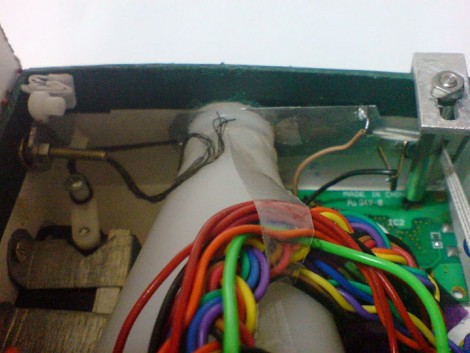
This automatic fish feeder didn’t take long to put together and it allows you to adjust how much food is dispensed. [Gagandeep Singh] built it around an Atmel AT89C2051 microcontroller. Like many of the automated feeding systems we see, this uses a character display and a few buttons for the user interface. We’re always curious at how they mechanically dispense the food. In this case, the motor seen at the left pulls open a sliding baffle which is pulled closed again by rubber bands at the right. It’s a bit more involved than the last fish feeder we saw, but your guess is as good as ours on which system works better.

Urine A Candidate For Energy Independence

We thought we were supposed to have fusion-power for our DeLorean by now but it perhaps urine-power is just around the corner instead. [Gerardine Botte] has been working on creating hydrogen from urine, the world’s most abundant waste product. The voltage needed to break apart the urea atoms is less than half that of water, and the way we see it, you’ve had the added benefit of already using the water once before creating the fuel. [Gerardine] also makes the point that urine has phosphorus in it which could be another useful outcome of the process because it is needed as an agricultural fertilizer. Does this mean that you can repay your designated driver by fueling up his vehicle after a night at the bar? It’s probably better than doing the same for the battery of your cell phone.

Hackers produced the first vegetable-oil powered vehicles so we’re throwing down the challenge of producing the first pee-and-go automobile. Good luck and wash your hands when you’re done.

[Thanks Peter]

Personal Pencil Production Plant

[vimeo=http://vimeo.com/9661763]

[Robb Godshaw] put together a pencil production line for home use. The whimsical assembly line starts with a graphite rod and extrudes clay polymer around it. From there it’s down a conveyor belt to get stamped and then into the oven made from a hacked toaster. The final step is to cut out a plug of eraser and attach it to the back-end of the pencil. This low-speed assembly line reminds us of a Rube Goldberg machine with all the wasteful steps cut out.

Keyboard Input For PlayStation

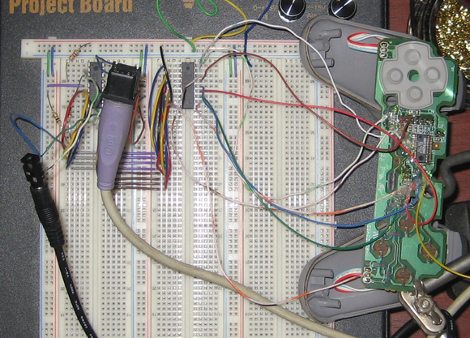
Anyone who has tried their hand at RPG Maker 1 (or any text input with a controller) knows how difficult it can be typing long paragraphs into the console. [Thutmose] is here to save the day with Kupid 1.0 (2.0 in production). A PICAXE takes ps/2 keyboard input and converts it to a series of d-pad button presses for PS1 and PS2 controllers, providing quick data entry compared to the previously monotonous task.

We’re happy to learn that the source code and hardware is released, meaning it has the potential to be easily adapted to any controller/console.