Android Development 101 – Part 3:Introduction To Databases

In this tutorial we will be pivoting from our last tutorial on Graphical Elements to start focusing on databases in Android development. The android platform uses SQLite databases in its applications and is one of five data storage options in android development. We will only be focusing on SQLite development in android because it is key to the construction of a workable/functional program. After this tutorial you should be able to implement a SQLite database that you are then able to insert and select items from tables in the database.

For this project we will be creating a Random Quote generator that has you enter quotes or sayings in a textbox and press a button to insert them into the database. We will issue a confirmation toast that allows us to see if the data was entered into the database successfully and the textbox will be blank. If a second button is pressed, the database will be accessed and told to select a random quote from the database to show in a toast on the screen.

Continue reading “Android Development 101 – Part 3:Introduction To Databases” →
Break Out The Two-ply, Ecobot III Poops

[youtube http://www.youtube.com/watch?v=qU6zi1_aZiw&feature=player_embedded%5D

Imagine our surprise when this article on Ecobot III and the disgusting video above showed up in our feed. The robot can theoretically be self-sustaining forever, so long as it has a food source. Yes, you read correctly, food.

Typical robots relying on grub burn the biomass to produce heat/steam/energy, but Ecobot III actually digests using Microbial Fuel Cells and extracts energy in the form of hydrogen.

The process isn’t very efficient (yet), and of course waste must be excreted, but we’re inching closer and closer to the day our robot overlords are invincible. The project has come to a halt (we can’t imagine why), but you can still read up on the process, and meet Ecobot’s brothers: II and I.

Related: We’re all going to die, Carnivorous robots.

LED Matrix With A Gross Of Pixels

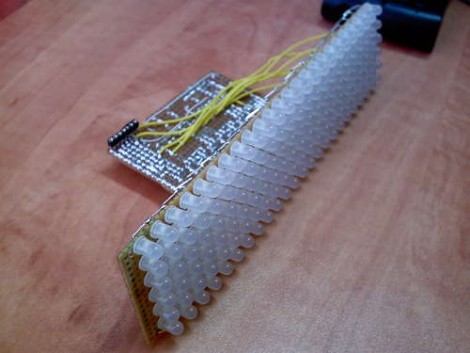
This LED matrix is arranged in a 24×6 pattern for message scrolling. There’s no etched boards here, making us wonder where [Syst3mX] found protoboard this long. He’s using an Arduino to drive the demonstration (clip after the break) but you can use any microcontroller with this setup. That’s because he’s using three shift registers for column data and a decade counter for row scanning, requiring just five control pins.

While you’re going to the trouble of ordering components, maybe you should try your hand at building a touch sensitive LED matrix too.

Continue reading “LED Matrix With A Gross Of Pixels” →

Complete The Hack A Day Survey, Win A Shirt

Take our reader survey. Do it. Do it right now.  Do you think we should run more articles on the dietary needs of Llamas? Here is your chance to let us know.  We got a lot of great feedback from [Jason]’s post, and now we’re ready for more. We’ve put together 10 quick questions that will help us get a feeling for what you want. We will be choosing 5 participants at random to give free t-shirts (the basic logo one).

Update: While we wait for our survey slave to get the changes made, please just put something in the fields that are mandatory(questions 7-9). Even if you put “no opinion”, we’ll get good info from the rest of the survey.

IPhone 4 Steadicam

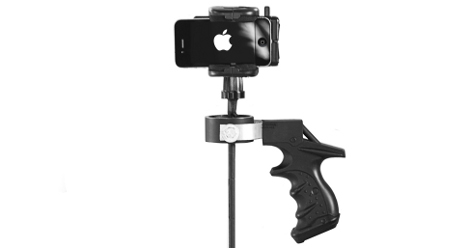
It’s been a while since we’ve seen a steadicam, and to quench our thirst is this  iPhone 4 steadicam. The system does use the typical 3 axis PVC gimbal and heavy weight setup that we’ve seen before, but (why has it taken so long to get this implemented?) the addition of a hand grip means you no longer get blistered fingers. The tutorial recommends the use of an expensive cup holder mounting system, but we think making your own epoxy one might save another dime and allow a wider range of cameras or phones.

The whole process is also wrapped up in a quick and simple how-to video (after the jump alongside an in action video), which goes to show even though a hack may have been done several times before, presentation can make a big difference and impact.

[Thanks Max Lee]

Continue reading “IPhone 4 Steadicam” →

Rapid Furniture Prototyping

SketchChair is a piece of software that takes the engineer out of engineering furniture. In a child’s-dream-come-true you draw the outlines you’d like to have, add some legs, and the software pops out a design ready to be laser-cut. The finishing touch of adding palm fiber and felt produces what we imagine is a moderately comfortable place to sit. Now the hard part will be convincing your spouse that you should spend the money building an industrial grade laser cutter because of all the money you’ll save on furniture.

We’re still holding out for furniture that is 3d-printed from rock to match our Flintstone’s motif.

Oh, and as always, video after the break.

Continue reading “Rapid Furniture Prototyping” →

IPad Arcade Dock Has Hidden Projector

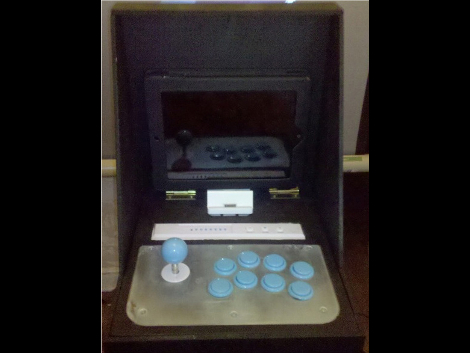
This iPad dock is a well-executed gaming accessory. [Linkreincarnate] used a Hori Wii fighting stick as the controller. In his hardware explanation he outlines several benefits of this choice including built-in support in most of the iPad emulators, as well as foregoing the need for a wired connection. Just above the controls there is a standard docking connector which holds the iPad in place and patches through the audio to some external speakers. But  that’s not all that is included in the build, the final touch is a pico projector that can be used if you want a larger gaming experience. Video of the hardware and a gaming demonstration can be found after the break.

Continue reading “IPad Arcade Dock Has Hidden Projector” →