Speech recognition makes it easier for us to be lazy with our devices – or perhaps set up the coolest voice-controlled project around. After the voice controlled home automation post, we received a lot of emails asking “how can I make it recognize my voice?”. Whether your project involves a PC or an Android phone, a high-budget, or no budget at all, there is a solution out there. Join us after the break for a complete set of instructions on setting up speech recognition, and some of the best software options out there to meet your needs.
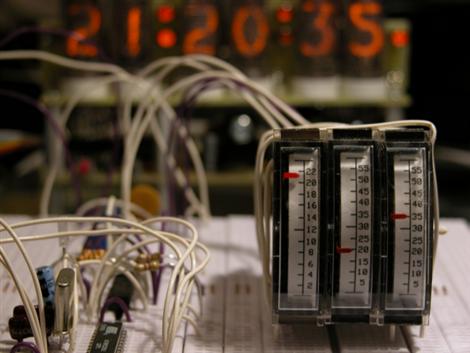
Meter Clock

This analog meter clock was built by [Len Bayles]. Its 3 meters are controlled by an AT89c2051. The circuit itself is very simple, and available on the site. The meters are powered from a DAC, with a quad amp in between to keep the meter from drawing too much current.
[via HackedGadgets]
Control A TV With GLCD Commands
[youtube=http://www.youtube.com/watch?v=t3gMjuVdQnA]
This hack lets you use a TV in place of a graphic LCD screen. But we like to think of this less as a replacement for a GLCD and more of a simple way to get your information onto a television. A PIC 18F452 acts as a translator between the GLCD parallel inputs and a composite video output. There are some malformed image links on the page which we’ve fixed and linked to after to the break so that you can take a look at the schematic, component layout, and PCB artwork. The assembler code and hex file are available for download but you’ll need to register to get access to them.
Working image links:
[Thanks Flacoclau]
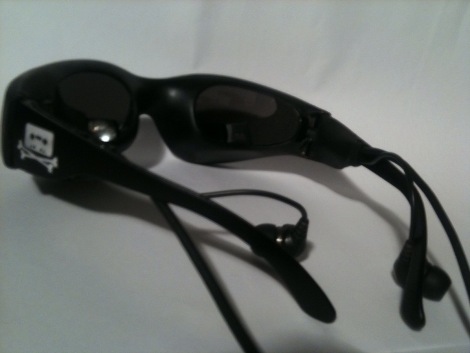
Stylin’ HMD

Watch out, these sunglasses are actually a head mounted display. [Staffan] says he’s wanted dataglasses since ’95, but whats currently out there makes the user look ridiculous, and we have to agree. While his forum posts are a little lacking in detail, he’s promised us more info soon. And for now lets us know at least the resolution, well sort of: Its either 480×1280 or 480x427x3, you can be the judge. Update: [Staffan] has clarified “The resolution is 480*1280 true pixels. It is accomplished by spanning the screen across two Kopin CyberDisplay VGA modules.”
Regardless, [Staffan] is looking for help perfecting the glasses, with what in particular we’re not sure, but the project looks promising and we hope he keeps up the good work.
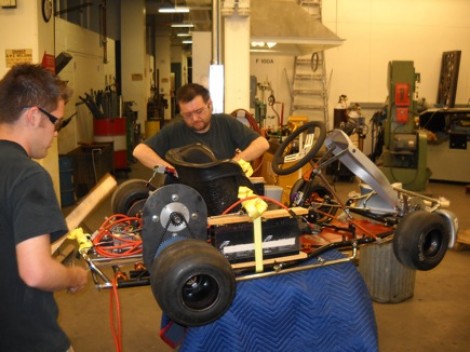
Building An Electric Kart

[Henry Herndon] is working on building an electric kart, mostly with surplus parts. He’s got some experience with electric vehicles but that doesn’t mean the build is going without a hitch. So far he’s come up with a way to make the peculiar motor shaft play nicely with his rig but once everything was put together he had trouble with the chain coming off of the cogs.
We know there’s a lot of links here so far but just a couple more: [Henry] took some shots of the kart chassis before adding the motor, and just for fun, take a look at his scotch tape dispenser. When you’re done clicking on those join us after the break for some test drive footage.
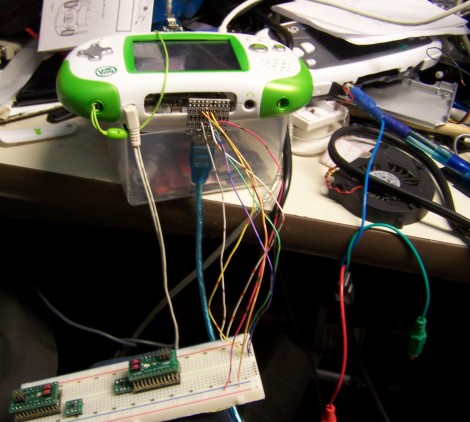
Leapster Explorer Continues The Didj Tradition

Leapfrog has a new device out called the Leapster Explorer. [The Moogle] has been poking around the insides and he patched into the serial bus to get USB host mode running. Because the same cartridge interface is used for the Didj and the Explorer, tools like the DJHI should continue to work. The $70 price tag makes this a no-brainer if you interested in doing some portable hacking. We’ve seen promising Didj hacks such as OpenGL and Video out, hopefully the new hardware will help advance the cause.
Stepping Beyond The Ethernet Shield

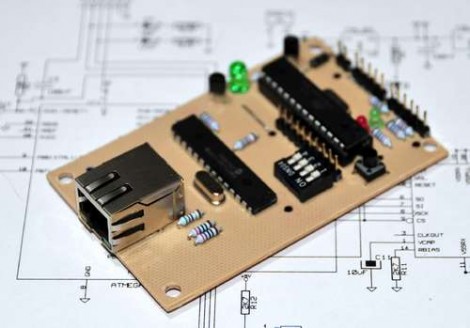
We’ve said it time and again, the Arduino is a prototyping platform. In that spirit, [Doug Jackson] shows you how to conserve the expensive Arduino board and Ethernet shield by building your own Arduino Ethernet module. You may remember the ENC28j60 as a NIC for your microcontrollers. [Doug’s] board makes use of that chip and adds an ATmega168 with a crystal, power regulator, breakout pins, and even a few DIP switches which can come in quite handy.