Velosynth Annoys Those Around You As You Ride

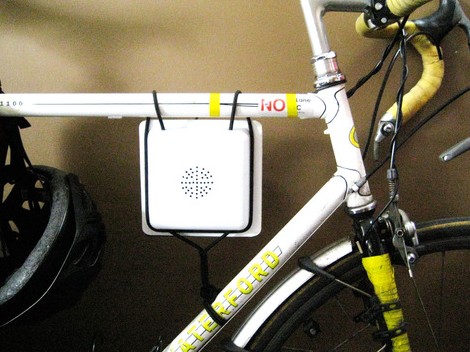
We’ve always put stock in ‘the quieter the better’ when it comes to road bikes. You’ll find this truth if you spend 100k on the back wheel of someone with a sqeaky rear derailleur. But apparently the folks at Effalo never learned this lesson as they’ve produced a bike computer that generates noise as you ride.

Perhaps it just takes some ingenuity to turn this into a beautiful music maker along the lines of the Force Trainer hack. No problem because the velosynth is a hackable design. The case was made with a vacuum form and inside you’ll find a bunch of small breadboards. The JeeNode, which is an Arduino/Xbee combination, serves as the heart of the device by taking speed and acceleration data from the bicycle wheel. From there it is passed on to various modules, Bob’s your uncle, and sound comes out. Check out their sales pitch after the break and if you’re starting to get some ideas about using this check out the open source info they’ve provided.

Continue reading “Velosynth Annoys Those Around You As You Ride” →

Talking Poker Timer

[youtube=http://www.youtube.com/watch?v=k8iIuPnXzm8]

This interesting box of buttons is a talking poker tournament timer. Full of useful tools like a binary time display, words of wisdom, countdowns to the end of the game, and even good old “bicycle built for two” mode (around 1:20).  While we find it fairly difficult to understand, we applaud the feature list, especially the song.  He used an Arduino with a voice shield, so there’s not much to the electronics side, but you can download his source code from his site.

[via Makezine]

X-Band Linear Rail SAR Imaging

[Greg Charvat] really wanted high resolution X-Band linear rail SAR imaging system. He wanted it bad enough to scrounge through parts at HAM radio swap meets until he had the bits to build one himself. The unit is used to take high resolution radar imaging. For example, the image above is constructed of push pins behind a foam wall. The synthetic aperture radar system came in at roughly  $250. Not bad at all. You may have to dig through the links a bit to find the build information. Be sure to check out the hardware gallery and the schematics(pdf).

[via Makezine]

Student Soaker, Wireless Water Gun

[youtube http://www.youtube.com/watch?v=0aaQIkLkSIo%5D

As far as pranks go, [Austin Shaf’s] wireless hidden water gun is a real treat. The video above goes over a brief explanation and shows the setup in action. The prankster holds onto a wireless AVR remote, and when the unsuspecting victim walks by, he activates a second AVR controlling a pump; spraying water everywhere.

While most of us are out of school by now, the project would still be a fun office or perhaps street prank. If you’re one for registering, schematics and source code can be found at AVRFreaks. Alternatively, check after the jump for a copy of both.

Related: Office Pranks, and Water Guns.

Continue reading “Student Soaker, Wireless Water Gun” →

The PR2 Calls The Shots

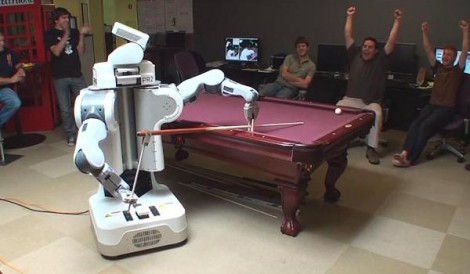
Can you beat this robot at pool? This sparks something of a “let the wookie win” attitude for us, but we still love to watch the video. This is the PR2 playing pool thanks to the folks over at the Willow Garage. It uses a laser sensor to detect the legs of the pool table, and cameras to find the diamonds and balls at the playing surface rather than using an overhead camera. They cut down on the coding work needed by using FastFiz, an open source Billiards physics library. The final step was building an interface so the robot could use a cue. Check it out after the break (no pun intended).

Continue reading “The PR2 Calls The Shots” →

Replacement Speedometer

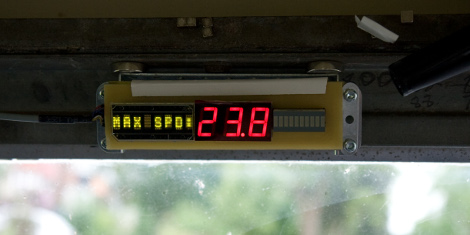
[Howard] built his own replacement speedometer for his truck after the original speedometer cable broke. He’s using surface mount components and produced a two-board design that is quite nice. When he tipped us off he mentioned that this is Arduino powered and uses a hall effect sensor. There’s not talk of this in his writeup but we gather that he’s just using the bootloader on an AVR chip and that he hall effect sensor measures the rotation of one of the wheels. When the vehicle isn’t moving the board alternates between max speed and trip distance. Once he’s on the roll it shows current speed.

Building A Cluster Of IPaq PCs

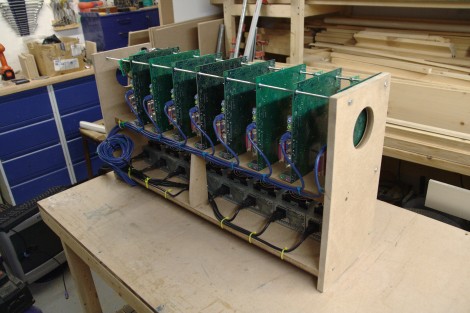
[Steven Pigeon] got his hands on ten iPaq computers that a friend acquired through an eBay auction. The older machines were in good condition but the march of technology had left them behind as casualties. He’s given them new life by assembling a cluster. The first order of business was testing the hardware to make sure it’s working. [Steven] used memtest86+ that comes along with the Ubuntu distribution of Linux to find one bad memory chip in the bunch (a revelation that took 10 hours to discover on the slow hardware). He assembled the unit above with MDF as a support structure and threaded rod to hang the boards. He ended up with a beautiful module and his next step is to choose the operating system that will pull the whole thing together.

We find this build every bit as beautiful as the file cabinet cluster. It’ll be interesting to check back with him and see what kind of performance he can get out of it.