Resurrecting ISA Hardware

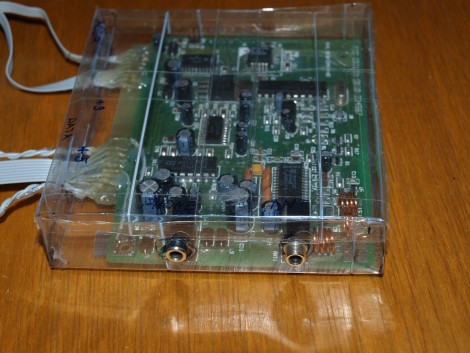
[Alex] had an old FM radio tuner card come his way. It used an ISA connector, a standard that went the way of the dodo in the mid-nineties. With the challenge of implementing an ISA-bus to configure the card he set out on his mission. What he came up with is a working radio using the ISA card and driven by a PIC 16F877. Join us after the break for schematic, code, and a few details. Continue reading “Resurrecting ISA Hardware” →
Preserving Old Stuff With The Library Of Congress

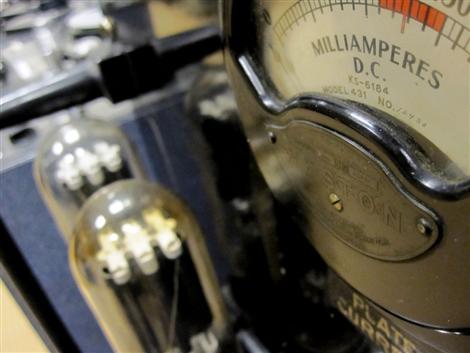
Take a few moments and browse this gallery from the Library of Congress. Tasked with the job of preserving the roughly 150 million historical items, they are constantly developing new methods using bleeding edge technology. There is an odd balance of some of the oldest documents in tandem with some of the newest technology evident in these pictures. From doing spectral scans of ancient books to laser mapping warped phonographs, everything must be preserved and documented.

Baxter The ButlerBot And RoboFridge

[youtube=http://www.youtube.com/watch?v=HvOGwylZOM4]

[Steve Norris] has been devoting his time, effort, and knowledge to the most noble of causes; cool beverage acquisition. Baxter the ButlerBot and RoboFridge work in tandem to deliver cold ones when needed. As you can see in the video, this possibly over engineered system works quite smooth. Though the details on his site are pretty limited, browsing his Flickr stream will get you all those delicious construction photos you crave.

[via Flickr]

Distributed Flight Array

[youtube=http://www.youtube.com/watch?v=7iHZKMDvdNI&w=470]

Though it is in the beginning stages of development, the Distributed Flight Array is already looking very interesting. Each unit can scuttle across the ground using the down force from its prop, but when 4 or more join forces, they can take off and fly. The documentation shows that they should be smart enough to fly in random configurations, though in the video we only see the standard 4 prop layout. This is being worked on by the same people who produced the balancing cube.

[via BoingBoing]

DUO 128 Elite, 4 Bit CPU

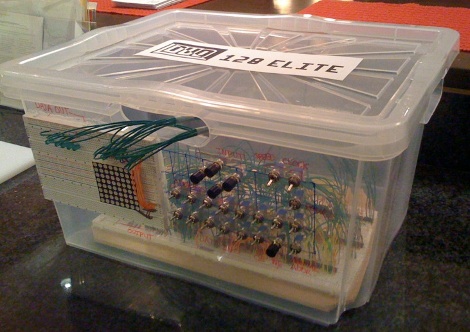
We’re not sure how we missed [Jack Eisenmann’s] 4 bit TTL CPU when we were tipped off the first time, but we’re glad it was sent in again for us to feature it.

41 different ICs (mostly TTL) come together to comprise the DUO 128 Elite. While the architecture is a little different than what we’ve seen before, using “nyckles”, the DUO 128 Elite still works perfectly. Catch a video of some example programs, including pong, after the divide.

[Thanks Marc G-C]

Continue reading “DUO 128 Elite, 4 Bit CPU” →

An Arduino Watch You Would Actually Want To Wear

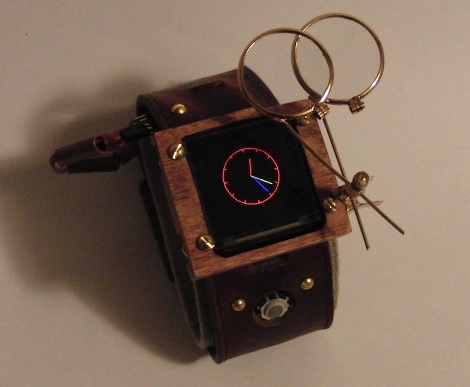
Leather work, copper tubing, small easy to use package. Now that is a beautiful Arduino Watch. [Matthew Garten] has retrofitted his old Arduino Watch and given us the details that we crave.

Previously, all we had was a video and a few pictures of a quite uninviting watch. But now we know it has temperature, range finding, and trackball input while displaying time, games, and more with its 128 by 128 pixel OLED 16 bit display. And did we mention the much more enticing steampunk case?

Getting Your Message Across At Commencement

[Yomagaocho] is graduation from Northwestern University on June 18th (wow that’s late in the year… they must be on quarters). He decided to spice up his mortarboard for the commencement ceremony. A normal message wasn’t good enough, and even a solar-powered diorama wasn’t going to suit him. Instead he added 256 addressable LEDs to the top so that he can get his message across without being limited to a couple of words. See it demonstrated after the break.

He was nice enough to give us the technical details. The matrix is a 16×16 grid mounted in some laser-cut black acrylic. We immediately wondered about the display working in sunlight (a June graduation will probably be outside). He didn’t use any current limiting resistors with the LEDs, dangerous to the longevity but this should provide maximum brightness. It’s certainly a geeky concept, but having the ribbon cable that controls it trailing down into your robe might make those graduation photos a bit embarrassing a few years down the road. Continue reading “Getting Your Message Across At Commencement” →