Possibly The Most Beautiful Piece Of Hardware

[youtube=http://www.youtube.com/watch?v=lNAKL9qtnIA]

I’m going to break from the typical Hackaday article format for a moment. I’m smitten, captivated by this wondrous new discovery. Forgive my ignorance for having never seen one of these before, I didn’t go to school for electronics. For those, who like myself wondered, what is this beautiful glowing thing, it is a mercury arc valve rectifier.

This is not some chintzy attempt at neo victorian styling (steampunk if you absolutely must), this is an actual piece of electronics used in the field. Widely used to convert alternating current to direct current for railways and street cars, these could actually be found in the wild. There was a time, that opening a door in a power station would have presented you with this fantastic green and purple glowing orb, dripping mercury sparkling inside. If you are anything like me, you would most likely have been frozen in your tracks, convinced you were bearing witness magic.

[via Make]
When Multimeters Go Boom

[youtube=http://www.youtube.com/watch?v=M-FZP1U2dkM]

Ever wondered how expensive versus cheap multimeters hold up to abuse? [Dave] gives us a pretty good idea by, well, blowing them up. He’s using a capacitor bank to put roughly 4.2 KiloVolts into the poor little meters. If you absolutely must skip to the multimeters, go to about 5:00. You really will miss out on some good stuff though.

[via HackedGadgets]

Remote Operated Underwater Vehicle

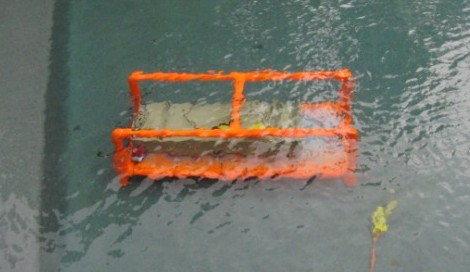
PVC hull, SLA batteries, Bilge Pumps, sounds like a good start to [Jimmy’s] ROV project. Paintball gun (as a BCD), dual live cameras paired with an Arduino making it internet controlled, all tethered with a fiber optic cable, sounds like [Jimmy’s] ROV got a whole lot more astounding.

While some very important parts have yet to be implemented, like the leak detectors, the project looks to be going quite smoothly. With updates promised, we can’t wait to watch this continue until the end.

Related: Yellow Subs and double ROVs

Answers.hackaday.com Is LIVE

Quick, go to answers.hackaday.com and sign up for an account. Ages ago, we announced that we would be bringing a community driven question and answer system to Hackaday. We eventually got tired of waiting for the feature to be provided and improvised. Well, the wait is over. You can now post your own questions and answers. Go nuts, post away, but remember to be respectful. We’re still figuring out this system ourselves, so be patient with us as well.

Be warned, we’re going to be pretty strict on trolling.

It is worth noting that there is a money system integrated into it. This means that you can offer a real reward for answers to your questions. You certainly don’t have to though.

Paintball Graffitti

Paintball as a large format printer? That’s exactly what facade printer is. A paintball gun was mounted with two controllable axes of movement. A computer reads in the image data and prints it out by shooting paintballs to form a dot-matrix display. There’s a couple of wins here, the paintball paint can be washed off, and this will work on coarse or uneven display medium. Check out a video of the printing process after the break.

If you already built your own paintball turret, give the other guys and chance and hack it to print instead of gunning down unsuspecting adversaries.

Continue reading “Paintball Graffitti” →

Laser Command Game Uses Laser For Control

[vimeo=http://vimeo.com/10819322]

[Eliji Hayashi’s] project for a class at Carnegie Mellon University is absolutely delightful! It is a game he calls Laser Command because a laser pointer is used as the gaming controller. An 8×8 LED matrix serves as the display, but is also used as an 8×8 light sensor, much the same way as the LED advent project did. The display is rapidly switched between producing light and sensing it. The laser is bright enough that it becomes easy to pick up the voltage generated within the matrix during the sensing periods. The game is programmed on an Arduino mini and the whole thing wraps up into an incredibly small package. Brilliant.

[Thanks Juan]

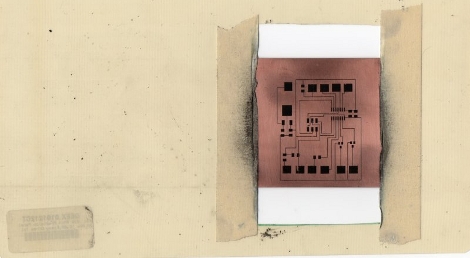
Print Toner Directly To A PCB

We use the toner transfer method to fabricate printed circuit boards. The most difficult part of this is printing, ironing, and removing the paper from the toner that is used as an etchant resist material. [Mark Lerman] is developing a method to apply toner directly to the copper clad using a laser printer. Each of the photos in his gallery have comments that take us through his process. A laser printer has been modified to negatively charge the copper plate, thereby attracting the positively charged toner to it. Once the toner has been applied, the board is baked in an oven, then run through a laminator. This process can yield 2 mil traces and it looks like the potential for incredibly clean boards is just around the corner. The question is, will this be easier and take less time than using photo resist?

We’ve contacted [Mark] in hopes of getting more details. If you can’t wait for a follow-up, take a look at this thread concerning his work.

[Thanks Komradbob]