Phaser-to-laser Mod Puts Out 465mW

Here’s another Star Trek phaser toy with a laser added. [Jay] started with a 1994 Star Trek phaser and added a 12X Blu-Ray diode. The sound effects of the toy still work, a nice touch that you can check out in the video after the break. That video shows him popping balloons with the laser, a feat made possible by the 465 mW that it puts out when the diode is driven at 320 mA of current. He’s made a nice carrying case for the weapon but we didn’t see a spot in there for protective glasses like we’ve seen with other phaser hacks. He did make one safety consideration by adding a safety switch and indicator LED to signal when the laser diode is armed.

Continue reading “Phaser-to-laser Mod Puts Out 465mW” →

AeroQuad – Build Your Own Quadcopter

It hurts us to look at this quadcopter, agonizingly so when we watch the video after the break. That’s because we feel the unstoppable compulsion to build one. This four-rotor helicopter has a lot to be proud of; it features Gyro stabilization, Xbee remote control for very long distance operation, and computer interface for data graphing and calibration.

We like the quadcopter that we came across at CES but building one of our own is more fun than buying it ready-made. The pain we’re feeling is mostly in our pocketbook. To help ease the agony we scoured the parts list and the assembly instructions in order to get an estimate of what this might cost. We’re looking at around $415 plus shipping, not including transmitter and receiver for controlling it.  Yep, that’s a sharp stabbing pain but we’re not sure we can just let it go.

Continue reading “AeroQuad – Build Your Own Quadcopter” →

GSM Car Starter

It’s just starting to warm up around here but it was very cold for a long time. We’re not fond of going anywhere when it’s way below freezing but those professional hermit opportunities never panned out so we’re stuck freezing our butts off. Fed up with his frigid auto, [Aaron] installed a remote starter to warm the car up before he got to it. This didn’t help at work because of the distance from his office to the sizable parking lot is too far for the key fob’s signal to carry. He decided to make his starter work with GSM so he could start the car with a phone call.

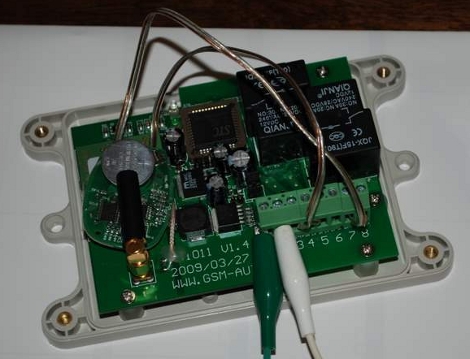
The first attempt involved a pre-paid cell phone for $30. The problem is that anyone who called the phone would end up starting the car. After a bit of looking he found a GSM switch that just needs an activated SIM to work. When called, it reads the incoming phone number for authentication but never picks up the phone so there’s no minutes used. He cracked open an extra key-fob and wired up the lock and start buttons to the relays in the GSM switch. Bam! A phone call starts (and locks) his car.

Maybe this isn’t as hardcore as body implants but it’s a fairly clean solution. He uses the car’s 12v system to power the switch and pays $10 every three months to keep the SIM card active. There’s an underwhelming demonstration video after the break showing a cellphone call and a car starting. Continue reading “GSM Car Starter” →

A Day At The Lake For The Disabled

We do a lot of useless hacks just for the fun of it so when we see something with purpose it’s pretty exciting. This hack turns any kayak into a motorized vessel that can be controlled by a quadriplegic person using a sip & puff interface. After the break you can see some clips of navigation and an explanation of the hardware.

[Mark’s] system starts by adding outriggers to a kayak to prevent the possibility of the boat rolling over in the water. Each pontoon has an electric trolling motor attached to it that is controlled by an Arduino via a motor driver.

The Arduino takes navigational commands from a sip & puff controller. A straw in the operator’s mouth allows them to sip or puff for a split second to turn left or right. Longer sips or puffs control forward and reverse incrementally, up to a top speed of about 3.7 miles per hour. [Mark] incorporated an auxiliary remote control interface so that a safety observer can take control of navigation if necessary.

His build came in around $1300, a tiny cost if this makes kayaking available to several people each summer. Great job [Mark]! Continue reading “A Day At The Lake For The Disabled” →

Home Made Small Form Factor LED Projector

[youtube=http://www.youtube.com/watch?v=mQ8Kq2wLrf0]

[Newtonn2] dropped a tip in our inbox this morning that made us quite happy. This is a step by step build of a small form factor LED based projector. While the size may not get some of you too excited at first, those of us who have built projectors before know that home made ones are usually quite large. This one is roughly the size of the small office projectors you would see in a large retailer.  He’s using a 30 watt LEd for the light and we didn’t notice a lumen measurement anywhere, but it looks bright enough to be watchable. Pictures usually turn out dark, so in person, the projection probably looks more bright and crisp. Now he just needs to find a high definition LCD that size.

Spherical And Stereoscopic Photography

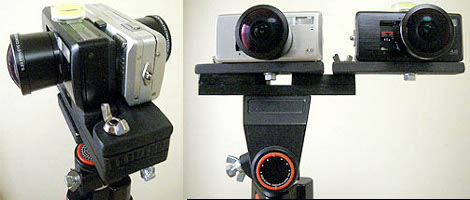
[Ryubin’s] experiments with spherical video continue. This time around he’s using two cameras, both with fisheye lenses, to capture 360 degree by 360 degree video. The two cameras mount back to back and each record a 360 degree vertical view in a 180 degree horizontal range. By stitching the two recordings together and synchronizing them by comparing moving objects a seamless spherical video is produced.

He’s got one more trick up his sleeve with this setup. The tripod mount has a pivot point that allows the two cameras to shoot side-by-side instead of back-to-back. This produces a hemispherical video that is stereoscopic. That’s a pretty cheap way to make this type of 3D imaging compared to some of the CES offerings.

There are a few example videos up on his webpage. If you missed it earlier this month, he’s the guy that build a spherical video setup using a light bulb.

Start The Car With A Wave Of Your Hand

[Jair2K4] likes his RFID almost as much as he likes his chaw. Ever since his car was stolen he’s had to start it using a screwdriver. Obviously this is not a good way to leave things so he decided to convert his starter to read an RFID tag. He installed an RFID transponder he picked up on eBay, wiring it to the ignition switch. He’s removed the clutch-check sensor and wired a rocker switch to enable the RFID reader. We presume the rocker switch will eventually be used to shut the car off as well.

While most would have purchased a key-chain RFID tag, [Jair2k4] went far beyond that and had the tag implanted in his hand. This is an honor usually reserved for pets and until he adds RFID functionality to the door locks maybe a key fob would have been a better answer. But, to each his own. See his short demonstration video after the break.

Continue reading “Start The Car With A Wave Of Your Hand” →