ARM Cortex-M3 Prototyping On A Budget

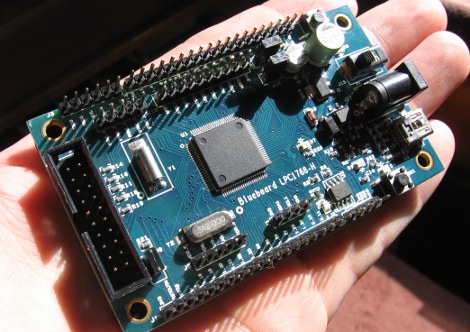
NGX Technologies sent us this Blueboard LPC1768-H to play with. It’s basically a breakout board for an NXP LPC1768 ARM cortex-M3 microcontroller (datasheet). The board adds a few extra goodies, such as a choice of mini-USB connector or barrel-jack to provide regulated power to the chip. There’s also a clock crystal for the internal RTC and an Atmel 256kb EEPROM chip. This chip has 70 I/O ports, accessed through the pin headers on top and bottom of the board. The 20-pin header to the left is for a JTAG programmer (yes, you’ll need a separate programmer). Coming in at only $32.78 this is a very accessible route for projects that require more power than some of the traditional hobby controllers. The shipping seems to have come down since NGX’s last offering, now it would be under $10 to ship to the States.

The LPC1768 is the same controller from the mbed that we reviewed. What’s missing is some of the interface hardware and the boot-loader, but the tradeoff comes with a $66 savings. This is to mbed what an AVR board is to the Arduino, a way to get even closer to the hardware.

There are a few things we think are missing. Most notably, there isn’t a datasheet or user guide for the board itself.  The only information available is a schematic (PDF), but that should be enough for those already well versed in working with microcontrollers. There is also a 12MHz clock crystal on the board but it doesn’t seem to be jumpered in case you wanted to use a different frequency. We’re not sure if this is much of an issue, the internal RC oscillators offer a lot of flexibility including operation up to 100MHz.

We feel this is a solid platform that will help to get more people into ARM development because of its low price. Let us know your thoughts in the comments.
Arduino Balloon Tracking

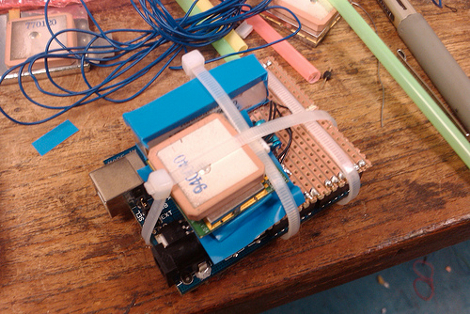
The Ferret is a high-altitude balloon tracking hardware package. Created by [Adam Greig] and [Jon Sowman], it uses an Arduino to gather NMEA data from a GPS unit, format the data into a string, and transmit that string on narrow-band FM. The project, built in one afternoon, is a tribute to the prototyping simplicity the Arduino provides.

The unit was powered by four AA batteries, using the Arduino’s on board voltage regulator. This provided a bit of heat which helps in the frigid reaches of the upper atmosphere. The bundle above was put in a project box and attached to the outside of the balloon’s payload, then covered with foam for warmth and moisture resistance. This tracking is a lot less complicated than some of the photography setups we’ve seen for balloons. It’s also more versatile because it broadcasts the GPS data so that many people can track it, rather than just logging its location.

Quad-copter Controlled With Voice Commands

[youtube=http://www.youtube.com/watch?v=7nUq28utuGM]

In the video above you’ll see two of our favorite things combined, a quad-copter that is voice controlled. The robot responds to natural language so you can tell it to “take off and fly forward six feet”, rather than rely on a cryptic command set. The demonstration shows both an iPhone and a headset used as the input microphone. Language is parsed by a computer and the resulting commands sent to the four-rotor UAV.

This makes us think of the Y.T.’s robot-aided assault in Snow Crash. Perhaps our inventions strive to achieve the fiction that came before it.

[Via Bot Junkie]

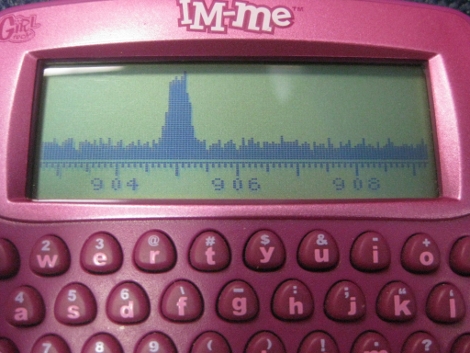
IM-ME Spectrum Analyzer

[Michael Ossmann] rolled out some firmware that makes his IM-ME into a Spectrum Analyzer. He met up with [Travis Goodspeed], who authored the IM-ME flashing guide, at SchmooCon and spent some time hacking wireless doo-dads in the hotel bar. Once he arrived home the new firmware was just a few coding sessions away from completion. It scans one frequency at a time, displaying the results in a 132 column graph on the screen. He also added a ribbon cable and header to the debug contacts so that future hacking would be as simple as plugging in the GoodFET.

[Thanks Jared and Travis]

Make Your Own OLEDS

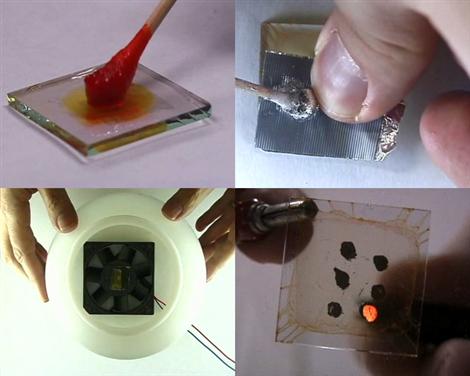
The University of Wisconsin is hosting a tutorial on how to make your own Organic Light Emitting Diodes. This is so amazingly awesome. We want you guys to make some. Someone make your own matrix and display some patterns on it and submit it. Please. Though we’ve seen lots of uses for OLED screens, we never really delved into the process of creating them. It looks much less complicated than we would have imagined.

[via MakeZine]

Bill Paxton Pinball

No, your eyes do not deceive you, you are looking at a [Bill Paxton] pinball machine. [Ben Heck], commonly known for his portable gaming system modifications has finally finished his pinball machine build. We’ve had our eye on it ever since [Jeri Ellsworth] challenged him to see who got theirs done first. As you can see, he’s done a fantastic job on the machine itself. He has also documented it fantastically, there’s a build log, a gallery, demonstration videos etc.

[thanks Matt]

Adding An Automotive Cold Air Intake

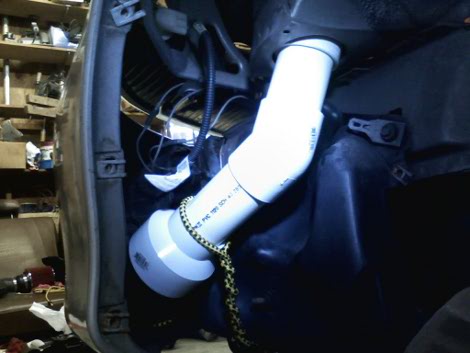
[Thomas] and a buddy were sucking down a few brews when they decided to hack their 2001 Chevy Cavalier for a bit better performance. If they could find a way to bring cooler air to the engine they speculated that they’d see an increase in efficiency. Instead of routing the air intake to a hood scoop, they took off the factory air filter and mounted a cold air filter in its place. PVC pipes were then used to create a delivery path from the front of the vehicle with the output in close proximity to the new filter. They tested their work and discovered a drop in intake temperature from 101 to 48 degrees Fahrenheit at 60 mph, and from 109 to 54 degrees Fahrenheit at 45 mph. Now the sedan runs better and generates more horsepower, all for around $35 in parts.