Motion Sensing Camera Hack

[youtube=http://www.youtube.com/watch?v=xlTyCymEM9g]

Researchers at the University of Liege have developed an algorithm to separate movement from background. They call it ViBe and this patented piece of code comes in at under 100 lines of C. Above you can see the proof of concept shown by hacking the code into CHDK, a Canon PowerShot alternative firmware. The package is available for non-commercial use and might be just the thing you need to get your project to recognize where it needs to serve the beer.

[Thanks Juan via Slashdot]
Arduino Based Multiboot Cable For Game Boy Advance

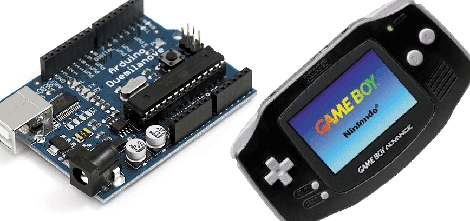
[Steve] wanted to do some ARM development and set his sights on the Game Boy Advance as a development package. In order to get his code onto the device he build an Arduino-based communications cable. It is necessary to have a microcontroller involved because the GBA uses a peculiar 16-bit serial communications protocol. This cable is an adaptation from the 8051-based cable developed by [Matt Evans] several years ago. [Steve’s] got it working by porting the 8051 assembler over for the Arduino, but we’d recommend adding a level converter to his hardware setup to step down from the Arduino’s 5v logic to the 3.3v logic the GBA expects.

He didn’t make up a wiring diagram, but in the code comments [Steve’s] laid out the connections as follows:

Arduino 8 to GBA SO
Arduino 9 to GBA SI
Arduino 10 to GBA SD
Arduino 11 to GBA SC

That’s it, follow the README in his source code package and you’re on your way to some ARM development.

Ditch The LPs And Build Your Own 3D Scanner

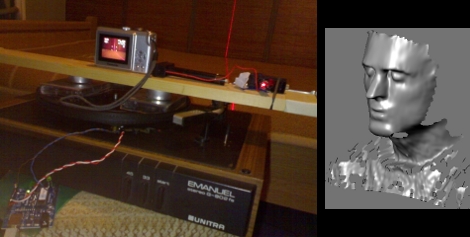
Find yourself an old record player, a laser level, and a digital scanner and you can build a 3D scanner. That’s what [Rob] did. The camera and laser level are mounted on the turntable for steady rotation. The camera captures the vertical laser line traveling around the room by recording 30 fps at a resolution of 640×480. This data is then translated into a Blender 3D file via a Python script and the Python Image Library. You can scan a whole room or just a small object. The face above is the result of this image capture after a bit of processing. [Rob] found this worked best in the dark and when scanning surfaces that are not reflective.

Make sure you also check out the camera-and-projector scanning method.

Google Summer Of Code 2010

Today’s the day the Google announces this year’s participant organizations in the Google Summer of Code. If you’re not tied down to a job this summer we hope you’ll take advantage of this opportunity to learn by doing and contribute code to a great open source project all at the same time.

A lot of our favorite software has benefited from GSoC in the past. XBMC has participated before, as well as WordPress, Asterisk, MySQL, Bluez, Natural User Interface Group, and many more.

Student applications are accepted between March 29th and April 9th. If you’re accepted in the program and excel at your work with passing grades at mid-term and final project dates, you’ll see your pockets grow by $5000. Get out there and put your mad coding skills to good use while you have the chance.

LED Lighting, A Learning Experience

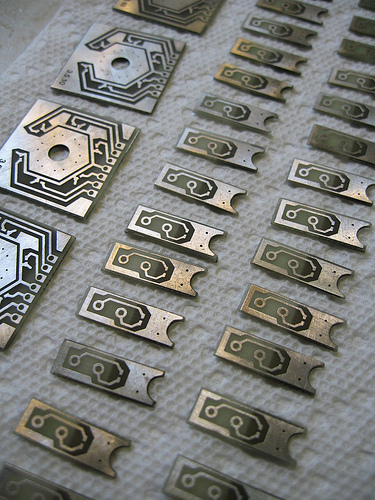
[Joel] has a very specific color temperature of lighting he wants in his home. So specific, he’s decided to build his own LED lighting to get it. Actually, he’s still searching for that perfect shade of white, but doing so has learned a lot.  He initially made some very pretty PCBs, but then found that hand soldering them made quite a mess. What better time to delve into reflowing? He shares his positive initiation to the skillet method in his latest update. The search still continues for that nice warm glow he’s desiring. We’ve actually seen [Joel] before, he likes smoked meat.

PCB Drill Press On A Budget

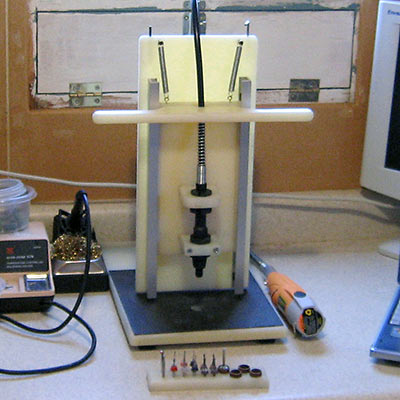
An accurate drill press is an essential tool for making your own through-hole printed circuit boards at home. Reader [Josh Ashby] offers up a solid design using scrap bin materials.

A major issue with PCB drilling is that even the slightest horizontal play will snap the delicate carbide drill bit. Hobbyist-grade tools such as Dremel’s drill press attachment are usually too sloppy for this task, while a more precise instrument might set you back a couple hundred bucks.

[Josh’s] design uses a nylon “sled” moving vertically in an aluminum u-channel track. Most of these materials were salvaged or were acquired inexpensively from a local hardware store, and assembled in less than a day. Surprisingly, this low-tech approach has proven sufficiently smooth that he’s yet to break a bit while drilling. And the entire setup, including the knockoff Harbor Freight rotary tool, cost less than the wobbly name-brand accessory alone.

Woot How-to: Let There Be Light! (for Your Rovio)

Before we get into the how-to, we felt it would be appropriate to explain a little bit about how this came to be. As many of you may remember, a couple of months ago we attended CES 2010. While there, we also attended the It Won’t Stay in Vegas Blogger party and ended up meeting the guys from Woot. After all of us spent a little bit of time appreciating the open bar, a group of us stood ended up standing around and talking shop for a while. All of a sudden, a member of our group, Jeremy Grosser, proposed the idea that Hackaday and Woot form a partnership. Basically, they would give us a heads up on what they are going to sell and we would write up a how-to on how to do something cool or useful with that product. Then, when the day came for Woot to sell the product, we would post our how-to. What you are reading right now just so happens to be that idea in action, the first official partnership between Hackaday and Woot. In this how-to, we’ll be taking apart the Wowwee Rovio mobile webcam robot, adding some super-bright LEDs for better see-in-the-dark action, and see how some software called RoboRealm can give it a little bit of artificial intelligence.

Continue reading “Woot How-to: Let There Be Light! (for Your Rovio)” →