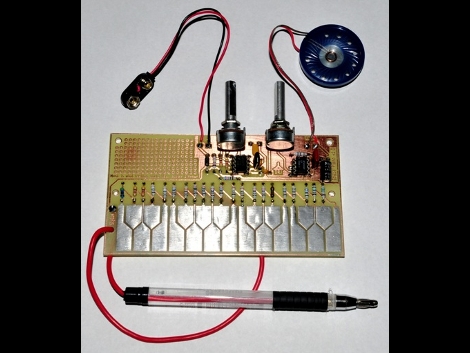
Analog Stylophone

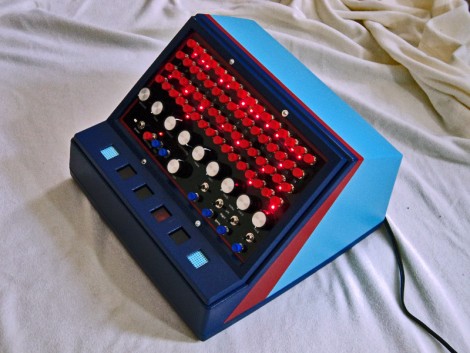
[Doug Jackson] just finished building an analog Stylophone. We’ve seen this instrument a few times before, most recently with an Arduino-based controller, but this one makes use of 555-timer, resistors, and potentiometers to generate the waveform for each note. If you’ve got the copper-clad and the means to etch the board everything else should be pretty easy to come by. We did note that since this is a single-sided board you’ll be soldering on the same side as the components, which can get a bit hairy but manageable. We just wish that [Doug] has posted a demonstration video so we could hear what this sounds like. But it can’t be too much different from that electronic vuvuzela that used a 555 timer as well.
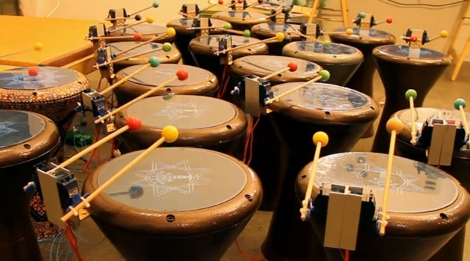

Darbuka Band

This robotic band has just the right amount of drums. [Liat] and her colleagues fit a group of Darbuka drums with a pair of servo-driven mallets. We’re quite surprised that the servo motors achieve such a successful strike and rebound without dampening the vibrations of the drum head. This is more often accomplished with solenoids because of their quick response and relative strength.

You can listen to a performance of this work-in-progress in the video after the break or make plans to see it live. The installment was built for the Bat-Yam international biennale of landscape urbanism. It will be attached to, and powered by alternative energy producers like solar cells and wind turbines. Continue reading “Darbuka Band”

76 Flaming Trombones Led The Big Parade

[Jonathan Crawford] is ready and willing to fire things up with his flaming trombone. A couple of years back his band teacher was going through the storage room triaging instruments. This trombone suffered from a bad case of red rot and would never function well again so [Jonathan] was able to get his hands on it and get to work.

He started by sanding down the instrument and painting it with high-temperature spray paint. Flexible copper tubing intended for an ice maker was used to relocate the propane outlet inside the bell of the instrument. A barbecue igniter, controlled with the player’s left thumb, lights the flame.

The torch that [Jonathan] is using would only allow a small amount of gaseous propane to come out the nozzle. He ended up drilling out the aperture, and using a short piece of vinyl tubing to bridge the gap between the nozzle and the supplementary copper tubing. At full blast this allows liquid propane to escape so be warned.

You can see him demonstrating this indoors in the video after the break. He mentioned to us that the first time he tried this out he set off the smoke detector. You’ve got to be careful when playing with fire, whether it’s a musical instrument, or a wearable flamethrower. So, you know, don’t try this at home. Continue reading “76 Flaming Trombones Led The Big Parade”

Self Playing Bayan Built Nearly 22 Years Ago

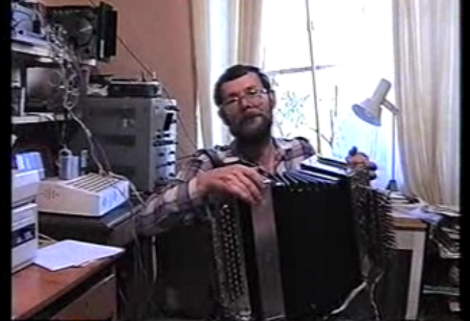
The year is 1988, where a Russian engineer [Vladimir Demin] has combined a Bayan, or button accordion, with several (we lost count at about 96) solenoids. If that alone doesn’t blow your mind the computer, also hand built by [Vladimir], controls the whole process leaving the operator to only work the bellows. Putting truth to the fact in Soviet Russia, accordion plays you. We wish we could find some more information about the instrument, but curse our inability to read Russian. Alas check after the break for a shorter version of the video in the link above.

Related: Electronic accordion doesn’t compare.

Continue reading “Self Playing Bayan Built Nearly 22 Years Ago”

Using Videotape Tape As A Controller

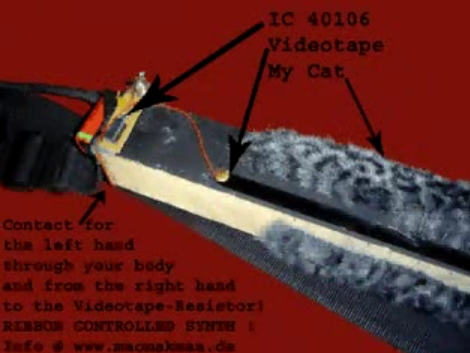
Behold the Bodystick, an instrument built and demonstrated by [Erich Lesovsky]. It’s a bit like a string bass but instead of strings there is a strip of VHS tape. Apparently not all VHS tape will work, but if you have the right kind you can run voltage through it and then change the resistance with a touch of your finger. It seems that the hand not touching the tape needs to be touching a conductive pad, completing the circuit. The resulting resistance changes the oscillator values on a CD40106 CMOS chip. This project is a bit out there (just like [Erich’s] Mega-Tape-O-Phone), and in keeping with its peculiarity is the demo video after the break. Enjoy!

Continue reading “Using Videotape Tape As A Controller”

Chipophone Plays Video Game Classics

This thrift shop organ gets a new life as an 8-bit music maker. Called the Chipophone, it relies on an ATmega88 to produce sounds that you might associate with classic video gaming. [Linus Akesson] takes us through all of the different sound settings in the video after the break, including performances of your theme music favorites.

The original organ uses transistor logic making it rather easy to patch into the hardware. Thanks to the build log we know that [Linus] used 74HC165 input latches to monitor each of the switches for the 120 inputs. Fifteen of these latches work like a backwards shift register 74HC595, cascading all of the parallel inputs into one serial signal. From there the microcontroller takes over, monitoring the keys, pedals, switches, and potentiometers and outputting the appropriate sounds.

Continue reading “Chipophone Plays Video Game Classics”

Programmable Drum Machine

This sequencer, called Drumssette, uses audio tape to churn out some beats. [Mike Walters] built this around a Tascam four track cassette recorder. The tape inside has a different drum sound on each of the tracks, with a corresponding row of red buttons. Pushing a button adds the drum sound to the loop on that beat. He’s using a series of digital logic gates to patch through the sounds as well as clocking the device from one of the tape’s tracks. It’s pretty  neat  to see the focus selector used in the video after the break to sync up the beginning of the repeated drum patterns. This isn’t the first time we’ve seen [Mike’s] work. If you missed it last year take some time to review the Melloman.

Continue reading “Programmable Drum Machine”