Open-Sourcing The Lisa, Mac’s Bigger Sister

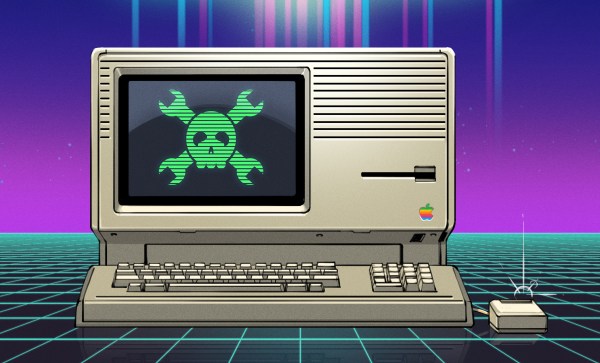
Forty years ago, on January 19th of 1983, Apple released the Lisa, which was in many ways a revolutionary system. On January 19th of 2023, to celebrate the system’s 40th birthday, the Computer History Museum released the source code for Lisa OS version 3.1 under the Apple Academic License Agreement. Written in Pascal, the source includes over 1,300 source files, covering the OS itself, the Lisa Toolkit development system and a number of applications. The questions one might ask at this point include what the Apple Lisa even is, and why it was such an important system in computer history.

This especially in light of the terrible flop that the Lisa turned out to be, with only 10,000 units sold over two years. Part of this failure was definitely due to the introductory price, that was set at $9,995 (over $27,000 in 2021 dollars). Although it featured an OS with memory protection, despite the lack of an MMU on the Motorola 68k, among other advanced features that placed it well beyond other desktop computers of the time, it got quickly crushed in the market by Apple’s MacIntosh, even after successive Lisa successor releases that sought to address its shortcomings.

Continue reading “Open-Sourcing The Lisa, Mac’s Bigger Sister”
New Commodore VIC-20 Build

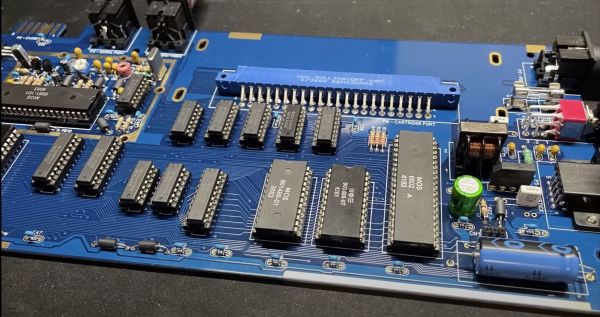
In a recent episode of [The Retro Shack], a new Commodore VIC-20 is built, using a ‘Vicky Twenty’ replacement PCB by [Bob’s Bits] as the base and as many new components as could be found. The occasion for this was that a viewer had sent in a VIC-20 that turned out to be broken, so in order to diagnose it, building a new one with known working parts seemed incredibly useful.

Advantages of the reproduction PCB are a number of board-level fixes that negate the need for certain bodge wires, while also having footprints for a wider range of round DIN connectors. The non-proprietary ICs were obtained along with other standard parts from a retro computing store, while the proprietary Commodore components were scrounged up from your friendly used component selling sites.

The result is what from the outside looks like a genuine VIC-20, and which should prove to be very useful in diagnosing the broken VIC-20 system in the future, as well as presumably to play some games on.

Continue reading “New Commodore VIC-20 Build”

Sequencing The Vintage Way

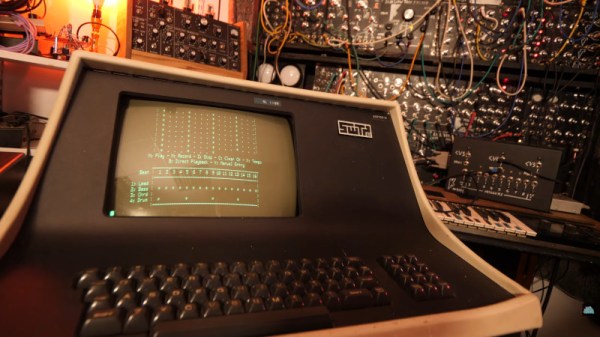
For most of us, an 8-bit microcomputer means one of the home computers which set so many of us on our way back in the 1980s. But this ignores an entire generation of 1970s 8-bit machines which filled the market for affordable office and industrial desktop computing before we were seduced by Pac-Man or Frogger. It’s one of these, an SWTPC 6809, that’s found its way into the hands of [Look Mum No Computer], and in direct contradiction to his branding, he’s used it to control a synthesizer.

As you’d expect from the name, the computer hides a 6809 processor, and comes from the end of the 1970s when that chip had been released in an effort to stave off the market threat from the likes of Zilog and MOS Technologies. It has an SS-50 bus motherboard, and the saga in the video below the break is as much about the production of a custom DAC and trigger port for it to drive the synth as it is about troubleshooting a four-decade-old computer. It’s a credit to SWTPC that the machine is largely working after all this time, however it succumbs to some damage during the development of the interface.

At the end though, there’s a fully functional sequencer on a 1970s computer, playing some pretty good electronic music from an analogue synth. This is EXACTLY the future we were promised, back in 1979!

Long-time readers will know this isn’t the first SWTPC that has graced these pages.

Continue reading “Sequencing The Vintage Way”

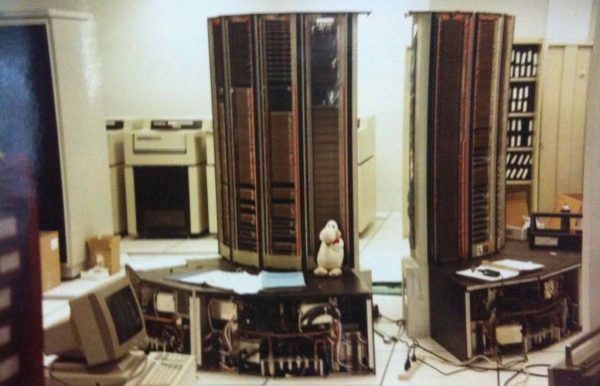
Cray X-MP serial number 302 being assembled (Credit: Andy Gelme)

Running Cray OS And UNICOS On Your Own Cray Simulator Instance

The Cray series of super computers have been pretty much symbolic for high-powered computing since the 1970s, and to this day there’s a certain level of mysticism to them. Much of this is also helped by how rare these systems were and are today. Unlike Commodore, Apple and IBM PC systems which got sold by the truckload, Cray super computers and the much smaller workstation systems were and are significantly more rare. Despite or perhaps because of this [Andras Tantos] embarked on a decade-long quest to bring together what is left of the Cray legacy in the form of the Cray Files.

Part of this is a Cray system simulator that can be found on GitHub as well as online. This simulator allows you to run software written for the Cray X-MP (1982), Y-MP (1988), J90 (1994) and SV1 (1998), which covers essentially all major Cray systems after the Cray 1 and up till when Cray had become part of SGI in 1996. Described in the blog is the extensive archaeological work [Andras] had to undertake to unearth and resurrect these systems. Along the way he got a few lucky breaks, such as when finding two UNICOS CD images on Archive.org, and when people who used to work with Cray systems still had software and such lying around, along with the treasure trove of knowledge contained in their memories.

Although these Cray computer systems are as solidly obsolete as SGI and Sun’s once high-end systems of the 1990s are today, very few would have gotten a chance to use any of those systems, which makes it even more important that they are preserved. As an ongoing project, [Andras] is asking for anyone who might be able to fill in some of the remaining blanks to contact him.

[Heading photo: Cray X-MP serial number 302 being assembled (Credit: Andy Gelme)]

An Unexpected Amiga Network Interface

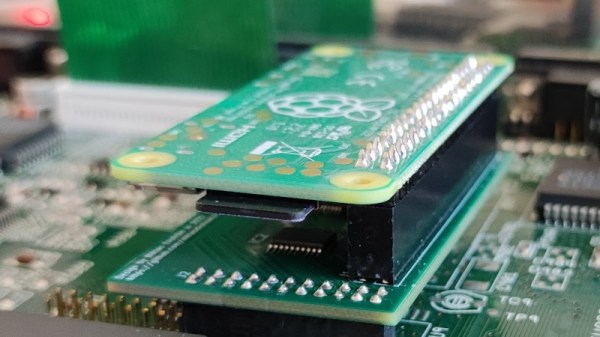
The retrocomputer enthusiast has increasingly to grapple with not only runaway computer prices but the astronomical cost of vintage peripherals. A welcome solution in some cases comes from the Raspberry Pi, which has proved itself fast enough to emulate those add-ons for a lot less outlay. A good one comes from [Niklas Ekström], who’s made a Pi-based network adapter for the Commodore Amiga 1200. Better still it doesn’t hog the main expansion port or the PCMCIA slot, instead it sits on the 1200’s rarely-used real-time-clock port. Software wise it uses an updated version of his earlier project for the Amiga 500. It provides access to the Pi command prompt, as well as a SANA driver and a mounted filesystem.

While many of us view the Amiga from 2023 as a retro gaming platform, for those of us who used it at the time it was a desktop productivity machine on a more affordable budget than the Macintosh. At the time the thought of having a UNIX-like operating system running on a super-powerful co-processor in your Amiga would have been beyond our wildest dreams, but whether it provides enough now to make a 1992 machine compete on the desktop is debatable. Who wants to run Firefox from the Pi in an X server on the Amiga?

Addressable LEDs From A Z80

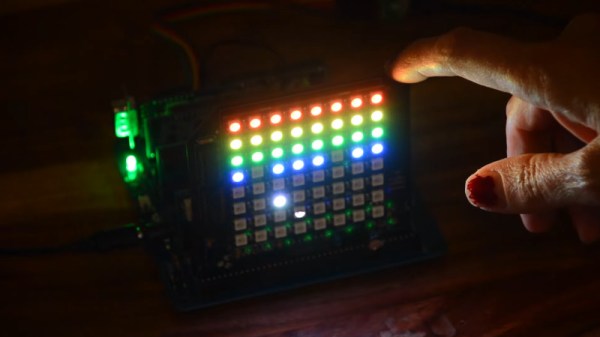
If you buy WS2812s under the Adafruit NeoPixel brand, you’ll receive the advice that “An 8 MHz processor” is required to drive them. “Challenge Accepted!“, says [ShielaDixon], and proceeded to first drive a set from the 7.3 MHz Z80 in an RC2014 retrocomputer, and then repeat the feat from a 3.5 MHz Sinclair ZX Spectrum.

The demos in the videos below the break are all programmed in BASIC, but she quickly reveals that they call a Z80 assembler library which does all the heavy lifting. There’s no microcontroller behind the scenes, save for some glue logic for address decoding, the Z80 is doing all the work. They’re all implemented on a pair of RC2014 extension cards, a bus that has become something of a standard for this type of retrocomputer project.

So the ubiquitous LEDs can be addressed from some surprisingly low-powered silicon, showing that while it might be long in the tooth the Z80 can still do things alongside the new kids. For those of us who had the Sinclair machines back in the day it’s particularly pleasing to see boundaries still being pushed at, as for example in when a Z80 was (almost) persuaded to have a protected mode.

Continue reading “Addressable LEDs From A Z80”

From A 6502 Breadboard Computer To Lode Runner And Beyond

As disruptive and generally unpleasant as the pandemic lockdowns of 2020 were, they often ended up being a catalyst for significant personal growth. That was often literal growth, thanks to stress eating, but others, such as [Eric Badger], used the time to add skills to his repertoire and build a breadboard 6502 computer and so much more.

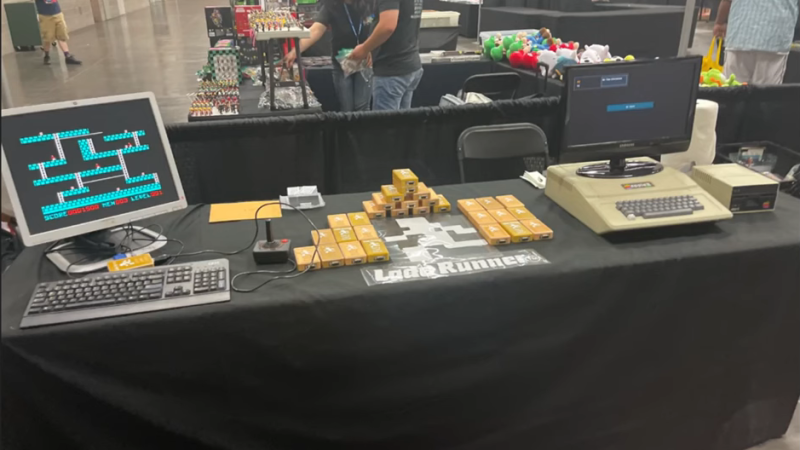
For those of you looking for a single endpoint to this story, we’re sorry to disappoint — this isn’t really one of those stories. Rather, it’s a tale of starting as a hardware newbie with a [Ben Eater] 6502 breadboard computer kit, and taking it much, much beyond. Once the breadboard computer kit was assembled, [Eric] was hooked, and found himself relentlessly expanding it. At some point, he decided to get the classic game Lode Runner going on his computer; this led to a couple of iterations of video cards, including a foray away from the breadboards and into PCB design. That led to a 6502 emulator build, and a side quest of a Raspberry Pi Pico Lode Runner appliance. This naturally led [Eric] to dip a toe into the world of 3D printing, because why not?

Honestly, we lost track of the number of new skills [Eric] managed to add to his toolkit in this video, and we’re sure this isn’t even a final accounting — there’s got to be something he missed. It’s great stuff, though, and quite inspirational — there’s no telling where you’ll end up when you start messing around with hardware hacking.

Continue reading “From A 6502 Breadboard Computer To Lode Runner And Beyond”