An Arduino With A Floppy Drive

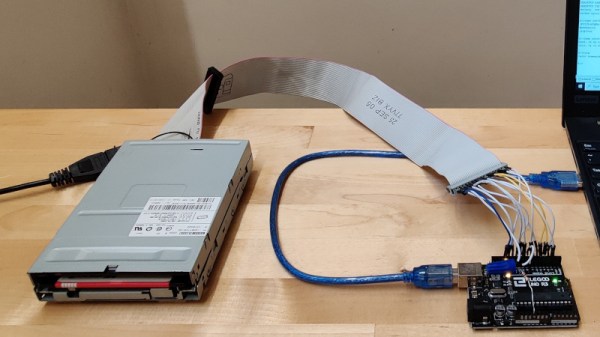
For many of us the passing of the floppy disk is unlamented, but there remains a corps of experimenters for whom the classic removable storage format still holds some fascination. The interface for a floppy drive might have required some complexity back in the days of 8-bit microcomputers, but even for today’s less accomplished microcontrollers it’s a surprisingly straightforward hardware prospect. [David Hansel] shows us this in style, with a floppy interface, software library, and even a rudimentary DOS, for the humble Arduino Uno.

The library provides functions to allow low level work with floppy disks, to read them sector by sector. In addition it incorporates the FatFS library for MS-DOS FAT file-level access, and finally the ArduDOS environment which allows browsing of files on a floppy. The pictures show a 3.5″ drive, but it also supports 5.25″ units and both DD and HD drives. We can see that it will be extremely useful to anyone working with retrocomputer software who is trying to retrieve old disks, and we look forward to seeing it incorporated in some retrocomputer projects.

Of course, Arduino owners needn’t have all the fun when it comes to floppy disks, the Raspberry Pi gets a look-in too.
VCF Swap Meet Takes Step Back To Move Forward

When computers were the sort of thing you ordered from a catalog and soldered together in your garage, swap meets were an invaluable way of exchanging not just hardware and software, but information. As computers became more mainstream and readily available, the social aspect of these events started to take center stage. Once online retail started really picking up steam, it was clear the age of the so-called “computer show” was coming to a close. Why wait months to sell your old hardware at the next swap when you could put it on eBay from the comfort of your own home?

Of course, like-minded computer users never stopped getting together to exchange ideas. They just called these meets something different. By the 2000s, the vestigial remnants of old school computer swap meets could be found in the vendor rooms of hacker cons. The Vintage Computer Festival (VCF) maintained a small consignment area where attendees could unload their surplus gear, but it wasn’t the real draw of the event. Attendees came for the workshops, the talks, and the chance to hang out with people who were passionate about the same things they were.

Consignment goods at VCF East XIII in 2018.

Then came COVID-19. For more than a year we’ve been forced to cancel major events, suspend local meetups, and in general, avoid one another. Some of the conventions were revamped and presented virtually, and a few of them actually ended up providing a unique and enjoyable experience, but it still wasn’t the same. If you could really capture the heart and soul of these events with a video stream and a chat room, we would’ve done it already.

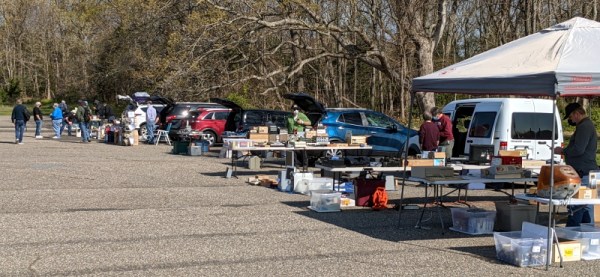
But this past weekend, the folks behind VCF East tried something a little different. As indoor gatherings are still strongly discouraged by New Jersey’s stringent COVID restrictions, they decided to hold a computer swap meet in the large parking lot adjacent to the InfoAge Science and History Museum. There were no formal talks or presentations, but you could at least get within speaking distance of like-minded folks again in an environment were everyone felt comfortable.

Continue reading “VCF Swap Meet Takes Step Back To Move Forward”

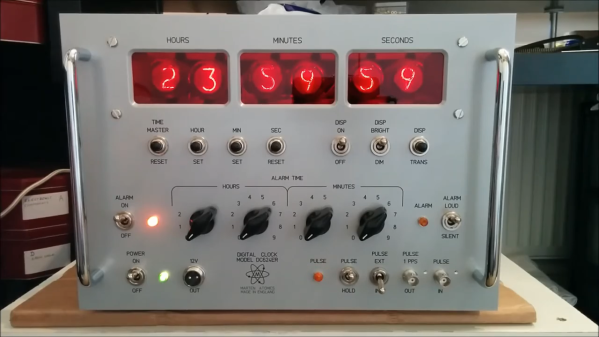
Boat Anchor Nixie Clock Plays The Cold Warrior Role Convincingly

The early Cold War years may have been suffused with existential dread thanks to the never-ending threat of nuclear obliteration, but at least it did have a great look. Think cars with a ton of chrome, sheet steel toys with razor-sharp edges, and pretty much the entire look of the Fallout franchise. And now you can add in this boat anchor of an electromechanical Nixie clock, too.

If [Teti]’s project looks familiar, perhaps it’s because the build was meant as an homage to the test equipment of yore, particularly some of the sturdier offerings from Hewlett-Packard. But this isn’t some thrift store find that has been repurposed; rather, the entire thing, from the electronics to the enclosure, is scratch built. The clock circuit is based on 4000-series CMOS chips and the display uses six IN-1 Nixies. Instead of transistors to drive the tubes, [Teti] chose to use relays, which in the video below prove to be satisfyingly clicky and relaxing. Not relaxing in any way is the obnoxious alarm, which would be enough to rouse a mission control officer dozing in his bunker. [Teti] has a blog with more details on the build, the gem of which is information on how he had the front panel so beautifully made.

We can’t say enough about the fit and finish of this one, as well as the functionality. What’s even more impressive is that this was reportedly [Teti]’s first project like this. It really puts us in mind of some of the great 6502 retrocomputer builds we’ve been seeing lately.

Continue reading “Boat Anchor Nixie Clock Plays The Cold Warrior Role Convincingly”

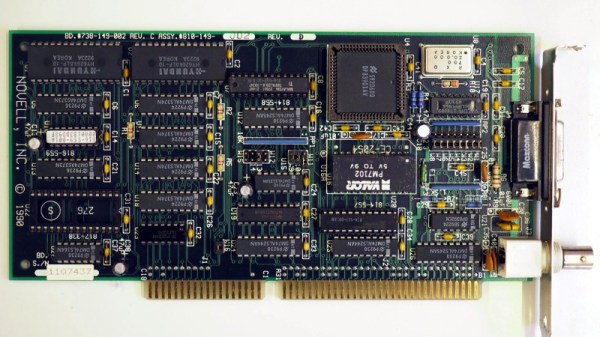
Was Novell’s NE2000 Really That Bad?

If you used almost any form of networked PC in the late 1980s or the 1990s, the chances are that you will at some point have encountered the Novell NE2000 network card. This 16-bit ISA card became a de facto standard for 16-bit network cards, such that very few “NE2000” cards were the real thing. A host of clones filled the market, some of which followed the spec of the original rather loosely. It’s something [Michal Necasek] examines as he takes the reader through the history of the NE2000 and why it gained something of a bad reputation. An interesting read for ’90s PC veterans who battled with dodgy Windows 3.1 network drivers.

The Novell line of network cards were not a primary product of the network server OS company but an attempt to spur the uptake of networked computers in an age when few machines were supplied from the factory with a network card installed. They were largely an implementation of the reference design for the National Semiconductor DP3890 Ethernet interface chipset, and for simplicity of interfacing and drivers they used an I/O mapped interface rather than DMA. The problem with the NE2000 wasn’t the card itself which would work with any NE2000 driver, but the host of “NE2000 compatible” cards that appeared over the decade as that magic phrase became a key selling point at the bottom end of the market. Sure they might contain a DP3890 or its clones, but even minor differences in behaviour would cause them not to work with all drivers, and thus they gained a bad name. The piece reveals the original card as one that might have been slow and outdated towards the end of its reign as a standard card, but maybe one not deserving of the ire directed at it.

If ancient networking kit is your thing, we’ve got some far more obscure stuff to show you.

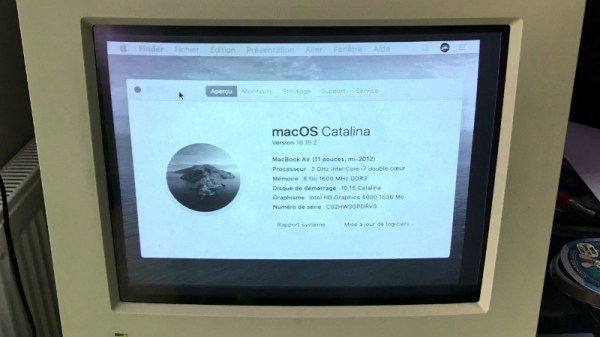
A Modern Mac Using An Ancient Mac Display

If you own an Apple product you probably live in a world with a few proprietary interfaces, but by and large your displays and desktop peripherals will use familiar ports such as USB and DisplayPort. For the Mac owner of yore though it was a different matter, as [Dandu] is here to tell us with the tale of a vintage Apple monochrome CRT monitor and a modern Mac.

There are no handy VGA ports to be found in this screen, instead it has a 15-pin D connector following a proprietary interface. With the right adapter it’s easy enough to produce VGA from the modern machine, but while it is in theory possible to map VGA pins to Apple pins there’s a snag with this particular model. Instead of using separate sync pins, it demands a composite sync of the type you might find in an analogue TV set that contains both horizontal and vertical sync pulses. The solution came through a simple transistor circuit, and then with the requisite settings on the modern Mac to deliver the 640×480 resolution it was possible to see a MacOS Catalina desktop on something more suited to a Mac II.

We’re more used to seeing CRT Macs in the form of the venerable SE/30, a machine that’s been on our radar for a long time.

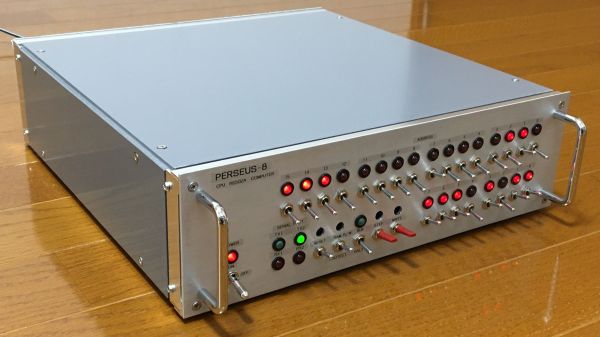
Gorgeous 6502 Celebrates Craftsmanship Of The Early Homebrewers

The days when a computer had a front panel bristling with switches and LEDs are long gone, and on balance that’s probably for the better in terms of ease of use, raw power, and convenience. That’s not to say there aren’t those who long for the days of flipping switches to enter programs, of course, but it’s a somewhat limited market. So unless you can find an old IMSAI or Altair, chances are you’ll have to roll your own — and you could do a lot worse than this aluminum beauty of a 6502 machine.

The machine is named PERSEUS-8 by its creator, [Mitsuru Yamada]. It follows earlier machines bearing the PERSEUS badge, all of them completely homebrewed and equally gorgeous. The PERSEUS-8 would have been an impressive machine had it come along 45 years ago — the 2 MHz version of the 6502, a full 16-bit memory address space, and 16 kB of battery-backed RAM. But the mechanical and electrical construction methods and the care and craftsmanship taken are where this build really shines. The case is fabricated out of aluminum sheets and angles and looks like it could have come from a server rack. The front panel is to die for — [Mitsuru] carefully brushed the aluminum before drilling the dozens of holes needed for the toggle switches and LEDs. And the insides are equally lovely — socketed chips neatly arranged on perfboard with everything wired up using period-correct wirewrap methods. Even the labels, both on the front panel and even on the motherboard, are a joy to behold.

Builds like this are the ones that really inspire us to take the extra steps needed to make our projects not only work, but also to be beautiful. We’ve seen this kind of craftsmanship from [Mitsuru] before — recall this serial terminal that never was, or the machine that came before the PERSEUS-8.

Inside A DEC Hard Drive

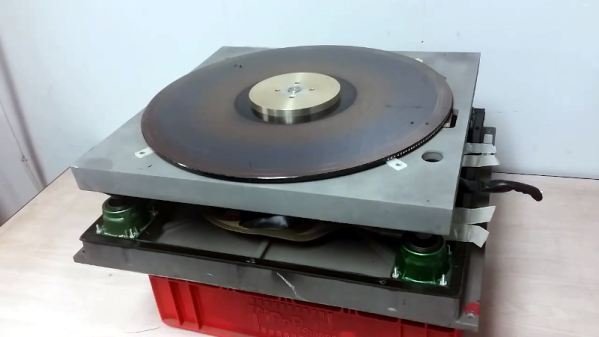
A lot of technology from the not-so-distant past doesn’t resemble modern versions very much. For a case in point, look at the DEC RS08 disk drive meant to pair with a circa 1970 PDP-8. Paired with an RF08 controller, this was state of the art, holding 262K 12-bit words with a blistering access speed of almost 63K/second unless you were plugged into 50Hz AC when it was closer to 50K/second. [Uniservo] had the disk unit, but not the controller. Someone else had a controller, but no disk drive. So [Uniservo] is shipping the disk to its new owner in a move worthy of a Reeses’ Peanutbutter Cup. The problem? The disk is super fragile and shipping is risky, so he decided to remove the platter for separate packing. Good thing for us, because we get a peek inside.

The nickel-cobalt platter looks like a thick LP record with heads underneath. As you might guess from the data transfer specification, the motor was just a common AC motor that rotated the platter against the head.

Continue reading “Inside A DEC Hard Drive”