Rubidium Frequency Standard Explained

You’ve probably heard of rubidium frequency standards, which are used where you need an extremely accurate time or frequency reference. [IMSAI] guy has a good explainer video about what’s actually going on inside one of these standards. Much of the basic idea also applies to cesium standards.

The explainer starts with the periodic table. Rubidium and cesium are both alkali metals, with a single electron in their outermost electron shell. Rubidium has 37 electrons, with the outermost one relatively loosely bound. Naturally occurring rubidium consists mainly of two isotopes, rubidium-85 and rubidium-87, which have the same number of protons and electrons but different numbers of neutrons.

A rubidium standard typically has three gas cells that have a bit of rubidium in them. An RF-excited rubidium-87 discharge lamp produces light at very specific wavelengths. The RF energy excites rubidium atoms into higher electronic states, and when their electrons fall back to lower-energy states, the atoms emit photons.

That light passes through a filter cell containing rubidium-85. The filter preferentially absorbs part of the lamp’s spectrum, leaving light that optically pumps the rubidium-87 atoms in the second resonance cell into one of two closely spaced hyperfine states of the atom’s ground state.

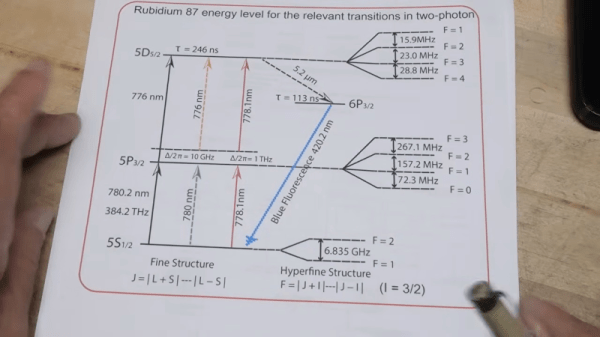
Those two states differ because of the interaction between the magnetic moment of the outer electron and that of the rubidium-87 nucleus. Their energy separation corresponds to a microwave frequency of about 6.835 GHz.

The resonance cell is illuminated by the filtered light while also being exposed to microwave energy from a local oscillator. When the microwave frequency is exactly equal to the rubidium-87 hyperfine transition frequency, it transfers atoms between the two ground-state hyperfine levels. That changes how strongly the cell absorbs the optical pumping light, producing a detectable dip in the light reaching a photodetector.

Electronics then servo the microwave oscillator onto the center of that absorption dip, using a feedback technique somewhat analogous to a phase-locked loop. Once locked, the oscillator is effectively referenced to an atomic transition rather than to the dimensions or mechanical properties of a crystal, giving you an extremely stable frequency standard.
Continue reading “Rubidium Frequency Standard Explained”

Inside A Rubidium Frequency Standard

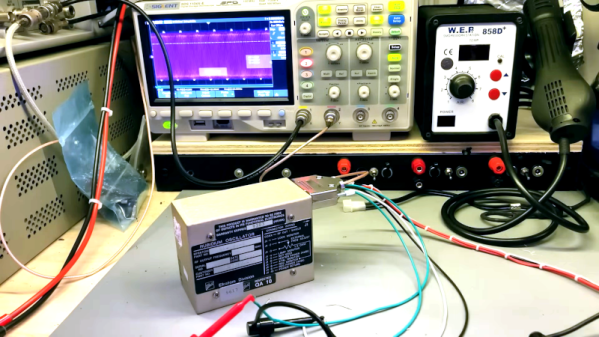
We think of crystals as the gold standard of frequency generation. However, if you want real precision, you need something either better than a crystal or something that will correct for tiny errors — often called disciplining the oscillator. [W3AXL] picked up a rubidium reference oscillator on eBay at a low cost, and he shows us how it works in the video you can see below. He started with a GPS-disciplined oscillator he had built earlier and planned to convert it to discipline from the rubidium clock.

The connector looks like a D-shell connector superficially, but it has a coax connector in addition to the usual pins. The device did work on initial powerup, and using a lissajous pattern to compare the existing oscillator with the new device worked well.

Continue reading “Inside A Rubidium Frequency Standard”

Atomic Antenna Uses Lasers

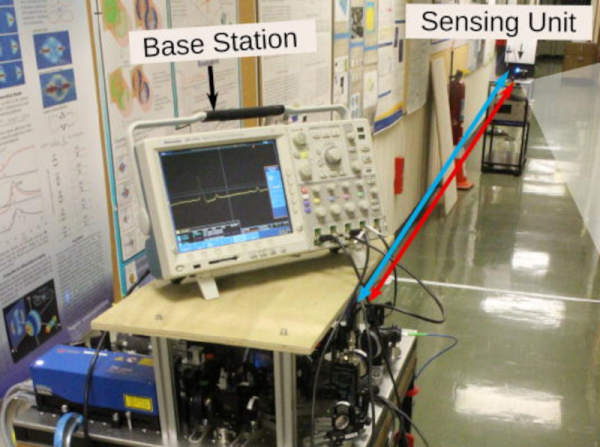
If you think about it, an antenna is nothing more than a radio frequency energy sensor, or — more precisely — a transducer. So, it shouldn’t be a surprise that there could be different ways to sense RF that would work as an antenna. A recent paper in Applied Physics Letters explains an atomic antenna comprised of a rubidium vapor cell.

The interesting thing is that the antenna has no electrical components in the antenna, and can be located far away from the actual receiver. Instead of coax cables, the signal is read with a laser.

Continue reading “Atomic Antenna Uses Lasers”

Quantum Atomic Interferometer For Precision Motion Sensing

The current state of the art of embedded motion sensing is based around micro-electromechanical systems (MEMS) devices. These miracles of microfabrication use tiny silicon structures, configured to detect acceleration and rotational velocity in three dimensions. Accumulate these accelerations and rotations, and you’ve got a device that can find its orientation and track movement without any external waypoints. This is the basis of the technique of dead reckoning.

Why do we care about dead reckoning anyway? Surely GPS and related positioning systems are good enough? Above ground GPS is usually good enough, but underwater and underground this simply won’t work. Even heading indoors has a dramatic effect on the GPS signal strength, so yes, we need another way for some applications.

Right now, the current state of the art in portable sensors are MEMS devices, and you can get them for the cost of a hamburger. But if you want the ultimate in accuracy, you’ll want a quantum atomic interferometer. What that is, and how it will be possible to make one small enough to be useful, is half of the story. But first, let’s talk MEMS.

Continue reading “Quantum Atomic Interferometer For Precision Motion Sensing”

Vacuum “Tube” Might Replace GPS One Day

GPS and similar satellite navigation systems changed everything. The modern generation is far less likely to have had to fold a service station map or ask someone for directions on the side of the road. But GPS isn’t perfect. You need to see the sky, for one thing. For another, an adversary could jam or take down your satellites. Even a natural disaster could temporarily or permanently knock out your access to the satellites.

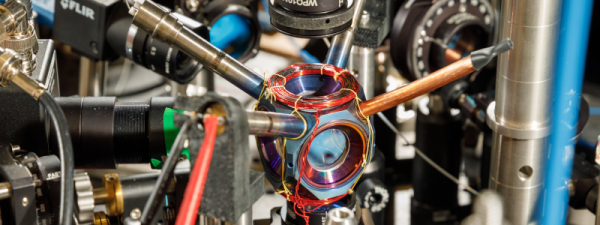
The people at Sandia National Labs worry about things like that and they want to replace GPS with quantum accelerometers and gyroscopes. The problem: those things take expensive and bulky vacuum systems and lasers. Sandia, however, has had a sealed device about the size of an avocado that weighs about a pound that could possibly do the job. Their goal is to see it work without maintenance for four more years.

This is no ordinary vacuum tube, though. It is made of titanium and sapphire. By itself, the device doesn’t do much of anything, but it shows that rubidium can be contained in a sealed chamber with no additional pumping. These quantum sensors aren’t anything new, but a tiny self-contained cold-atom sensor can pave the way for putting these sensors in vehicles like ships, aircraft, and ground vehicles. Submarines, which don’t usually have a clear shot at the sky without floating an antenna, are also candidates for the new technology.

A navigation system based on this technology uses a laser to cool the subject atoms and then measures their movements. This allows very precise determination of acceleration and rotation which allows for a more precise inertial navigation system.

If you need a refresher on how GPS works, we can explain it. If you think the idea of a module containing rubidium is far-fetched, don’t forget you can already get them for precision clock work.

Boat Anchor Nixie Clock Plays The Cold Warrior Role Convincingly

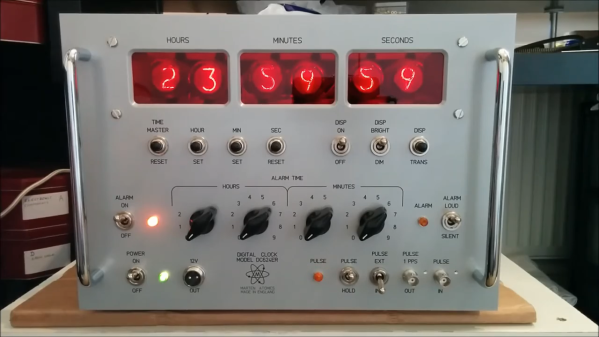
The early Cold War years may have been suffused with existential dread thanks to the never-ending threat of nuclear obliteration, but at least it did have a great look. Think cars with a ton of chrome, sheet steel toys with razor-sharp edges, and pretty much the entire look of the Fallout franchise. And now you can add in this boat anchor of an electromechanical Nixie clock, too.

If [Teti]’s project looks familiar, perhaps it’s because the build was meant as an homage to the test equipment of yore, particularly some of the sturdier offerings from Hewlett-Packard. But this isn’t some thrift store find that has been repurposed; rather, the entire thing, from the electronics to the enclosure, is scratch built. The clock circuit is based on 4000-series CMOS chips and the display uses six IN-1 Nixies. Instead of transistors to drive the tubes, [Teti] chose to use relays, which in the video below prove to be satisfyingly clicky and relaxing. Not relaxing in any way is the obnoxious alarm, which would be enough to rouse a mission control officer dozing in his bunker. [Teti] has a blog with more details on the build, the gem of which is information on how he had the front panel so beautifully made.

We can’t say enough about the fit and finish of this one, as well as the functionality. What’s even more impressive is that this was reportedly [Teti]’s first project like this. It really puts us in mind of some of the great 6502 retrocomputer builds we’ve been seeing lately.

Continue reading “Boat Anchor Nixie Clock Plays The Cold Warrior Role Convincingly”

Rubidium Disciplined Real Time Clock

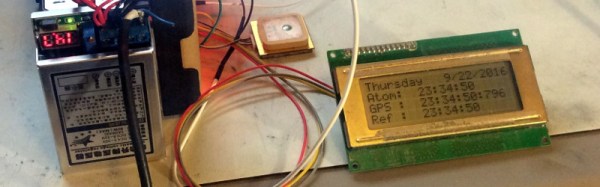
[Cameron Meredith] starts the Hackaday.io page for one of his projects by quoting a Hackaday write-up: “A timepiece is rather a rite of passage in the world of hardware hacking“. We stand by that assertion, but we’d say most of the clocks we feature aren’t as capable as his project. He’s made a real-time-clock module controlled by a rubidium frequency standard, and since it also includes a GPS clock he can track local time dilation effects by comparing the two.

Surplus rubidium standards are readily available, but each description of one seems to feature a lot of old-fashioned hardware hacking simply to get it working. This one is no exception, an unusual connector had to be replaced and an extra power supply module attached. Once those modifications had been made and a suitable heatsink had been attached, he was able to bring the rubidium standard, an RTC module, and GPS module together with an ATMega32U4 miniature Arduino-compatible board and an LCD display. The firmware is functional, but he admits it is not finished.

All the project’s files can be found on the Hackaday.io page linked above. Future plans include also monitoring the NIST WWVB radio time signal from Fort Collins, Colorado, for an extra time dilation comparison.

We’ve featured innumerable clocks over the years here at Hackaday, but among them have been a few based upon atomic standards. More than one has been used as a lab reference standard, but most similar to this build is [Max Carters] experiments to check the accuracy of an atomic standard, also using the WWVB transmissions.