Introducing Boron Buckyballs

A buckminsterfullerene, also known as a buckyball, is typically a fullerene consisting of sixty carbon atoms (C60) arranged in a way that resembles a football-like sphere. Extending this arrangement to other types of atoms has until now however proven as elusive as finding non-carbon-based lifeforms. In a paper by [Hyun Wook Choi] et al. and published in Chemical Science the discovery of boron buckyballs is detailed. There is also a soft-paywalled article in the Chemical & Engineering News magazine for a higher-level perspective.

The discovered boron-based buckyball ups the number of atoms to eighty, forming B80 (boron fullerite) with a slightly larger diameter than C60 at 0.85 nm versus 0.71 nm. Perhaps more interesting are the claims by the authors that boron fullerite may have more practical applications than its carbon-based cousin, mostly due to it being predicted to be a semiconductor with an 0.8 eV energy gap and better electron acceptance that provides interesting doping prospects.

Producing these boron structures used laser vaporization with a helium carrier gas that was seeded with argon to increase cooling efficiency. Inside this boron cluster the reported structures were then discovered and characterized as described in the paper.

Obviously, going from a fascinating laboratory discovery to bulk production won’t be easy, and the predicted properties of boron fullerite may turn out to be incomplete or have a dark side that we aren’t aware of. Regardless, they’re bound to be more useful at least than the carbon version that’s remained mostly a curiosity despite many years of research.

Discovery Of An Active Wind From The Milky Way’s Central Black Hole

One of the fun aspects of astrophysics is that much of it involves phenomena which you cannot exactly study from up close, with the supermassive black hole (SMBH) at the center of this galaxy – called Sagittarius A* (Sgr A) – being a great example. Although it’s been predicted since 1971 that black holes like Sgr A radiate energy which then pushes away nearby matter to create something akin to solar wind, this had so far not been proven. Now astronomers have discovered evidence for this emanating from Sgr A*.

Using five years worth of observations made with the Atacama Large Millimeter/Submillimeter Array (ALMA) and correlating it with other observations, a Southern Lobe of movement was identified, along with evidence for a Northern Lobe. Unlike a star where you are dealing with relatively massive quantities of matter being hurled into space, in the case of a very quiet SMBH like Sqr A* you are talking about occasional small wisps of gas of which a fraction gets turned into the radiation that then exerts pressure on the remaining gas.

It is speculated to be exactly this quiescent nature of Sgr A* that makes it so difficult to find evidence of SMBH wind, though one could also argue that having a well-fed SMBH whose event horizon rapidly expands would be fascinating from an astrophysics perspective, but less exciting for any nearby inhabited planets.

Desalinating Seawater With Solar And No Brine

Although desalination is very commonly used these days to convert seawater into fresh water, one of the major disadvantages of current approaches is that commercial desalination plants produce a lot of brine, which has to be dumped somewhere ideally without causing major environmental issues. A new solar-thermal method as demonstrated by [Luheng Tang] et al. was published in Light: Science and Applications, with accompanying PR article.

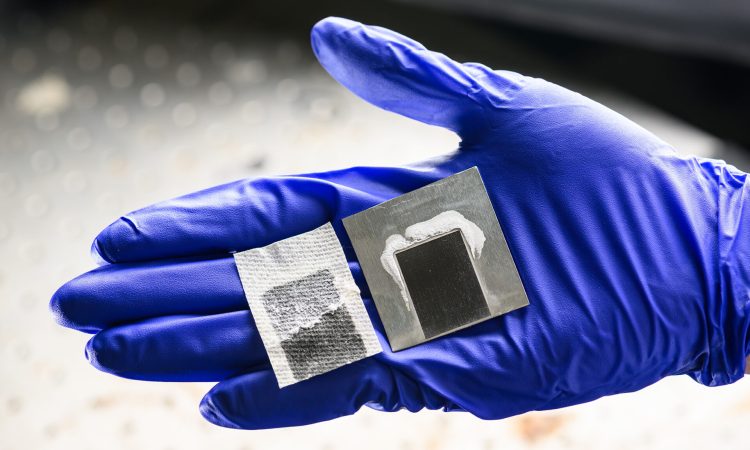
This method is claimed to require no pre-treatment or leave brine, using special panels that wick water across their surface and then use solar radiation to distill this water. This differs from previous similar methods through a special surface treatment that prevents build-up of salts which would require cleaning or replacement.

The salts and other contaminants that would normally end up in the brine slough off these cells and can then be further processed to recover everything from plain table salt to lithium as well as gold, uranium and other substances of interest that are prevalent in seawater.

So far these self-cleaning cells have been tested with water from a number of oceans with a claimed 74% solar-to-vapor conversion efficiency and nearly 100% salt extraction. As always the challenge will be in scaling this up to industrial levels, but so far it looks promising.

Apparently what a fusion power plant should look like

Less Than 10 Years? Commonwealth Fusion Systems Applies To Plug Into Grid In 2030s

Whenever the topic of fusion power comes up, someone will say it’s only 10 years away from commercialization in an excited tone, and someone older or more cynical will point out that it’s been 10 years away since Eisenhower was president. So it’s with a certain-sized crystal of sodium chloride that we share the news here that the US-based Commonwealth Fusion Systems is applying to feed 400MWe into the grid there by the early 2030s.

The early 2030s is, notably, less than ten years from now.

Commonwealth Fusion Systems isn’t a bunch of nobodies out to suck up venture capital; they’re a talented group of researchers from MIT’s well-known plasma laboratory out to suck up lots of venture capital and hopefully build reactors along the way. So far, the second part is going better than the first: they’ve raised a couple billion dollars, which has let them make great strides in building their SPARC reactor– like crafting the big magnet we told you about in 2021. As that article describes, SPARC is the precursor to the later, larger ARC reactor they hope to hook to the grid in slightly under a decade. Alas, SPARC remains under construction as of this writing. ARC is evidently in the final planning stages, with a physical location determined and grid-tie applied for at the “Fall Line Fusion Power Station” in Virginia.

CFS’s reactors are of the Tokamak type that has been favoured at universities since the 1970s. From China to Europe’s ITER who are also planning to produce power before another decade passes— though not, notably, into a power grid. While promising, Tokamaks aren’t the only game in town, either– steampunk startup General Fusion started making plasma last year, though while if it works it has some big advantages, that one is probably the traditional “ten years away” still.

What do you think? Will fusion power be in the grid before humans make it back to the moon? Add the flying-car potential of eVTOL and we might finally get close to the future we were promised.

Building A Gifford-McMahon Cryocooler With 3D-Printed Parts

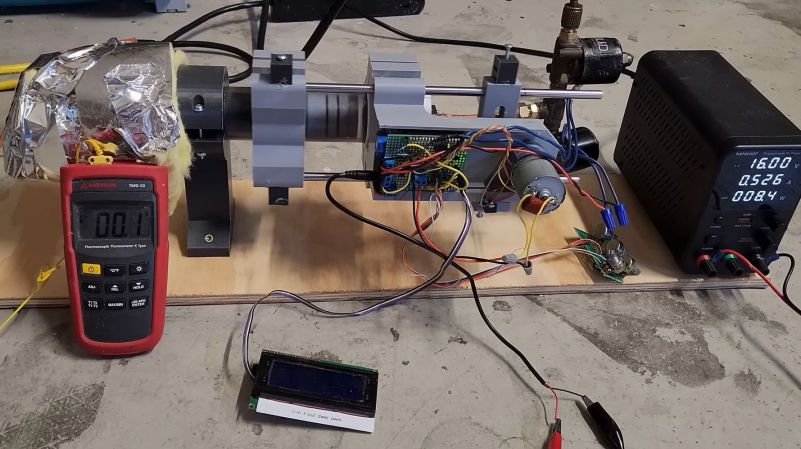
Although cryocoolers are capable of pretty impressive cooling, for many of them the underlying working principle is simple enough that you do not need any special skills or a big budget to make your own version. Take the Gifford-McMahon cryocooler for example, which works using nothing more than some kind of coolant gas and a piston in a cylinder that you can even 3D print, as demonstrated by [Hyperspace Pirate] in a recent video.

The lowest temperature reached across the two prototypes was only -84°C, but this was mostly due to some sub-optimal design choices, such as the use of regular air and a clear acrylic tube to get a good glimpse at the inner workings. The trickiest part of this type of cryocooler is probably that you need to move the piston containing the regenerator between both ends of the cylinder to get a cool and a hot side.

That particular problem was solved by using magnets to move the piston externally, which worked beautifully until the problem of using regular compressed air from the shop compressor caused massive ice formation that jammed up the piston. Obviously this was not an unexpected issue, and for the next step the coolant gas will be replaced by helium, as making that gas freeze up requires quite a bit more effort.

Continue reading “Building A Gifford-McMahon Cryocooler With 3D-Printed Parts”

Using Electrolysis For More Than Just Generating Hydrogen

When the topic of ‘electrolysis’ is mentioned, people typically think of just splitting plain old dihydrogen monoxide (hydric acid: H2O) into its constituent atoms, but this barely scratches the surface of what is going on during electrolysis. Once you understand the full picture it also becomes obvious how electrolysis can be used for other tasks, including metal refining, flow batteries and more, as covered in a recent video by [NightHawkInLight].

On a fundamental level electrolysis is what it says on the tin: a way to lyse (i.e. split apart) using electrons, which is what the anode and cathode provide or remove. This can be used to break down the bonds between hydrogen and oxygen, but also those of iron ore, like Fe3O4. Stripping the oxygen from the iron atoms is commonly done in a reduction process using the CO from coke or hydrogen,

Setup for electrolysing iron ore. (Credit: NightHawkInLight, YouTube)
Setup for electrolysing iron ore.

By instead dissolving the iron ore in acid, electrolysis can then be used to separate the two. In the example, the acid is created by one side of the electrolytic cell, with both electrodes separated by an ion-exchange membrane barrier that prevents the chemical processes on each side of the cell to affect the other side while still enabling the cell to work. How to make these membranes is also demonstrated in the video.

Through a careful arrangement of these membranes and the electrodes, you can guide which reactions can occur where, and which – negative or positively charged – ion can pass through which membrane, giving a lot of control. It can also be used to prevent undesirable reactions from happening, such as in this case the generating of chlorine gas from the NaCl being lysed.

Acidity indicator dye is used to show in great detail how the cell works, including its preparation of getting the acidity just right before the crushed iron ore is mixed with some of the generated acid and the resulting liquid added to the cell. Following this you get a closed-loop chemical process to which only fresh iron ore slush has to be added and electrodes swapped out for fresh ones as the build-up of iron becomes sufficiently thick. In addition to supplying the cell with electricity, naturally, though you can even invert the cell and use it as a chemical battery akin to a lead-acid one if that’s more your thing.

Continue reading “Using Electrolysis For More Than Just Generating Hydrogen”

Microsoft Claims 20 Second Qubits

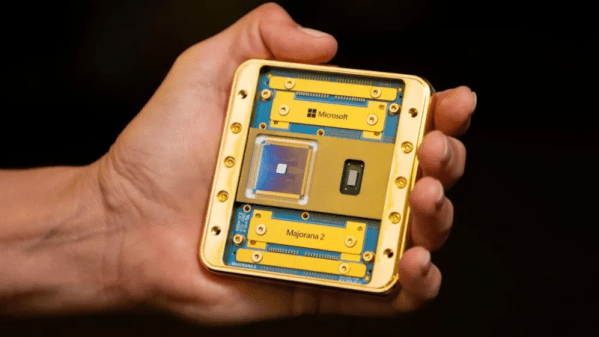
While it might seem that your computer malfunctions every few minutes, the reality is that modern computers are usually quite robust. Not so much for quantum computers, where qubit life is often measured in milliseconds. Now, the company claims to have qubits that last for about 20 seconds.

For example, Microsoft’s Majorana 1 quantum chip, which, incidentally, was mired in controversy, provided 8 qubits that were stable very briefly. This second-generation chip provides 12 qubits that average 20-second lifespans.

Continue reading “Microsoft Claims 20 Second Qubits”