Brain Control For The Arduino

brain-controlled-arduino

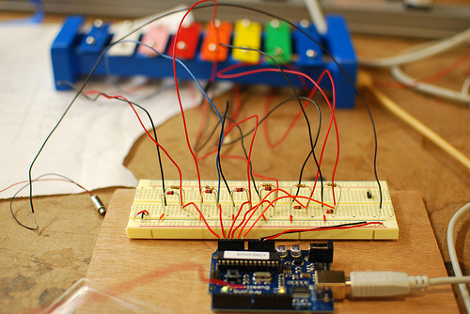
When we hear about a brain controlled Arduino project we immediately think about a coding nightmare. As always, the simple hacks are the best hacks. [Joel] and [Akshay] used hardware from a kid’s game as a brain interface for an Arduino.

We came across the video (embedded after the break) of their work and asked for more info on what we thought was an incredibly difficult hack. It turns out they purchased Uncle Milton’s Force Trainer which uses a headset to measure brain waves and has a base unit that reacts to these measurements. Hacking into this device didn’t require reverse engineering of anything. They took the easy route, and tapped into the five LEDs on the base unit. As the game measures greater levels of concentration, it lights up more LEDs.

So far tapping into the game is just a proof of concept. It’s up to you to implement a brain controlled beer bot.

Continue reading “Brain Control For The Arduino”

Reverse Geocache Puzzle

fig1-6471

[Mikal] wanted to create an awesome electronic wedding gift for his friend who was moving to France. After experimenting with a few things, he settled on creating a puzzle box that would only open in a certain location. Since his friend introduced him to the Arduino, he fittingly used one in the design, along with a serial GPS module and a mini character LCD. The box itself is locked using a servo-controlled chopstick, which could theoretically be snapped if [Mikal] really screwed something up. To save battery life, he used a small Pololu module to provide power that uses only 0.01 microamps in standby, and can be shut off by the Arduino.

The box was designed to be mysterious yet self-explanatory. When the button on the front is pushed, the box comes to life for 3 minutes, displaying the distance away from secret location. Additionally, it warns how many tries are left: the button can only be pushed 50 times before it is sealed “forever”. In order to open the box, you have to be within 2km of the destination. Theoretically, you can narrow down the location to one of 2 points after 2 readings, but a less scientific approach would probably be a lot more fun.

This seems like an amazing gift, and the same concept could be repurposed into hundreds of other devices. For extra fun, he could have placed it at a geocache location.

3D Magnetometer Mouse In Processing

FFB4SV5G0SD7J7G_MEDIUM

[etgalim] works in Solidworks extensively and wanted a more intuitive way of rotating objects onscreen. To do this, he created a mouse that responds to rotation. He put a 3D compass module inside an old mouse and wired it up to an Arduino. The Arduino then relays the I2C sensor data to the computer. So far, he has a Processing script that uses the mouse to rotate a cube, but eventually he wants to write a Solidworks plugin. It’s a bit shaky, and we think it would be a bit smoother (and cheaper) if he used gyros like the jedipad. Video after the jump.

Continue reading “3D Magnetometer Mouse In Processing”

1480W Scooter Motor Guarantees Head Trauma

[Jerome’s] been working on some improvements to an electric foot scooter he picked up from a friend. He ordered up a powerful brushless motor and some lithium batteries. His system uses a belt drive and at 33 volts it can reach 25 miles per hour.

He had some problems with too much torque when the motor was first started. This resulted in unintentional wheelies, which sounds really cool if you’re not the one trying to hang on to the scooter. [Jerome] is using an Arduino to control the system so he built in the ability to gradually ramp up the speed of the motor and also added the ability to control the speed via remote control. You should note in the video after the break that [Jerome] is test-piloting his build sans-helmet.

So, we spend a lifetime and countless sums of money filling our noggins with knowledge. This is a precarious investment since a rather small bump to the melon could corrupt all of that data and end the once spectacular cognitive power. If you’re smart enough to build a foot scooter that can go 25mph, be smart enough to wear a helmet when you ride on it!

Continue reading “1480W Scooter Motor Guarantees Head Trauma”

RFID-enabled Robot…mood…tail…thingy.

moodtail

Furries: is there nothing they cannot do? Well okay, “shower” remains an elusive concept, but wearable technology seems to be in, as evidenced by this robotic mood tail. [Wei-Chieh Tseng]’s adorable Arduino-driven fashion accessory operates either via Wii Nunchuk or a set of RFID cards tagged with specific emotions to depict.

Details are scant. It appears to have been a project for a physical computing or design class. One thing’s for certain: Halloween is going to be awesome.

[via Engadget]

Turntable Sequencer Scratches With Coins

scratching-with-arduino

[tvst] has an interesting take on a sequencer. His design uses coins on a turn table to trigger midi events in a loop. There are four tracks available, each having its own sensor above the spinning platform. The sensors consist of an IR transmitter and receiver setup as a voltage divider. When something passes below the IR transmitter and reflects the infrared waves back up to the receiver, the output of the sensor moves to digital high. The four sensors are connected to an Arduino which is used in conjunction with ttymidi, which converts the Arduino data into midi events.

We like projects that provide a more tangible interface for the user. Coins work well for this setup. They reflect infrared enough to trigger the sensors, and they’re easy to pick up and move without upsetting the rest of the tracks. It would be great if this could be expanded to differentiate between coins (pennies versus dimes, etc.) in order to increase the resolution from four different events to eight or more. Check out the video after the break. Continue reading “Turntable Sequencer Scratches With Coins”

Metal Race Combines Operation And Calculator Game

metal_race

[Greg] was feeling nostalgic about the game RACE for to TI-83 graphing calculator. In the game, your car is stationary with controls to move the scrolling maze from side to side in order to avoid a crash. He set out to build a physical version of the game with a don’t-touch-the-side concept that reminds us of Operation.

The game board is a wire frame constructed from paperclips then attached to a motorized frame. The vehicle is also metal and is attached to the lens sled from a scrapped CD-ROM drive. The maze scrolls from left to right with up and down vehicle motion controlled by two arcade buttons. An Arduino controls the motors and monitors the button inputs. He has plans to add a buzzer that sounds when the metal car “crashes” in to the wire walls of the maze. We’ve embedded video of the working game after the break. For more build photos take a look at his flickr set. Continue reading “Metal Race Combines Operation And Calculator Game”