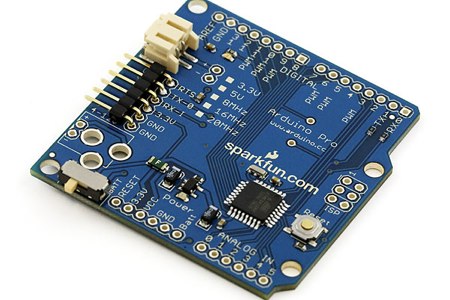
SparkFun Arduino Pro


SparkFun’s new Arduino Pro is an updated version of their Skinny. The board comes populated with the running gear of an Arduino, but without all of the connectors in place. It’s targeted at people building integrated systems around the Arduino and not just prototyping. The board is 3.3V with an 8MHz bootloader just like the LilyPads and is fully certified by Arduino. It has a small side mounted power switch, but you have to supply your own DC jack (if you need it). There is no USB hardware on board and you’re expected to program it via an FTDI breakout board or cable. We definitely like the stripped down approach, but it would have been nice if the price had dropped more.

[via Make]

RGB Monome Clone


[Julien Bayle] has posted this great breakdown of building an RGB monome clone. He is a musical performer using Ableton Live. He wanted to do away with the need for a computer screen and found that the monome would have been perfect had it been RGB. So he decided to build his own.

The parts list for the entire project is as follows:

  • 1x Arduino board
  • 4x Sparkfun breakout PCB
  • 4x Sparkfun buttons pads (like our door lock)
  • 4x Sparkfun buttons bezel
  • 64x RGB LEDs common cathode
  • 64x Diodes Small Signal (1N4148)
  • 1x MAX7221 (LED Driver)
  • 1x 74HC164 (8-Bit Serial-In, Parallel-Out Shift Register)
  • 1x 74HC165 (8-Bit Parallel-In, Serial-Out Shift Register)

He also has files for the schematics and source code as well as information on how to assemble and test it.

The RGB aspect is still under development. He is using the LEDMatrix-Serial Interface-RGB from Sparkfun Electronics to run it. It is expensive, but is exactly what he was looking for.

There aren’t very many pictures of the project, and none of the working RGB unit. He makes up for it in sheer information. Many parts have links to manufacturers or support forums. Hopefully he’ll post some pictures and video of the final product soon.

Arduino Tux Plant Care


Some of us need a little help keeping our green leafy friends happy. The Arduino Tux (translated) plant care system was built to make things a little easier.

The author had a broken tux toy laying around and wanted to do something fun with it. He cut a hole in the front to mount an LED matrix and connected it all to an Arduino. A couple of metal rods serve as a resistivity sensor in the plant’s dirt.

When you water the plant, tux flashes some hearts and a smiley face. As the moisture drops, tux gets less happy with the end result being a big frown.

These are the same people who brought you the Arduino Photolab.

[via Hack a Day Flickr Pool]

New From SparkFun


SparkFun is rolling out interesting things to play with every week. They’ve added a NanoMuscle actuator that uses a shape memory alloy to lift nearly 70 times its own weight. Their LilyPad collection has expanded to include small momentary switches and a thermistor type temperature sensor. Lastly, they’ve got an FM receiver module. It just needs an antenna and uses I2C or SPI for control.

StickDuino, USB Stick Arduino Clone


The Arduino hardware clones keep rolling in. This weeks entry into the modern dev board’s roster is the StickDuino. The board is designed to be fully hardware compatible and plugs directly into your USB port. The StickDuino uses all SMD components. The creators know that this can make assembly more difficult so they’ve space the components out, opted for larger pads, and collected some links to SMD tutorials. The board feature two more analog inputs than the Diecimila and it has a jumper so you can switch it to 3.3V. All around it looks like a great product; frankly we love anything with full board layouts.

Simple Tracking In 3D Space

[kylemcdonald] has posted this how to build a simple 3D tracking interface. Using 6 resisters, some wire, aluminum foil, an Arduino, and a cardboard box, he was able to do 3D capacitive sensing. Coupling that with Processing, he was able to overlay an interface using augmented reality. The video above shows a 3D tic tac toe application. While it seems less than perfect, its pretty amazing for how simple it is.

Seen anything similar to this out there? What applications would be fun with this?

Ard-e: Cheap Arduino Robot Platform


[Adam] sent in his robot: Ard-e. It’s build on a cheap remote control bull dozer kit along with a pile of cheap parts. He managed to keep the cost under $100. You might be getting sick of the Arduino love, but we love how the platform makes it possible for the micro controller novice to get results without taking advanced assembly language.