Think Your Way To Work In A Mind-Controlled Tesla

When you own an $80,000 car, a normal person might be inclined to never take it out of the garage. But normal often isn’t what we do around here, so seeing a Tesla S driven by mind control is only slightly shocking.

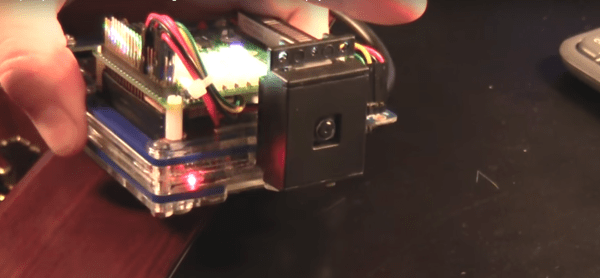
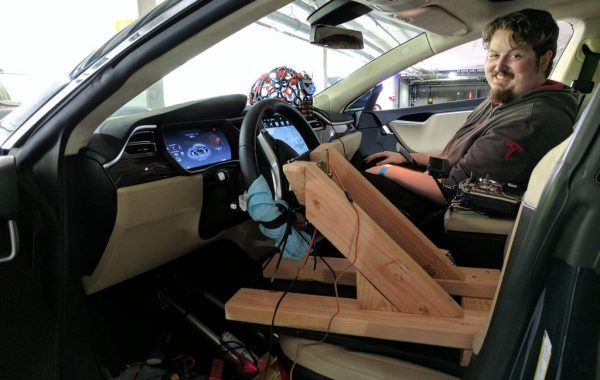
[Casey_S] appears to be the owner of the Tesla S in question, but if he’s not he’ll have some ‘splaining to do. He took the gigantic battery and computer in a car-shaped case luxury car to a hackathon in Berkley last week and promptly fitted it with the gear needed to drive the car remotely. Yes, the Model S has steering motors built in, but Tesla hasn’t been forthcoming with an API to access such functions. So [Casey_S] and his team had to cobble together a steering servo from a windshield wiper motor and a potentiometer mounted to a frame made of 2x4s. Linear actuators attach to the brake and accelerator pedals, and everything talks to an Arduino.

The really interesting part is that the whole thing is controlled by an electroencephalography helmet and a machine learning algorithm that detects when the driver thinks “forward” or “turn right.” It translates those thoughts to variables that drive the actuators. Unfortunately, space constraints kept [Casey_S] from really putting the rig through its paces, but the video after the break shows that the system worked well enough to move the car forward and steer a little.

There haven’t been too many thought-controlled cars featured here before, but we have covered a wheelchair with an EEG interface.

Continue reading “Think Your Way To Work In A Mind-Controlled Tesla”

One Hundred Weeks Of Legal Car Hacking

There is a scene in the movie “Magic Mike” where the lead character — a male stripper — explains to a room of women the laws against having physical contact with a performer. Then he intones, “… but I see a lot of lawbreakers up in this house.”

We know if we could look out through the Web browser, we could say the same thing. There’s a lot of gray zone activities considered commonplace. Have you ever ripped a CD or DVD to take with your on your phone? Gray; we won’t judge. A lot of the legal issues involved are thorny (and I should point out, I’m not a lawyer, so take what I say with a grain of salt).

Do you own your car? Well, probably you and the bank, but certainly the deal you made involves the idea that you own the car. If it is paid off, you can do what you like with it, including — if you wanted to — stripping it bare for parts. Back in the day, your car was some wheels and some mechanical devices. These days, it is a computer (actually, a few computers) and some I/O devices that process gasoline into rotary motion. Computers have software. Do you own that software?

The answer has, legally, been no. However, a recent decision by the US Copyright office allows car owners to legally analyze and modify their vehicle software (with some limitations) for the next two years. After that? We’ll see.

Continue reading “One Hundred Weeks Of Legal Car Hacking”

A Car Stand Made Of Sand

When the guys at [Practical Engineering] say they have a dirty car stand, they really mean it! They made a block of dirt and sheets of fiberglass as reinforcement material, and the resistance was put to test by using it as a car stand. And yes, the block does the job without collapsing.

An exmple of MSE
A MSE structure. The lateral walls add no strength, they just look nice.

Soil is a naturally unstable material, it relies only on friction for structural stability, but it has a very low shear strength (the resistance of the material’s internal structure to slide against itself). Therefore, as soon as you put some weight, a soil structure fails. The trick is to form a composite by adding layers of a stiff material. Those layers increase the shear strength and you end up with an incredibly strong composite, or ‘mechanically stabilized earth‘ (MSE). You probably drive by some everyday, as in the picture at the right.

Even though the modern form of MSE was due to French engineer Sir Henri Vidal, reinforced soil has been used since the beginnings of human history, in fact, some sections of the Great Wall of China were made using this technique. [Practical Engineering] explanation and demonstration video is very well made, be sure to check it after the break. In case you don’t want to play with dirt next time you need to fix your car, you can always make a 3D printed jack.

The Lotus Sevens: The Real Most-Hackable Cars

In the late 1940s and early 1950s, Europe was still struggling to recover from the crippling after-effects of war. In Britain it is referred to as the “austerity period”, with food still rationed and in which “make do and mend” was very much the order of the day. The consumer boom of the late 1950s and 1960s was very far in the future, and if you were a hardware hacker your source materials were limited to whatever you could find from war surplus or whatever prewar junk might come your way. This was a time in which the majority of adults had recently returned from war service, during which they had acquired practical skills through the necessities of battle that they sought an outlet for in peacetime.

One field that benefited from this unexpected flowering of creativity was that of motor racing. Before the war it had been an exclusive pursuit, with bespoke cars at famous circuits like the banked track at Brooklands, in Surrey. In a reflection of the wider social changes that followed the war the motor racers of the post-war years came from humbler backgrounds, they raced homemade specials made from tired-out prewar motors on wartime airfield perimeter tracks like the one at Silverstone which still hosts Formula One racing today.

Continue reading “The Lotus Sevens: The Real Most-Hackable Cars”

Glow-In-The-Dark Antenna Helps You Spot Your Car At Night

It’s late, and you’re lost in a sea of cars trying to remember where you parked. If only your vehicle had a glow-in-the-dark antenna to make it easier to find, you wouldn’t be in this situation. Faced with just such a problem himself, Instructables user [botzendesign] has put together a handy tutorial to do just that.

[botzendesign] first removed the antenna and lightly abraded it to help the three coats adhesion promoter do its job. A white base coat of vehicle primer was applied — lightly, so it doesn’t crack over time — and once it had set, three coats of Plasti Dip followed. Before that had a chance to dry, he started applying the glow-in-the-dark powder, another coat of Plasti Dip, repeating four more times to ensure the entire antenna had an even coat of the photo-luminescent powder and then letting it dry for 24 hours. Continue reading “Glow-In-The-Dark Antenna Helps You Spot Your Car At Night”

Toyota’s Code Didn’t Meet Standards And Might Have Led To Death

We were initially skeptical of this article by [Aleksey Statsenko] as it read a bit conspiratorially. However, he proved the rule by citing his sources and we could easily check for ourselves and reach our own conclusions. There were fatal crashes in Toyota cars due to a sudden unexpected acceleration. The court thought that the code might be to blame, two engineers spent a long time looking at the code, and it did not meet common industry standards. Past that there’s not a definite public conclusion.

[Aleksey] has a tendency to imply that normal legal proceedings and recalls for design defects are a sign of a sinister and collaborative darker undercurrent in the world. However, this article does shine a light on an actual dark undercurrent. More and more things rely on software than ever before. Now, especially for safety critical code, there are some standards. NASA has one and in the pertinent case of cars, there is the Motor Industry Software Reliability Association C Standard (MISRA C). Are these standards any good? Are they realistic? If they are, can they even be met?

When two engineers sat down, rather dramatically in a secret hotel room, they looked through Toyota’s code and found that it didn’t even come close to meeting these standards. Toyota insisted that it met their internal standards, and further that the incidents were to be blamed on user error, not the car.

So the questions remain. If they didn’t meet the standard why didn’t Toyota get VW’d out of the market? Adherence to the MIRSA C standard entirely voluntary, but should common rules to ensure code quality be made mandatory? Is it a sign that people still don’t take software seriously? What does the future look like? Either way, browsing through [Aleksey]’s article and sources puts a fresh and very real perspective on the problem. When it’s NASA’s bajillion dollar firework exploding a satellite it’s one thing, when it’s a car any of us can own it becomes very real.

Hacker Helps His Mother Lift Her Walker When He’s Not There

[typo]’s mother gets around with a walker. It’s a great assistive device until she has to lift the heavy thing up into her car. Noting that this was a little cruel he did as any hacker would and found a way to automate the process.

The build is pretty cool. She had to give up her passenger seat, but it’s a small price to pay for independence. He removed the door paneling on the passenger side. Then he welded on a few mounting points. Next he had to build the device.

The well-built device has a deceptively simple appearance. The frame is made from CNC milled panels and the ever popular aluminum extrusion. It uses a 12V right angle drive and some belting to lift the chair. There’s no abundance of fancy electronics here. A toggle switch changes the direction of the motor. There are some safety endstops and an e-stop.

Now all she has to do is strap the walker to the door. She picks the direction she wants the lift to go and presses a button. After which she walks the short distance to the driver’s seat, and cruises away.