
New Circuits With Old Technology

Before the invention of transistors, vacuum tubes ruled the world. The only way to get amplification or switching (or any electrical control of current) back then was to use tubes. But some tube design limitations were obvious even then. For one, they produce an incredible amount of heat during normal operation, which leads to reliability issues. Tubes were difficult to miniaturize. Thankfully transistors solved all of these issues making vacuum tubes obsolete, but if you want to investigate the past a little bit there are still a few tubes on the market.

[kodera2t] was able to get his hands on a few of these, and they seem to be relatively new. This isn’t too surprising; there are some niche applications where tubes are still used. These have some improvements over their ancestors too, operating at only 30V compared to hundreds of volts for some older equipment. [kodera2t] takes us through a few circuits built with these tubes, from a simple subminiature vacuum tube radio to a more complex reflex radio.

Taking a walk through this history is an interesting exercise, and it’s worth seeing the ways that transistor-based circuits differ from tube-based circuits. If you’re interested enough to move on beyond simple radio circuits, though, you can also start building your own audio equipment with vacuum tubes.

Continue reading “New Circuits With Old Technology”

Casting A Cannon Is A Lot Harder Than You Think

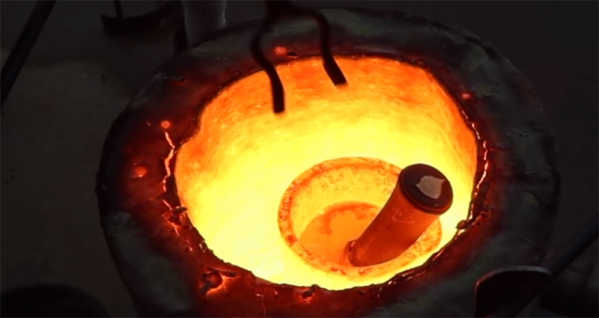
We’ve seen backyard casting, and for the most part, we know what’s going on. You make a frame out of plywood or two by fours, get some sand, pack it down, and very carefully make a mold around a pattern. This is something else entirely. [FarmCraft101] is casting a bronze cannon. Sure, it’s scaled down a bit, but this is the very limit of what sanity would dictate a single person can cast out of molten metal.

This attempt at casting a cannon is more or less what you would expect from a backyard bronze casting experiment. There’s a wooden flask and a greensand mold, everything is tamped down well and there’s a liberal coating of talcum powder inside. This is a large casting, though, and this presented a problem: during the pour, the halves of the flask were only held together with a few c-clamps. This ended poorly, with molten bronze pushing against the mold and eventually flowing onto the garage floor. Doing this alone was perhaps a bad idea.

The failure of the mold meant some math was necessary, and after some quick calculations it was found that more than 300 pounds pushing the sides of the mold apart. A second pour, with the sides of the flask bound together with nylon straps, was much more successful with a good looking bronze cannon ready for some abuse with a wire wheel.

This is only the first video in the series, with the next videos covering the machining and boring out of the barrel. That’s some serious craft right there.

Continue reading “Casting A Cannon Is A Lot Harder Than You Think”

Postal-Themed Rat Rod Mower Really Delivers

There are birthday presents, and then there are birthday presents. You know, the amazing ones that are the polar opposite of phoning it in. This is one of those presents.

So, [peterbrazil]’s wife is a rural mail carrier on a small island. For her upcoming birthday, he wanted to build a lil’ something she could show off in the local Tractor Days Parade. He found an old Cub Cadet riding mower that was destined for the dump, and the rest is well-documented history.

This glorious conversion required a lot of frame work, but it’s obvious this wasn’t [peterbrazil]’s first rodeo. He got some tires and tie rods from a friend who used to race lawnmowers (yeah, really) and went from there. He wanted this rat rod to be totally slammed (lowered as far as possible), but that would prohibit [Mrs. peterbrazil] from riding it ’round the farm after her parade dust settles. Instead, he went for the raked look, which means the front is lower than the back.

We love all of the reuse here, which includes a wheelbarrow cleverly cut into a seat and a dashboard, an old mailbox for a bed/cargo box, and a pitchfork grill. There are some modern touches as well, like a 3D printed mailbox shift knob with a working door, printed ignition switch box for the dash, and an adapter that makes room for a huge cone air filter. The seat cushion is a nice touch, too—the sunflower fabric adds both femininity and farm flavor to the build.

Always wanted to build a hot rod, but don’t have the garage space? Get some traction with an R/C rod.

Sonic Screwdriver Shuts Off Mains

In the world of Doctor Who, the sonic screwdriver is a versatile tool with a wide range of capabilities. [Hartley] wanted some of that action for himself, and built a device of his own.

Unable to recreate the broad swathe of features from the show, he settled on something easier. The device is fitted with an ATTiny85, and a 433MHz transmitter. It’s programmed to switch wirelessly controlled mains sockets on and off. This lets him control appliances in his house with a flick of a screwdriver. Power is supplied by the classic AA battery, with a boost converter stepping it up to 5V to run the electronics.

It’s all wrapped up in a 3D printed case, that was carefully designed to fit all the parts inside. A paper mockup of the PCB layout was also used in the design phase. [Hartley] took full advantage of CAD software, to ensure everything fit correctly first time.

It’s a fun project, as sonic screwdrivers often are. Video after the break.

Continue reading “Sonic Screwdriver Shuts Off Mains”

SerialPlot Does Exactly What You Think It Does

The serial port remains a hacker staple, being one of the easiest ways to move a little bit of data from one machine to another. All manner of projects use the interface, and often, sensors are connected and their data read over such connections. In these cases, it can be useful to plot said data, and SerialPlot is a tool that can do just that.

SerialPlot is capable of reading data over several serial ports at once, and plotting it for your viewing pleasure. It’s capable of interpreting data in a variety of integer and float formats, and plotting multiple channels in a synchronised manner. It’s also capable of sending basic commands out over the serial port, which can be used to trigger or control attached equipment.

Overall, it’s a useful utility for anyone with an array of sensor’s connected over the most classic of interfaces. Of course, if you’re having trouble keeping track of all your serial ports, there’s a utility to help with that, too.

Etching Aluminium Coins, Just For Fun

[MakeFailRepeat] was heading to MakerCentral in Birmingham, an event to which many makers were bringing coins to swap and trade. Wanting to get in on the action, he decided to etch some coins of his very own.

Etching aluminium is a simple process, readily accessible to the average maker. [MakeFailRepeat] started with an aluminium bar, and applied sticky-backed vinyl to the surface. This was then lasercut with the coin artwork, and the pieces removed to leave a negative space design for etching. With the resist layer in place, the aluminium was placed in a bath of salt water, and attached to the positive electrode of a DC supply or battery. With the negative electrode attached to a bolt, the aluminium is left to etch, with care taken to avoid over-etching. As a final finishing step, the coins were then placed in a cobbled-together rock tumbler, using scrap 3D printer filament as media.

The coins are a little rough around the edges, but we think they’re great for a first attempt. There’s plenty of different ways to etch; toner transfer is a particularly popular method. Video after the break.

Continue reading “Etching Aluminium Coins, Just For Fun”

Routing IP Over Instant Messages Is Possible Yet Impractical

Telegram is an instant messaging app, well known for its focus on security and encryption. It’s used by government officials, journalists, and the paranoid, and can also handle VoIP calls, in addition to its text messaging capability. [PiMaker] wondered if all this encryption could be put to good use, and decided to try and route IP over Telegram, as you do.

The project is called Teletun, and it works! It uses telgram-cli, a command line interface for the instant messaging network. The actual IP routing is handled with a Python script, and [PiMaker] recommends that in use, the user should “pray to the gods for mercy”. Reports are that bandwidth is limited, but latency can go as low as 100ms, which suggests Telegram is indeed a fairly instant messenger.

Tunneling over instant messaging services is good practice for any aspiring hacker, but likely to be unwieldy for any practical purpose. If you can think of one, other than irritating the intelligence agents tapping your communications, throw it down in the comments below. Otherwise, consider other oddball ways to (ab)use Telegram.