Decentralized Chaos In Germany

When you’re planning an event with 15,000 hackers in a tight space these days, the COVID logistics can take the wind right out of your sails. And so the Chaos Computer Club decided, for one more year, to put aside plans for the traditional year-end Chaos Communications Congress. In it’s place this year? Everyone is doing their own thing, together but apart, for the “Dezentrale Jahresendveranstaltungen”.

Some local clubs are putting on local events, some of them have talk streams, and it’s all happening everywhere and at once. If you’re not near one of the roughly 30 locations in Europe that are doing something live – check out the streams. But be warned, there’s a lot to process!

Maybe it’s best to start with the schedule, where you can see what’s coming up next. Live streams are going on throughout, until Dec 30. If you missed a talk, you can check out the pre-release versions on Relive, but note that start times and end times are approximate, so you might need to seek around. And once they’re edited and polished up, they’ll show up on the permanent event playlist, which is still just getting started as we write this.

Right now, we’re watching a talk in German about how to program laser shows, but yesterday there were some great talks on subjects as varied as the history of the C language, how perimeter cybersecurity is dead, how to find the Norwegian prime minister in an “anonymous” dataset, and how Hackaday friend [Dave Darko] made his LED dodecahedron that he was showing off at Supercon.

In short, there’s a lot going on. Check it out.

Supercon 2022: Mooneer Salem Goes Ham With An ESP32

After being licensed as a ham radio operator since the early 2000s, you tend to start thinking about combining your love for the radio with other talents. In a 20-minute talk at Hackaday Supercon 2022, [Mooneer Salem] tells the story of one such passion project that combined software and radio to miniaturize a digital ham radio modulator.

[Mooneer] works as a software developer and contributes to a project called FreeDV (free digital voice), a digital voice mode for HF radio. FreeDV first compresses the digital audio stream, then converts it into a modulation scheme sent out over a radio. The appeal is that this can be understandable down to very low signal-to-noise ratios and includes metadata and all the other niceties that digital signals bring.

Traditionally, this has required a computer to compress the audio and modulate the signal in addition to two sound cards. One card processes the audio in and out of your headset, and another for the audio coming in and out of the radio. [David Rowe] and [Rick Barnich] developed the SM1000, a portable FreeDV adapter based around the STM32F4 microcontroller. However, flash space was running low, and the cost was more than they wanted. Continue reading “Supercon 2022: Mooneer Salem Goes Ham With An ESP32”

Supercon 2022: Sam Mulvey Shows You How To FM Radio

Sam Mulvey built his own radio station in Tacoma, WA. Is there a better way to meld ham radio practice with a colossal number of DIY electrical and computer projects? Sam would say there isn’t one! This 45-minute talk is basically the lessons-learned review of setting up KTQA 95.3 – the radio station on the hill.

Sam starts out the talk by introducing you to LPFM. And maybe you didn’t know that there’s a special type of license issued by the US FCC allowing non-profit community radio stations up to 100 W, covering an radius of around 5 km. It’s like running a pirate radio station, but by jumping through a few legal hoops, made legal.

Trash on the Radio

Putting a radio station together on a budget requires a ton of clever choices, flexibility, and above all, luck. But if you’re willing to repair a busted CD player or turntable, scrounge up some used computers, and work on your own amplifiers, the budget doesn’t have to be the limiting factor.

Being cheap means a lot of DIY. For instance, Sam and friends made a custom console to support all the gear and hide all the wiring. Some hot tips from the physical build-out: painted cinderblocks make great studio monitor stands, and Cat-5 can carry two channels of balanced audio along with power, with sufficient isolation that it all sounds clean. Continue reading “Supercon 2022: Sam Mulvey Shows You How To FM Radio”

DC Zia 30-in-ONE Badge for DEF CON 30

Nostalgic 30-in-ONE Electronics Badge For DEF CON 30

[hamster] and the DC Zia crew offered up a throwback 30-in-ONE Learn Electronics indie badge for DEF CON 30. The badge is inspired by the Radio Shack “100-in-1” style project kits that so many of us cut our teeth on back in the 70s and 80s.

DC Zia is a hacker group loosely associated with New Mexico who have been working together to make an indie badge for DEF CON each year.  If you aren’t familiar with the badgelife community of hardware hackers and programmers who make electronic indie conference badges, check out our BadgeLife Documentary.

The 30-in-ONE badge is provided in the form of a kit, so the learning and fun begins with assembling the badge. From there, an included booklet guides the badge holder through building and experimenting with 30 different circuits.

The included components include resistors, capacitors, LEDs, transistors, switches, transformer, speaker, OLED display, battery box, and a bundle of jumper wires for making any desired circuit connections.  The documented circuits have compelling titles such as the Electric Cat, Light Theremin, Grandfather Clock, and Frequency Counter.

Flashback to what DC Zia, and other groups, were up to five years prior in our expose on The Hardware Badges of DEF CON 25.

Continue reading “Nostalgic 30-in-ONE Electronics Badge For DEF CON 30”

A Hacker Walks Into A Trade Show: Electronica 2022

Last week, the world’s largest electronics trade fair took place in Munich, so I had to attend. Electronica is so big that it happens only once every two years and fills up 14 airplane hangars. As the fairly generic name suggests, it covers anything and everything having to do with electronics. From the producers of your favorite MLCC capacitors to the firms that deliver them to your doorstep, from suppliers of ASIC test equipment to the little shop that’ll custom wind toroids for you, that’s a pretty wide scope. Walking around, I saw tomorrow’s technology today from the big players, but I also picked up some ideas that would be useful for the home gamer.

When I first walked in, for instance, I ran into the Elantas booth. They’re a company that makes flexible insulation and specialty industrial coatings. But what caught my eye was a thermoformed plastic sheet with circuit traces on it. To manufacture them, they cut out copper foil, glue it to a flat plastic sheet with a glue that has a little give, and then put it all together into a vacuum former. The result is a 3D circuit and organically formed substrate in one shot. Very cool, and none of the tech for doing that is outside of the reach of the determined hacker.

The Cool Stuff

All of the stands, big or small, try to lure you in with some gimmick. The big fish, firms with deep pockets, put up huge signs and open bars, and are staffed by no shortage of salespeople in suits. The little fish, on the other hand, have to resort to showing you the cool stuff that they do, and it’s more often the application engineers sitting there, ready to talk tech. You can guess which I found more interesting.

For instance when I walked up to an obviously DIY popcorn popper that was also showing 5000 FPS footage of kernels in mid-pop, I had to ask. The company in question was a small UK outfit that made custom programmable power supplies and digital acquisition gear that interfaced with it. You could plug in their box to some temperature probes, fire off the high-speed video camera, and control the heating and cooling profile without writing any code. Very sweet. Continue reading “A Hacker Walks Into A Trade Show: Electronica 2022”

Hackaday supercon badge PCB showing illuminated activity lights after being loaded with a punch card

Supercon Badge Reads A “Punch” Card

This year’s Hackaday Supercon, the first since 2019 thanks to the pandemic, was a very similar affair to those of the past. Almost every hardware-orientated hacker event has its own custom electronic badge, and Supercon was no different. This year’s badge is a simulation platform for a hypothetical 4-bit CPU created by our own [Voja Antonic], and presented a real challenge for some of the attendees who had never touched machine code during their formative years. The challenge set was to come up with the most interesting hack for the badge, so collaborators [Ben Hencke] and [Zach Fredin] set about nailing the ‘expandr’ category of the competition with their optical punched card reader bolt-on.

Peripheral connectivity is somewhat limited. The idea was to build a bolt-on board with its own local processing — using a PixelBlaze board [Ben] brought along — to handle all the scanning details. Then, once the program on the card was read, dump the whole thing over to the badge CPU via its serial interface. Without access to theirPrinted paper faux punch card showing read LEDs and an array of set and reset bits of the encoding usual facilities back home, [Ben] and [Zach] obviously had to improvise with whatever they had with them, and whatever could be scrounged off other badges or other hardware lying around.

One big issue was that most people don’t usually carry photodiodes with them, but luckily they remembered that an LED can be used as a photodiode when reverse-biased appropriately. Feeding the signal developed over a one Meg resistance, into a transconductance amplifier courtesy of a donated LM358 there was enough variation for the STM32 ADC to reliably detect the difference between unfilled and filled check-boxes on the filled-in program cards.

The CPU required 12-bit opcodes, which obviously implies 12 photodiodes and 12 LEDs to read each word. The PixelBlaze board does not have this many analog inputs. A simple trick was instead of having discrete inputs, all 12 photodiodes were wired in parallel and fed into a single input amplifier. To differentiate the different bits, the illumination LEDs instead were charlieplexed, thus delivering the individual bits as a sequence of values into the ADC, for subsequent de-serialising. The demonstration video shows that it works, with a program loaded from a card and kicked into operation manually. Such fun!

Punch cards usually have a hole through them and can be read mechanically, and are a great way to configure testers like this interesting vacuum valve tester we covered a short while back.

Continue reading “Supercon Badge Reads A “Punch” Card”

Welcome Back, Supercon!

The last two Novembers, Hackaday’s annual gathering was held in remote mode: Remoticon instead of Supercon. While still recovering from jetlag, I’m reflecting on the pros and cons of live versus virtual events. And wondering how we can combine the virtues of both for next year. Come brainstorm with me!

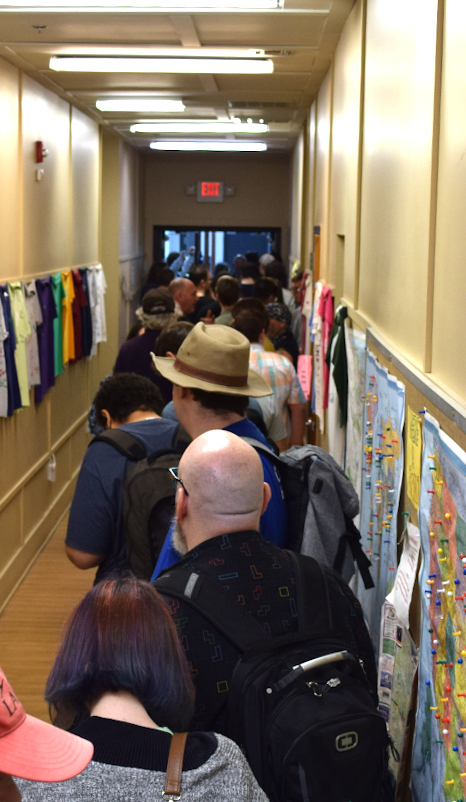
The blatantly obvious pros of having a live Supercon is the ease of talking to everyone who is there, trading code tips, life experience, and must-see projects. In person, you can physically trade badge add-ons in real time, without waiting for customs to clear the packages. Simply hanging out has a real charm to it, and doing so over shared tacos is even better. Spontaneous collaborations were easy and natural. And finally, while you can watch someone electrocute a twinkie with a neon sign transformer on YouTube, you can’t smell the ozone.

Against this, all of the expensive travel, the aforementioned jetlag for some, and the real-world limitations that only so many people can fit in a given physical space at once.

The best part of Remoticon was hearing from people who wouldn’t have been able to make it to an in-person con, whether it’s because it’s of geography or money. Since everything is online, there’s no missing out, and anyone can freely dip in to one talk or another. The online chat channels were better attended during Remoticon as well – perhaps because they were the only game in town – but that was a more global community.

There’s probably nothing that can be done about the tacos, but what could we do about incorporating the benefits of Remoticon? We did stream one stage live, and we had two chat channels open for commentary the whole time. If you took part remotely in Supercon, let us know how it went, and if you have any suggestions to improve our remote experience for next time. Because in the end, we want Hackaday to be as inclusive and as global as the hacker community itself.

Banner Photo by Poyu Chen.