Supercon Keynote: Megan Wachs Breaks Down RISC-V

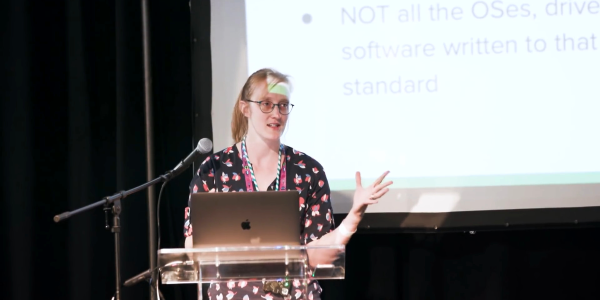
The 2019 Hackaday Superconference kicked off with a marvelous, and marvelously geeky, keynote talk on the subject of RISC-V by Dr. Megan Wachs. She is VP of Engineering at SiFive, a company that makes RISC-V processors in silicon, but the talk is a much more general introduction to the RISC-V open instruction-set architecture (ISA) and why you’d care. The short answer to the latter is the same reason you care about any other open standard: it promotes interoperability, reusable toolchains, and will result in us all having access to better and faster CPUs.

The video is embedded below, and it’s absolutely worth a watch. Unfortunately, The video is missing the first few minutes, you can follow along through her slides (PDF) and read through our brief recap below of what fell down the video hole.

Continue reading “Supercon Keynote: Megan Wachs Breaks Down RISC-V”

Hackaday Belgrade Early Bird Tickets On Sale Right Now

Tickets for Hackaday Belgrade 2020 just went on sale. If you’re quick you can grab an Early Bird ticket at half the price of general admission!

Hackaday’s premiere European hardware conference returns for the third time on May 9th, 2020, bringing together talks, workshops, hardware hacking, food and drink, entertainment, and of course the best gathering of hardware geeks you’ll find anywhere. It’s awesome, because you’re awesome — and I do mean you. Whether you’re submitting a talk proposal or just grabbing a ticket to make this the first conference you’ve ever been to, we can’t do it without you.

Hackaday’s Home in Serbia

We’ll be at Dom Omladine again this year. The venue has feels like a home for Hackaday with a large space for talks, a workshop area, and a huge open area for lobby-con where you’ll find Belgrade’s finest baristas, a great spread of food, and a beer tap to keep the day rolling. Bring along your hardware projects to hack alongside the conference’s custom hardware badge designed by Voja Antonic as we open up the bar and get the live IDM sets started.

It’s still early in our planning (these are Early Bird tickets after all) but it’s very likely we’ll have a meetup the night before the conference. Friends old and new often get together on Sunday to keep the fun going. On Saturday, doors for the conference will open around 9 am and the fun will continue well beyond the 2 am “official” end. We recommend you make travel plans to include the full weekend.

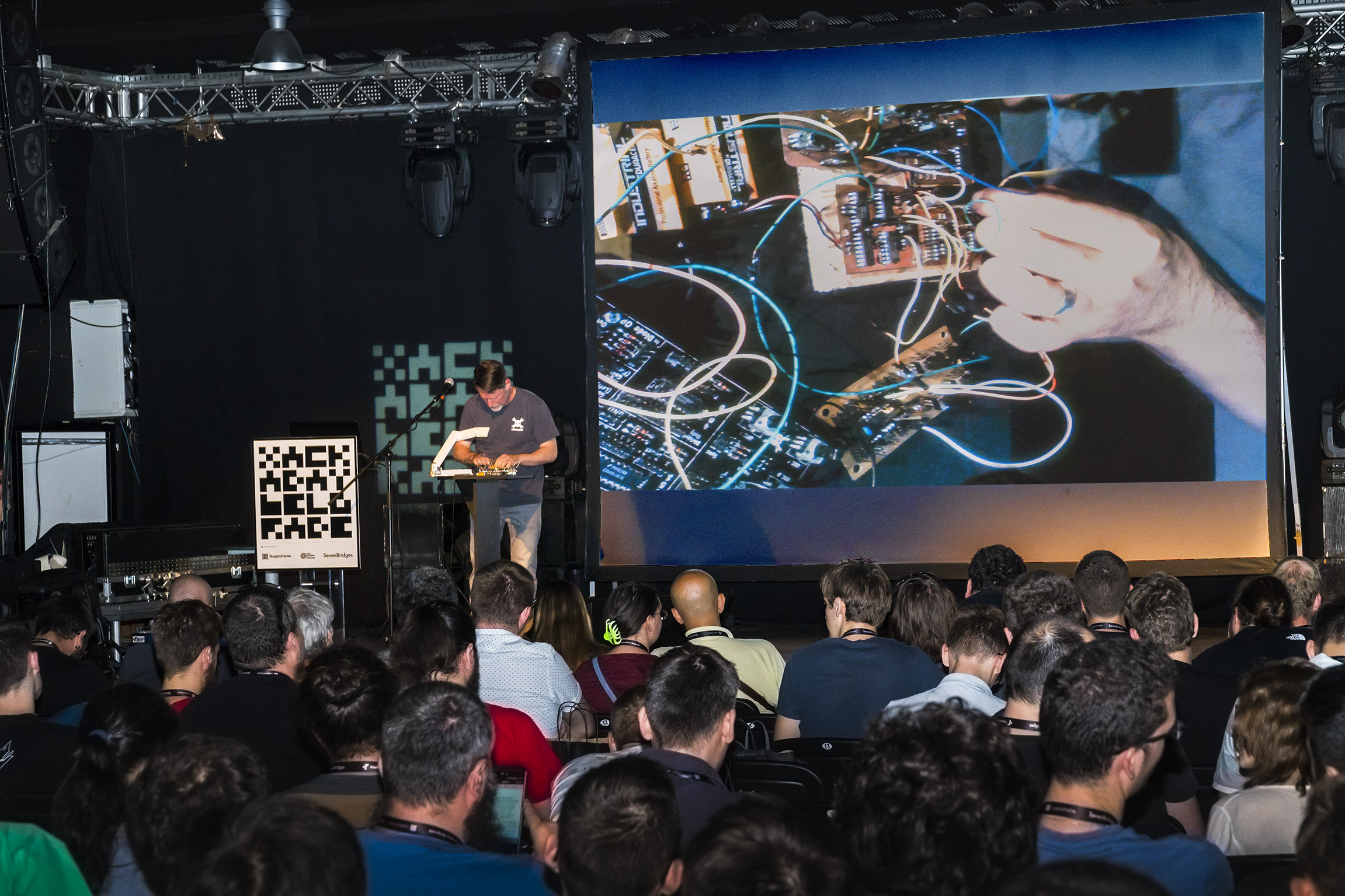
Elliot Williams demos Logic Noise live on stage

Don’t just ask for Friday off of work, bring your friends and co-workers along with you. If you’re most comfortable digging through datasheets while a hot soldering iron idles on your bench and a 3D-printer whirs away in the corner, Hackaday Belgrade is calling you. I encourage those who were at the first two events in 2016 and 2018 to share their stories below.

Don’t miss this one, it only comes around in even-numbered years and tickets will sell out.


Hackaday Belgrade 2020 Posters by Aleksandar Bradic (click for full size download link):

An Eight-Day Home Automation Hackathon Is Inspiration For Getting More Projects Done

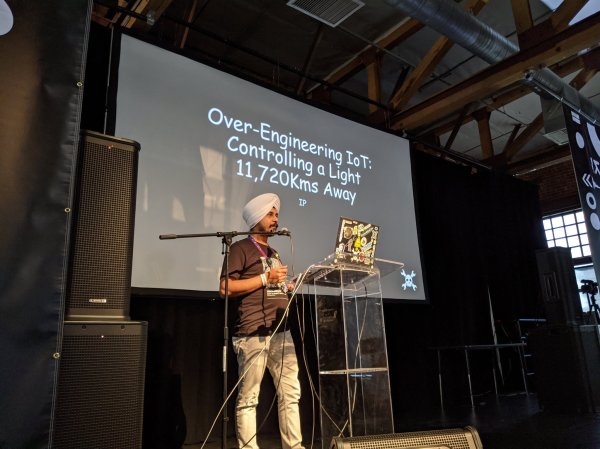
There’s nothing quite like a deadline to cut through extras and get right at the heart of the problem. Maybe we should all follow Interpreet’s example and stop thinking about automating our homes and just make it in an eight-day hackathon. His talk at the 2019 Hackaday Superconference covers the zero-to-deployment home automation build he finished in the eight days leading up to his move from one continent to another.

Hackaday’s very own Inderpreet Singh found himself pulling up roots and moving from his home in India to teach at Centennial College in Toronto, Canada. He needed a way to keep an eye on his home from afar and the name of the game is IoT. When the only choice is “whatever works right now”, you can learn a lot about simple solutions.

He chose familiar hardware to work with, with the ESP8266 making up the bulk of the nodes and a Raspberry Pi as as a central hub for the setup. He chose to communicate between all the nodes on his system using WiFi because the hardware is robust and available. With security in mind, he keeps the automation system separate from the daily use WiFi system by grabbing an extra access point to serve as the automation network. The Raspberry Pi serves as a router of sorts; its Ethernet port is connected to the IoT device’s AP, while the onboard WiFi is used to connect to the home’s main AP for a connection to the wider Internet.

Software for the system is built on a REST API served by a Python Flask app. Many would advocate for using MQTT but Inderpreet’s testing with that protocol came up short as the broker he intended to use was no longer available. One of the interesting parts of his system design is that all nodes will check in at regular intervals; this allows them to inquire about actions they need to take, but it also allows the system to detect a malfunctioning node immediately. I’ve seen a similar trick used by Elliot Williams where he assigns a “ping” topic to all MQTT devices that causes them to report in with their IP address. Having a system to query and ensure the health of every node is a big tip to take away from this talk.

Continue reading “An Eight-Day Home Automation Hackathon Is Inspiration For Getting More Projects Done”

Bringing The Blockchain To Network Monitoring

If you need to make sure your computer isn’t being messed with, you’ll have a look at the log files. If something seems fishy, that’s grounds for further investigation. If you run a large network of computers, you’ll probably want to look over all of the logs, but you won’t want to run around to each computer individually. Setting up a central server to analyze the logs exposes an additional attack surface: the logs in transit. How do you make sure that the attackers aren’t also intercepting and sanitizing your log file reports?

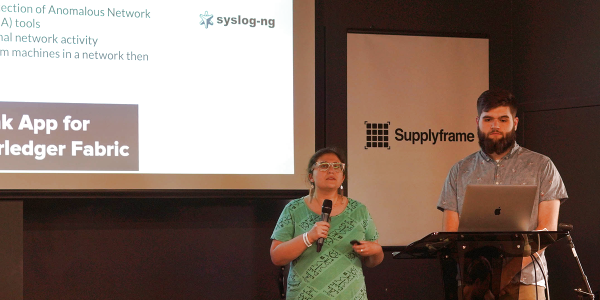
The answer to this question, and nearly everything else, is blockchain! Or maybe it’s not, but in this short presentation from the 2019 Hackaday Superconference, Shanni Prutchi, Jeff Wood, and six other college students intend to find out. While Shanni “rolls her eyes” at much of blockchain technology along with the rest of us, you have to admit one thing: recursively hashing your log data to make sure they’re not tampered with doesn’t sound like such a bad idea. Continue reading “Bringing The Blockchain To Network Monitoring”

Testing Your Grit: Tales Of Hacking In Difficult Situations

What’s your work area like? Perhaps you’re mostly a software person, used to the carpeted land of cubicles or shared workspaces, with their stand-up desks and subdued lighting. Or maybe you’ve got a lab bench somewhere, covered with tools and instruments. You might be more of a workshop person, in a cavernous bay filled with machine tools and racks of raw material. Wherever you work, chances are pretty good that someone is paying good money to keep a roof over your head, keeping the temperature relatively comfortable, and making sure you have access to the tools and materials you need to get the job done. It’s just good business sense.

Now, imagine you’ve lost all that. Your cushy workspace has been stripped away, and you’ve got to figure out how to get your job done despite having access to nothing but a few basic tools and supplies and your own wits. Can you do it? Most of us would answer “Yes,” but how many of us have ever tested ourselves like that? Someone who has tested her engineering chops under difficult conditions — and continues to do so regularly — is Laurel Cummings, who stopped by the 2019 Hackaday Superconference to tell us all about her field-expedient life with a talk aptly titled, “When It Rains, It Pours”.

Continue reading “Testing Your Grit: Tales Of Hacking In Difficult Situations”

Jen Costillo Explains Why Hackers Thrive In A Recession

If you haven’t noticed, this is an absolutely fantastic time to be a hacker. The components are cheap, the software is usually free, and there’s so much information floating around online about how to pull it all together that even beginners can produce incredible projects their first time out of the gate. It’s no exaggeration to say that we’re seeing projects today which would have been all but impossible for an individual to pull off ten years ago.

But how did we get here, and perhaps more importantly, where are we going next? While we might arguably be in the Golden Age of DIY, creative folks putting together their own hardware and software is certainly nothing new. As for looking ahead, the hacker and maker movement is showing no signs of slowing down. If anything, we’re just getting started. With a wider array of ever more powerful tools at our disposal, the future is very literally whatever we decide it is.

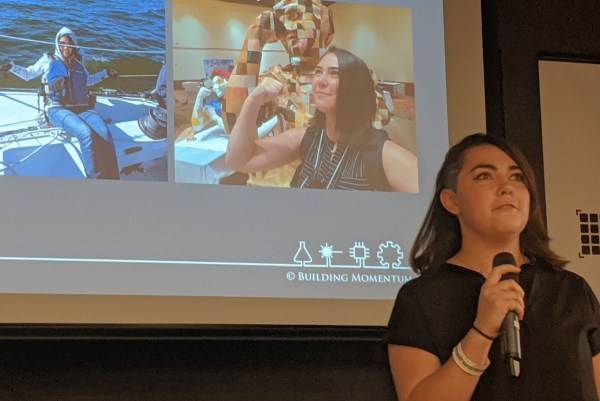
In her talk at the 2019 Hackaday Superconference, The Future is Us: Why the Open Source And Hobbyist Community Drive Consumer Products, Jen Costillo not only presents us with an overview of hacker history thus far, but throws out a few predictions for how the DIY movement will impact the mainstream going forward. It’s always hard to see subtle changes over time, and it’s made even more difficult by the fact that most of us have our noses to the proverbial grindstone most of the time. Her presentation is an excellent way for those of us in the hacking community to take a big step back and look at the paradigm shifts that put such incredible power in the hands of so many.

Continue reading “Jen Costillo Explains Why Hackers Thrive In A Recession”

The Way Of The PCB Artist: How To Make Truly Beautiful Circuit Boards

Getting your own PCBs made is a rite of passage for the hardware hacker. Oftentimes, it’s a proud moment, and many of us choose to immortalise the achievement with a self-aggrandizing credit on the silk screen, or perhaps a joke or personal logo. However, as far as artistically customized PCBs go, the sky really is the limit, and this is the specialty of [TwinkleTwinkie], whose Supercon talk covers some of the pitfalls you can run into when working at the edges of conventional PCB processes. 

[TwinkleTwinkie]’s creations are usually badges of one type or other — they’re meant to be worn on a lanyard around your neck, as a pin, or as a decoration added to another badge. The whole point is the aesthetic, and style is just as important as functionality. With diverse inspirations like Futurama, Alice in Wonderland and the shenanigans of the GIF community, his badges blend brightly colored boards with a big helping of LEDs and artistic silkscreening to create electronic works of art.

Keeping PCB Fab Houses from Upsetting the Artwork

These days, PCB fab houses offer more choice than ever, in terms of silkscreens, soldermask colors, and other options.  However, fundamentally, their primary concern is to produce reliable, accurate, electronically functional boards — and it’s something that can cause problems for #badgelife hackers designing for more aesthetic reasons.
Continue reading “The Way Of The PCB Artist: How To Make Truly Beautiful Circuit Boards”