How To Talk To Your Scope

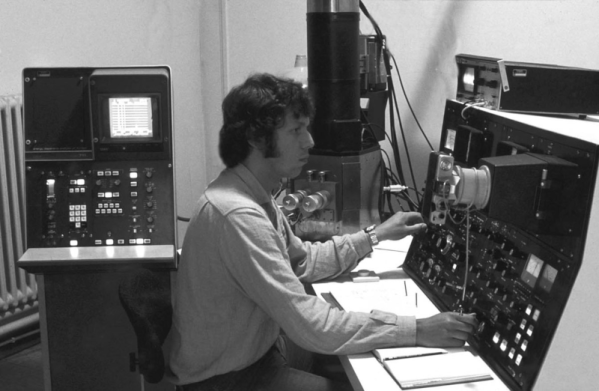
It used to be only high-end test equipment that had some sort of remote control port. These days, though, they are quite common. Historically, test gear used IEEE-488 (also known as GPIB or, from the originator, HPIB). But today, your device will likely talk over a USB port, a serial port, or a LAN connection. You’d think that every instrument had unique quirks, and controlling it would be nothing like controlling another piece of gear, especially one from another company. That would be half right. Each vendor and even model indeed has its unique command language. There has been a significant effort to standardize some aspects of test instrument control, and you can quickly write code to control things on any platform using many different programming languages. In a few posts, I will show you just how easy it can be.

The key is to use VISA. This protocol is defined by the IVI Foundation that lets you talk to instruments regardless of how they communicate. You do have to build an address that tells the VISA library how to find your device. For example: “TCPIP::192.168.1.92::INSTR.” But once you have that, it is easy to talk to any instrument anywhere.

I say that thinking it is a problem is half right because talking to the box is one task of the two you need to complete. The other is what to say to the box and what it will say back to you. There are a few standards in this area, but this is where you get into problems. Continue reading “How To Talk To Your Scope”

2023 Halloween Hackfest: This Year’s Spooky Winners

With the zombies, ghouls, and ghosts now safely returned to their crypts until next October, it’s time to unveil this year’s winners for the 2023 Halloween Hackfest.

For this contest, sponsors DigiKey and Arduino challenged the community to come up with their best creations for what’s arguably the most hacker-friendly of holidays. Pretty much everything was fair game, from costumes to decorations. The top three winners will get $150 credit from DigiKey and some treats from Arduino — just don’t try to eat them.

Continue reading “2023 Halloween Hackfest: This Year’s Spooky Winners”

A long, skeletal neck of a swan automaton sits on a table. Two men are on either side of it, lowering the swan's body back on.

Restoring The Silver Swan Automaton

It’s easier than ever to build your own robot, but humans have been building automatons since before anyone had even thought of electronics. One beautiful example is the Silver Swan, built in the 18th century.

The brainchild of [John Joseph Merlin] and silversmith [James Cox], the swan features three separate clockwork drives, appearing to swim in a moving river where it snatches fish in its motorized beak. Mark Twain said the swan had “a living grace about his movements and living intelligence in his eyes” when he saw it at the International Exhibition in Paris in 1867.

The swan has been delighting people for 250 years, and recently received some much-deserved maintenance. In the video below, you can see museum staff disassembling the swan including its 113 neck rings which protect the three different chain drives controlling its lifelike motions. Hopefully, with some maintenance, this automaton will still be going strong in 2273.

If you’d like to Bring Back the Age of Automatons, perhaps you should study this bird bath or the “Draughtsman-Writer.”

Continue reading “Restoring The Silver Swan Automaton”

Why Gas Turbines Rule The World

It is an interesting fact that the most efficient way to generate electricity — at least so far — is to spin the shaft of a generator. The only real question is how you spin it. Falling water works. Heat from a nuclear reaction is another choice. For many decades, the king of the hill was steam. Now, however, gas turbines rule the electric generator landscape, and [Construction Physics] explains why in a recent post.

With a steam turbine, something burns or otherwise generates heat that boils water. The steam spins the blades, which turns the generator. With a gas turbine, the system compresses air and mixes it with gas. The hot gasses then drive the turbine, which is more efficient than using the combustion to produce steam.

Turns out, the idea for the gas turbine is very old, but material science had to catch up to be practical. Inefficient compressors led to low operating pressures, which was good, in a way, because the materials couldn’t stand the heat and pressure. However, low pressures led to inefficient turbines that were not practical.

The post is long and covers a lot of details about Carnot, Brayton, and Rankine cycles. It is a fascinating read, and we learned a few new things. Bet you will, too.

Turbines are a little like jet engines, but they transfer more power to the turbine blade instead of generating thrust. Turbines show up in odd places today. Some odder than others.

The Case For A Technology Aware Lobby Correspondent

We cover all manner of stories here at Hackaday, including awesome hardware hacks, the latest trends and inventions, and in-depth guides to fascinating technologies. We also cover a few news stories from the wider world outside our community, usually when they have some knock-on effect that has an impact on us. Recently this last category of stories has included laws which present a threat to online encryption and privacy in the UK and in the European Union, for example. They’re not the most joyful of news, but it’s vital for everyone with an interest in online matters to be informed about them.

A Long And Inglorious History

A quad flat-pack computer chip, made by VLSI
The infamous Clipper chip. Travis Goodspeed, CC BY 2.0

Those of us who have followed the world of technology will know that badly thought out laws with a negative impact on technology have a long and inglorious history. Some like the infamous backdoored Clipper chip encryption device die an inglorious death as industry or the public succeed in making them irrelevant, but others such as the Digital Millennium Copyright Act or DMCA live on for decades and present an ongoing malign influence. Most recently our ongoing coverage of dubious drone stories included a hefty dose of equally dubious action from lawmakers.

When considering these pieces of legislation it’s easy to characterise the politicians who advance them as gullible idiots easily swayed by any commercial lobbyist with a fistful of cash. But the reality is far more nuanced, while some of them may well be tempted by those lobbyists  they are in most cases neither gullible nor foolish. Instead they are better characterised as clueless on technical issues, and thus easily swayed by received opinion rather than by technological reality. If there’s a fault in the system it’s that the essential feedback which provides the checks and balances is missing, and oddly while sitting here writing this story, the responsibility for this comes close to home. The solution doesn’t lie in changing the politicians, but in changing how they are treated by journalists. Continue reading “The Case For A Technology Aware Lobby Correspondent”

That Time NASA Built A Tiny Tank To Pop Shuttle Tires

The Space Shuttle has often been called the most complex pieces of machinery ever built, an underhanded compliment if there ever was one. But it’s a claim not strictly limited to the final spacecraft. With a project as far ahead of the technological curve as the Shuttle was in the 1970s, nearly every component and system of the legendary spaceplane required extensive research and development to realize.

A case in point is that the speed and mass of the Shuttle at touchdown required tires that could survive forces far beyond that of a normal airplane. Pumped up to an incredible 350 psi, the space agency estimated each tire had the explosive potential of two and one-half sticks of dynamite. So while testing landing gear upgrades in the 1990s, they cobbled together an RC tank that could “defuse” a damaged tire remotely by drilling holes into it and letting off the pressure. Continue reading “That Time NASA Built A Tiny Tank To Pop Shuttle Tires”

A Brief History Of Weather Control

It used to be a common expression to say that something would happen when “people walked on the moon.” That is, something that was never going to happen. Of course, by 1960, it was clear that someone was going to walk on the moon eventually. There were many other things everyone “knew” would happen in the future. Some of them came true, but many of them didn’t. Some, like video phones and robot factory workers, came true in a way, but not as people imagined. For example, people were confident that computers would easily translate between human languages, something we still have trouble doing entirely reliably. Another standard prediction is that people would control the weather.

Controlling the weather, in some ways, seems even less likely than walking on the moon. After all, we know where the moon is and where it will be. We still don’t understand precisely what causes the weather to behave the way it does. We have models and plenty of scientific theories. But you still can’t know exactly what’s going to happen, where, or when.

History

If you farm or live in a hut, weather is especially important. You want rain but not too much rain. Without scientific knowledge, many cultures had rain-making superstitions like a rain dance or other rituals meant to encourage rain. Some think that loud noises like cannon fire prevent hail.  Charlatans would promise rain in exchange for donations.

However, science would eventually surface, and in the 1800’s James Espy — the first U.S. meteorologist — theorized that convection was what really caused rain. He had bold plans to set massive fires to encourage rain but could not convince Congress to go along.

Half a century later, Robert St. George Dyrenforth tested the effect of explosions on rainfall. There is no evidence that his cannon and fireworks did anything. He did, however, claim credit for any rain that happened to occur nearby. There have been many reports that explosions cause rain — rain often falls after a heated battle, apparently.  The government in Thailand tried to induce rain using dry ice flakes dropped into clouds with, reportedly, some success. Abu Dhabi, Russia, and China’s governments claim to have working weather control today.

Continue reading “A Brief History Of Weather Control”