Simple Looking Antique Internet Radio Has A Lot Under The Hood

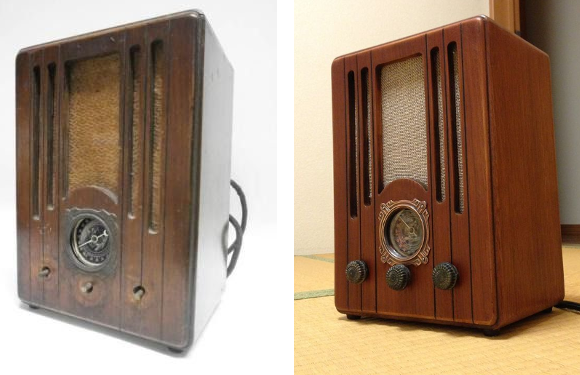
rpi-internet-radioAt first glance you might not even notice that this 1934 radio has been altered. But close study of the tuning dial will tip you off that changes have been made. It still scrolls through stations just like the original. But it’s not a wheel with some numbers on it. The rotary motion is an effect produced by an LCD screen.

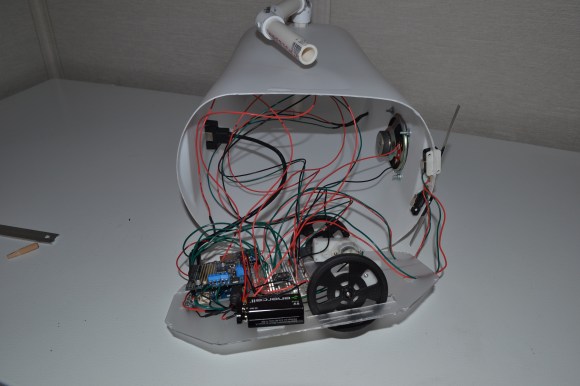
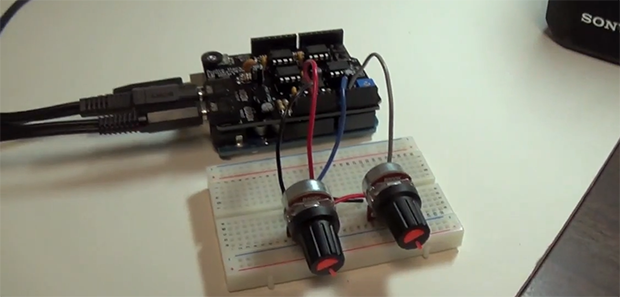
This is the second time we’ve seen one of [Florian Amrhein’s] Internet radio projects. The first used guts from a Laptop paired with an Arduino to pull everything together. This time he’s chosen to wield a Raspberry Pi board. It feeds a USB sound card for a bit better quality. A small amplifier board us used to power one large speaker behind the original grill of the radio.

Check out the demo video to see that radio dial in action. It’s delightful that he went to the trouble to emulate a rotating disc to keep with the theme of the project.

Continue reading “Simple Looking Antique Internet Radio Has A Lot Under The Hood”

Car Stereo AUX Input Taps Into CD Ribbon Cable

[Gezepi] wanted to add an auxiliary input to the stereo in his 1994 Camry. At first look there wasn’t an easy way to patch into the system. But a bit of probing with an oscilloscope and figured out that he could inject audio through the CD ribbon cable shown above. The CD reader is a self-contained unit that receives commands through the cable, and passes analog stereo audio back to the receiver portion of the head unit. We’re not sure how he figured out which pins to tap into, but it may have been as easy as probing with some headphones while a CD is playing.

The extent of his hack is documented in the image below. He cut the two audio leads on the CD side of the ribbon cable, then soldered his auxiliary jack on the receiver side of the cable connector. This ensures that two audio signals aren’t being piped into the receiver at the same time. Unfortunately it also means that he won’t be able to use the CD player. We have seen other methods that use a special audio jack as a pass-through which cuts the connection when a jack is inserted. That’s the method used in this Subaru hack.

Continue reading “Car Stereo AUX Input Taps Into CD Ribbon Cable”

Letting Bluetooth Take The Wires Out Of Your Headphones

bt-wireless-headphones

This picture shows the gist of [Alan’s] hack to transition his wired headphone to internalize a Bluetooth audio receiver (translated).

He starts with a pair of wired “ear muff” style headphones and an aftermarket Bluetooth audio adapter that he’s been using with them. But if you’re not going to plug them into the audio source why have six feet of extra wire hanging about? [Alan] ditched the plastic case surrounding the Bluetooth hardware and cracked open the earpieces to find room for it. It’s a tight fit but there was just enough room.

It is unfortunate that the headphone design doesn’t already have a wired crossover hidden in the arc connecting the earpieces. Alan strung some of that red wire himself to connect the two speakers. The board is mounted so that the USB port is located where the wires used to enter the plastic body. This makes it a snap to plug them in when they need a recharge.

You can play a little “Where’s Waldo” with this one by trying to spot the Raspberry Pi in his build log.


Beck’s Beer Bottle Sound Recording

This beer bottle includes recorded audio etched into the glass. But you certainly won’t find half an album included with your next sixer. This is a one of a kind item that took a team of engineers to craft.

The idea comes from Phonographic Cylinders invented by [Thomas Edison]. Analog audio was etched into cylinders made of wax which could then be played by a needle and amplifying horn. The beer bottle is a similar size of cylinder, but etching the audio signal into glass is a horse of a different color. The video below includes a recounting of the development process from the guys who pulled it off. It includes using hard drive parts and special processing filters that remove harmonics introduced by the milling rig.

We’re sure you’ve figured it out by now; this is an advertisement. We say good! This is the kind of advertising we want. It’s topical, well targeted, and worth paying attention to. We felt the same way about the recent Oreo campaign and that Skittles hack. We hope that ad execs will take note of this.

By the way, it is possible to do this stuff at home. Check out the guy who made an Edison Cylinder wedding ring.

Continue reading “Beck’s Beer Bottle Sound Recording”

Giving Toys An Electronic Voice

sound

Whether it’s a Furby or Buzz Lightyear’s button that plays, ‘To infinity and beyond’, most digital audio applications inside toys are actually simple affairs. There’s no Arduino and wave shield, and there’s certainly no Raspi streaming audio from the Internet. No, the audio inside most toys are one or two chip devices capable of storing about a minute or so of audio. [makapuf] built an electronic board game for his kids, and in the process decided to add some digital audio. The result is very similar to what you would find in an actual engineered product, and is simple enough to be replicated by just about anyone.

[makapuf]’s game is based on Game of the Goose, only brought into the modern world with electronic talking dice. An ATtiny2313 was chosen for the microcontroller and an AT45D 4 Megabit Flash module provided the storage for 8 bit/8khz audio.

The electronic portion of the game has a few functions. The first is calling out numbers, which is done by playing recordings of [makapuf] reading, ‘one’, ‘two’, ‘three’, … ‘twelve’, ‘thir-‘, ‘teen’ and so on. This data is pumped out over a pin on the ATtiny through a small amplifier and into a speaker. After that, the code is a simple matter of keeping track of where the players are on the board, keeping score, and generating randomish numbers.

It’s an exceptional exercise in engineering, making a quite complicated game with a bare minimum of parts. [makapuf] estimated he spent under $4 in parts, so if you’re looking to add digital audio to a project on the cheap, we can’t imagine doing better.

You can see a video of [makapuf]’s project after the break.

Continue reading “Giving Toys An Electronic Voice”

Echolocation Pinpoints Where A Gunshot Came From

echolocating-gunshots

[Kripthor] suspected that hunters were getting too near his house. When thinking of a way to quantify this belief he set out to build a triangulation system based on the sound of gunshots. The theory behind it is acoustic location, which is a specialized type echolocation.

The most common example of echolocation is in Bats, who emit ultrasonic noise and listen for its return (echo) to judge the location of objects. [Kripthor] doesn’t need to generate the sound himself, he just needs to pick it up at different points. The time difference from the three samples can be used to triangulate coordinates as seen in the image above.

He first tried using a PC sound card to collect the samples. The stereo input only provides two channels so he tinkered around with a 555-based multiplexing circuit to sample from three. The circuit noise created was just too great so he transitioned to using an Arduino. The ADC samples from each microphone via an NPN transistor which is used as a simple amplifier.

This brings to mind a homebrew sonar hack from way back.

Raspi Internet Radio With Google Music

SAMSUNG

It’s not his first Internet radio, but [Matthias]’ modernization of a classic Bakelite radio is a real, functional piece of art. Not only does it retain the look of an old radio, it also has the capability to listen to streams and his entire MP3 collection through the Internet.

For the software, [Matthias] used jquery to pull down web radio streams and soon figured out how to play all his MP3s through Google Music. This, and a web-based remote for his mobile device, allows the new old-school Internet radio to play everything [Matthias] would ever want to listen to.

The controls for the radio are rotary encoders, with indication provided by a really fabulous numbered LED display (seen above) replacing the 70-year-old tuning dial. These numbers indicate both the current Google Music playlist or the currently playing Internet stream, depending on what mode the selector knob is at.

It’s a beautiful piece of work, and the knobs and dials look like something that could have come from a real 70-year-old radio. That’s a win in our book.