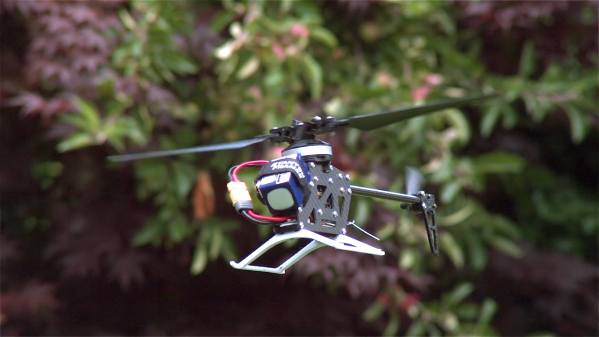
They say that drummers make the best helicopter pilots, because to master the controls of rotary-wing aircraft, you really need to be able to do something different with each limb and still have all the motions coordinate with each other. The control complexity is due to the mechanical complexity of the swashplate, which translates control inputs into both collective and cyclical changes in the angle of attack of the rotor blades.
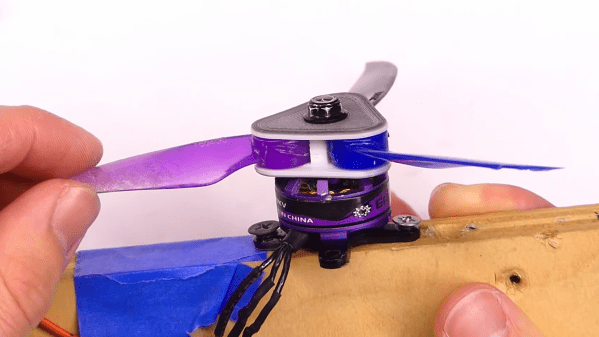
As [Tom Stanton] points out in his latest video, a swashplate isn’t always needed. Multicopters dispense with the need for one by differentially controlling four or more motors to provide roll, pitch, and yaw control. But thanks to a doctoral thesis he found, it’s also possible to control a traditional single-rotor helicopter by substituting flexible rotor hinges and precise motor speed control for the swashplate.
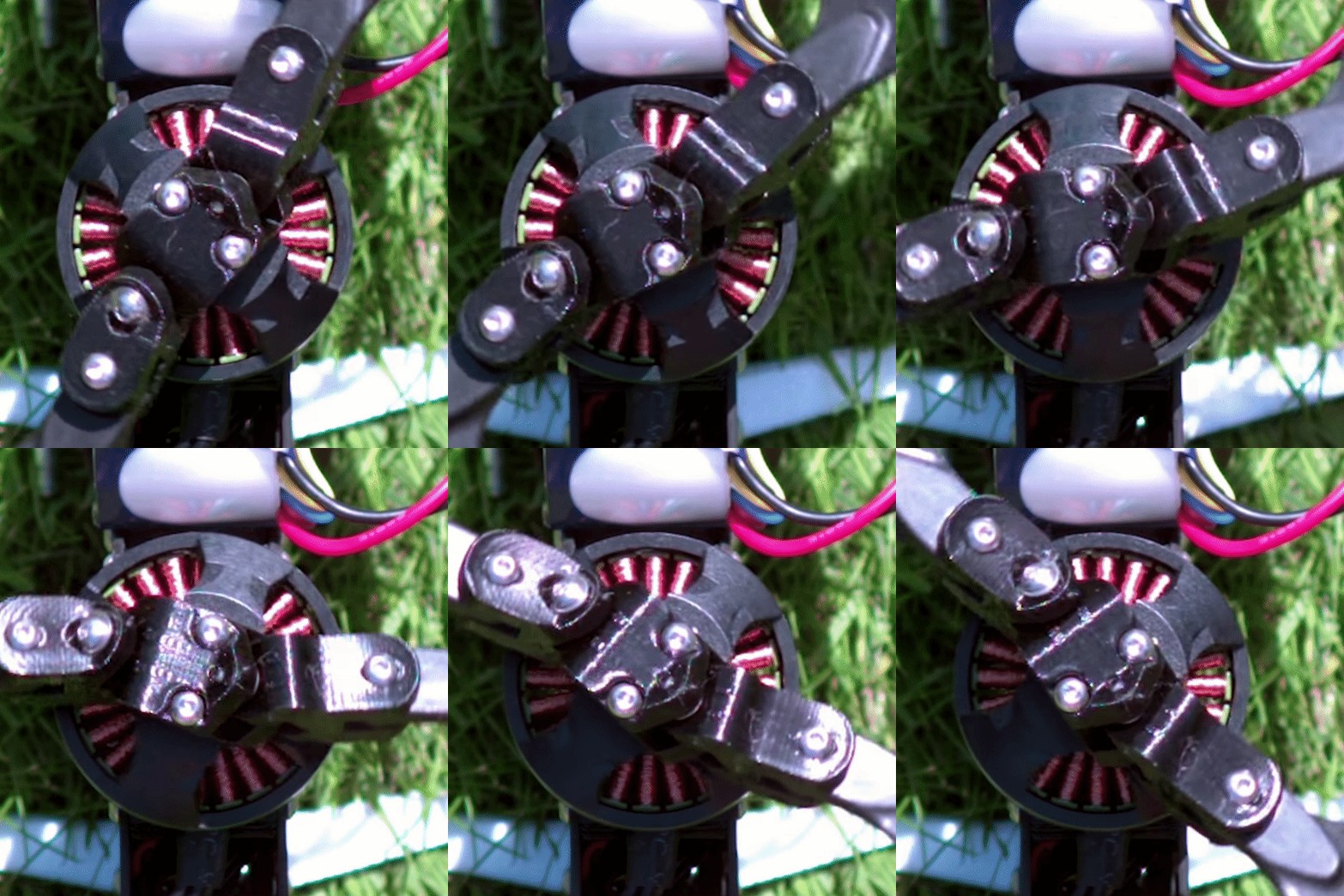 You only need to watch the slow-motion videos to see what’s happening: as the motor speed is varied within a single revolution, the tips of the hinged rotor blades lead and lag the main shaft in controlled sections of the cycle. The hinge is angled, which means the angle of attack of each rotor blade changes during each rotation — exactly what the swashplate normally accomplishes. As you can imagine, modulating the speed of a motor within a single revolution when it’s spinning at 3,000 RPM is no mean feat, and [Tom] goes into some detail on that in a follow-up video on his second channel.
It may not replace quadcopters anytime soon, but we really enjoyed the lesson in rotor-wing flight. [Tom] always does a great job of explaining things, whether it’s the Coandă effect or anti-lock brakes for a bike.
Continue reading “Building And Flying A Helicopter With A Virtual Swashplate”

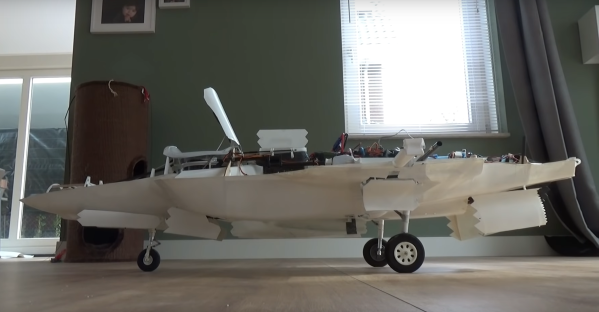
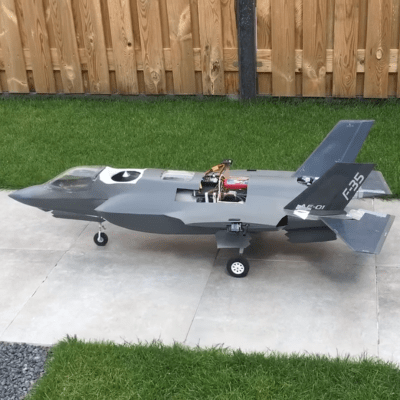 [Joel] wants his model to be as close as possible to the real thing, and has integrated all these features into his build. Thrust is provided by two EDF motors, the pivoting nozzle is 3D printed and actuated by three set of small DC motors, and all 5 doors for VTOL are actuated by a single servo in the nose via a series of linkages. For tilt control, air from the main fan is channeled to the wing-tips and controlled by servo-actuated valves. A flight controller intended for use on a multi-rotor is used to help keep the plane stable while hovering. One iteration of this plane bit the dust during development, but [Joel] has done successful test flights for both hover and conventional horizontal flight. The really tricky part will be transitioning between flight modes, and [Joel] hopes to achieve that in the near future.