Delivery Drone Aims To Make Package Handoffs Safer Than Ever

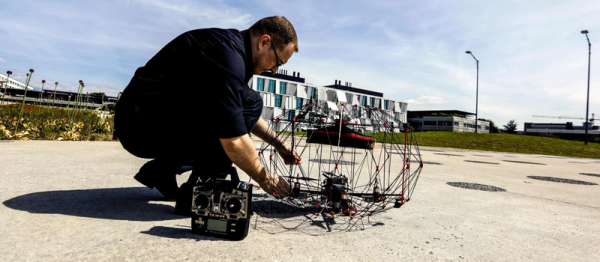
Picture this: you’re at home and you hear a rapping on your door. At last!– your parcel has arrived. You open the door, snatch a drone out of the air, fold it up, remove your package, unfold it and set it down only for it to take off on its merry way. Hand-delivery courier drones might be just over the horizon.

Designed in the [Laboratory of Intelligent Systems] at Switzerland’s École Polytechnique Fédérale de Lausanne and funded by [NCCR Robotics], this delivery drone comes equipped with its own collapsible carbon fibre shield — it fold up small enough to fit in a backpack — and is able to carry packages such as letters, small parcels, and first aid supplies up to 500 g and to 2 km away!

Continue reading “Delivery Drone Aims To Make Package Handoffs Safer Than Ever”
Hackaday Prize Entry: Bloodhound Autonomous Radiolocation Drone

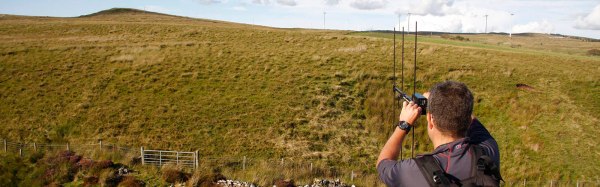
If you’re a first responder — say, searching for someone lost in the outback, or underneath an avalanche — and you’re looking for someone with a radio beacon, what’s the fastest way to find that beacon? Getting up high would be a good idea, and if you’re using radio direction finding, you’ll want to be able to cover a lot of ground quickly if only to make the triangulation a bit easier. High and fast — sounds like the perfect opportunity for a drone, right?

[Phil Handley]’s Bloodhound project is an autonomous drone that can scan a wide area, listening for emergency beacons while alerting the search and rescue personnel. His test bed tricopter uses DT750 brushless outrunners controlled by 18A Turnigy Plush ESCs and powered by a 2200mAh LiPo. A metal-gear servo works the yaw mechanism. He’s also got a Pixhawk Autopilot, a ArduPilot flight controller, a NavSpark GPS, a software defined radio dongle, and a Raspberry Pi. He made the air frame out of wooden dowels, following RCExplorer’s tricopter design.

The next challenge involves radio direction finding, essentially creating Bloodhound’s foxhunting skills. It needs to be able to autonomously track down a signal by taking readings from multiple angles. In addition to finding lost skiers, [Phil] also envisioned Bloodhound being used to track other beacons, of course—such as wildlife transponders or errant amateur rockets.

Fidget Spinner Slash Drone Is Both

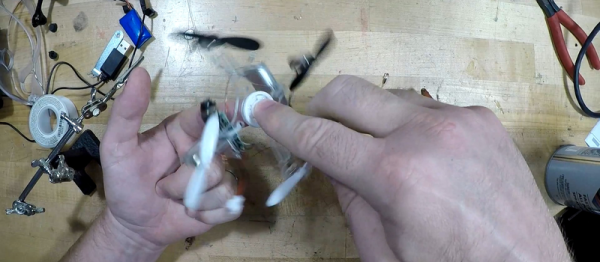
So Hackaday loves fidget spinners and we don’t care who knows it. Apparently so does [Jeremy S Cook], who decided to mash up a spinner and a cheap quadcopter. To what end? Is that even a question? Spinners are the bearing-studded equivalent to the Rubik’s Cube craze of the ’80s and all we can do is embrace it.

[Jeremy] designed a quadcopter shape with a hole in the center matching a VCB 22 mm ceramic bearing he had on hand. He CNCed out the design from a sheet of Lexan resin. Then he detached the electronics amd motors from a quad.

He used a rotary tool to cut off the housing, removed the motors, then inserted them in the new frame, using hot glue to secure them. He installed the control board 90 degrees off of the frame, before realizing it would mess with the accelerometer and re-installed it flat. Meanwhile, the center of the frame sports the all-important bearing.

If you’re looking for more quad projects check out these cool projects: a Power-Glove-controlled drone, this PVC-pipe quadcopter frame, and reverse engineering quadcopter controls.

Continue reading “Fidget Spinner Slash Drone Is Both”

Duocopter Does It With Two Fewer Propellers

Quads are a great ‘copter design. The paired blades counteract each others’ torque, and varying the relative speeds of the four motors makes it easy to steer. But what if you could get by with fewer blades, substituting a significantly fancier control algorithm?

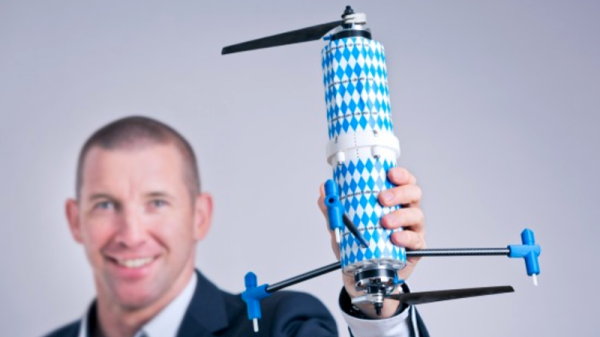
[Dirk Brunner]’s DuoCopter drone uses two propellers that counter-rotate, and it steers by increasing and decreasing the speed at which the blades rotate within a single revolution. Spinning faster on one side than the other makes it tilt. Saying this is one thing, but getting the real-time control algorithms up and running is another. From the video embedded below, it looks like [Dirk] has it working. (He also holds the world’s record for fastest quadcopter ascent, FWIW.)

Of course some of you out there won’t be satisfied until your ‘copter has only one propeller. Or maybe you’d prefer a third prop. Whatever your taste, we’re stoked to see people pushing the boundaries of copter design.

Continue reading “Duocopter Does It With Two Fewer Propellers”

UK To Register Multirotor Fliers

The British government has shown a surprisingly light touch towards drone fliers in the face of the strident media demands for them to be banned following a series of reports of near-misses with other aircraft. That is about to change with reports of the announcement of a registration scheme for craft weighing over 250 g (about 9 oz). Details are still a bit sketchy, but it is reported that there will be a written test and an element of geofencing around sensitive locations.

Our friendly professional multirotor flier’s reaction is that the existing laws are clear enough, and that this is likely to be no deterrent to any people who already use their drones illegally. It seems that the UK government is following the lead set by the USA in this matter, with the 250 g limit on that side of the Atlantic having already spawned an industry of smaller craft. Time will tell on whether the measures will be effective, we suspect that their success will depend on their not being overly stringent.

[Editor’s note: Following a lawsuit, the US FAA registration requirement was struck down for hobbyists because model aircraft are explicitly excluded from the FAA’s purview. The Brits are not likely to be so lucky.]

If there is a positive side to this announcement, it might be that the 250 g class of multirotor will inevitably become the focus of a lot of attention as manufacturers and engineers work to pack the most performance into the small platform. This small silver lining to the drone registration cloud might not be much, but we’ll take it.

We’ve covered the UK drone story as reported in the media in detail in the past.

Palace of Westminster image: Diliff [CC BY-SA 2.5].

DIY Air Cannon Snags Drones From The Sky

Who hasn’t had the experience of a pesky drone buzzing around that family picnic, or hovering over a suburban backyard where bikini-clad daughters are trying to sunbathe in peace? A shotgun used to suffice for such occasions, but with this compressed-air powered drone catcher, there’s no need to worry about illegally discharging a firearm to secure some privacy.

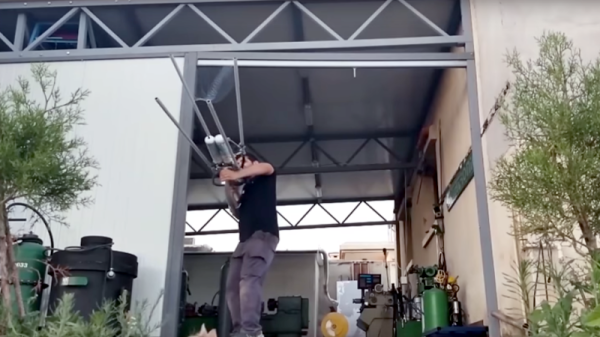
Before the comment line lights up with outrage, the above scenarios are presented entirely in jest. We do not condone the use of force on a drone, nor do we look favorably on those who use drones in a way that even hints at an invasion of privacy. We can all get along, and even though we hope [Make It Extreme]’s anti-drone gun will never be used in anger, it’s still a neat build that gives us lots of ideas. The rig is essentially four coaxial narrow-bore compressed-air cannons, each launching a slug attached to the corner of a lightweight net. A fairly complex set of linkages sets the spread of the barrels, and a pair of old oxygen tanks serve as reservoirs for the compressed air. A fast-acting dump valve is tripped by an interesting trigger mechanism mounted to a complicated stock and grip; we’d have liked to see more on the fabrication of that bit. The video below shows a test firing that results in a clean takedown of a drone, although we doubt the owner of the quad would characterize it as such.

This build is a bit of a departure from [Make It Extreme]’s usual fare of DIY tools like a shop-built vise or big belt sander, or their unusual vehicles like an off-road hoverboard. But it’s always great to watch a good fabrication video, no matter what the subject.

Continue reading “DIY Air Cannon Snags Drones From The Sky”

Flying Defibrillators

It’s a sad reality that, by and large, cardiopulmonary resuscitation (CPR) doesn’t save lives. Despite all the “you could save a life” marketing aimed at getting people certified in CPR, the instances where even the prompt application of the correct technique results in a save are vanishingly rare, and limited mostly to witnessed arrests in a hospital. Speaking from personal experience, few things are sadder than arriving on-scene as a first responder to see CPR being performed by a husband on his wife and knowing that no matter what we do, it’s not going to end well.

The problem is one of time. Hearts only rarely just stop beating outright; usually some kind of arrhythmia first causes the heart to beat ineffectively, leading to hypoxia and loss of consciousness. From there it’s about a four-minute trip to brain death, but in that brief window chances are pretty good that the heart can be restarted. That’s why witnessed cardiac arrests in a hospital have better survival rates — the needed electric reboot of the heart with a defibrillator is only as far away as the nearest crash cart.

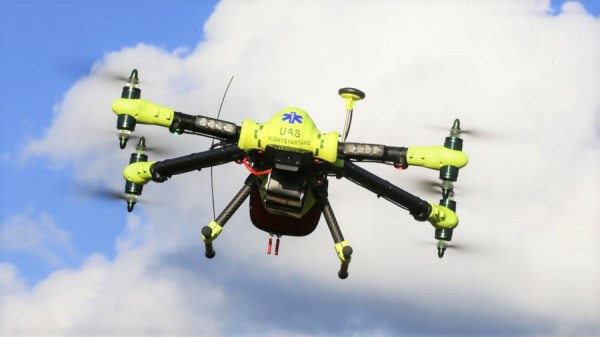
The advent of the automatic external defibrillator (AED) has increased the odds for survival of out-of-hospital cardiac arrest (OHCA), but the penetration of AEDs into public settings is far from complete enough to put one within a few minutes reach of everyone who might need one. So it’s only natural that thoughts would turn to delivering AEDs to cardiac incidents by drones. It seems like a great idea, but will it work? Continue reading “Flying Defibrillators”