London Gatwick Airport Closes Runway In Alleged Drone Strike

London is one of those cities with an identity problem when it comes to airports. There is no one London airport, instead a group of airports serve the city at various distances from it. London Gatwick is the second largest of these, and sits with its single runway in the Sussex countryside about 30 miles south of the city.

If you follow British news sources, you may have heard a little about Gatwick in the last couple of days. Its runway was closed for two short periods and a selection of flights were diverted, because of what is being reported as a drone sighting. This is an extremely serious matter, responsible multirotor owners will be painfully aware of the distance and altitude regulations surrounding flights near airports.

An oft-shared drone identification guide for airline pilots, of uncertain provenance.
An oft-shared drone identification guide for airline pilots, of uncertain provenance (phantompilots.com).

If you are familiar with the way that drone stories are reported by the mass media, you will probably not need to click on the link above to the BBC reporting to find out its tone. There is significant concern within the multirotor community that it presents a very one-sided view, and takes at face value the assertion that the sighting was a drone, when in fact there is no proof at all of that being the case. For those of us who have seen many such stories come and go it is difficult not to agree with the drone pilots, there is at best some lazy reporting in the air, and at worst some outright journalistic irresponsibility.

As Hackaday readers, you are used to writers with an in-depth knowledge of the subjects upon which they write. We don’t know all possible facets of technology and we occasionally get things wrong, but we all have very strong backgrounds in the tech, hacker, and maker industries and communities we write about. We have engineering education, we’ve worked in a wide variety of technology industries, we build our own stuff for fun, and we’ve founded and run hackspaces.

By comparison the journalists whose work you will read in the mainstream media are generalists. They will have a specific educational background and a particular set of interests, but in their work they cover whatever stories tumble off the endless conveyor belt of events. Thus when a drone story appears, they find themselves out of their normal comfort zone of politics or local news, and can not rely on their experience to inform their coverage of it. The responsible journalistic approach is to do a little research and ask the pertinent questions asking for concrete proof of drone involvement. We’re still waiting for that to happen in these allege drone encounters.

Multirotor building and flying is a significant feature of our community, and anything that brings the attention of law enforcement to the kind of work we do should be a worry to us all. Multirotors are not the only things covered by Hackaday that could be misrepresented in the same way. We’ve visited this topic before, take a look at our analysis of a series of air proximity reports blamed on drones. Some of them, you couldn’t make up.

Gatwick airport image: Andre Wadman [GFDL 1.2].

Automate The Freight: Front Line Deliveries By Drone

Gen. Robert H. Barrow, USMC, once said that “Amateurs talk about tactics, but professionals study logistics.” That’s true in many enterprises, but in warfare, the side that neglects logistics is likely to be the loser. Keeping soldiers fed, clothed, and armed is the very essence of effectively prosecuting a war, and the long logistical chain from rear supply depots to forward action is what makes that possible.

Armies have had millennia to optimize logistics, and they have always maximized use of new technologies to position supplies where they’re needed. Strong backs of men and beasts sufficed for centuries, supplemented by trains in the 19th century and supplanted by motor vehicles in the 20th. Later, aircraft made an incalculable impact on supply chains, allowing rapid mobilization of supplies and supporting the industrial scale death and destruction of the 20th-century’s wars.

Continue reading “Automate The Freight: Front Line Deliveries By Drone”

Manned Multirotor Flies Again, Electric Style

You can’t keep a good hacker down. [Amazingdiyprojects] wants to build a reliable manned multirotor, and by golly, he’s doing it.  After a crash of his petrol powered design, [Amazingdiyprojects] went back to the drawing board. The new version is called chAIR, and is electric-powered.

The flying machine is lifted by 76 Multistar Elite quadcopter motors. Control is passed through 5 KK 2.1 quadcopter controllers. The KK board is a very simple controller, and we’re a bit surprised [Amazingdiyprojects] didn’t go with a newer setup. Batteries are 80x Multistar 4S 5.2Ah packs, stored below the seat. If these names sound familiar, it’s because just about every electrical part was purchased from Hobby King – an online hobby retailer.

The machine has an all up weight of 162 kg. A bit more than a single person can carry, but chAIR breaks down for easy transport.

We’re blown away by all the little details on chAIR – including the new control system. The left stick controls throttle, while right appears to control aileron/elevator and twist for the rudder control. Somewhat different from the collective/cycle controls found on conventional helicopters!

Even the battery connectors needed custom work. How do you connect 20 batteries at once? [AmazingDiyProjects] mounted XT60 connectors in a metal ring. The ring is compressed with a central screw. A quick spin with a battery-powered drill allows this new aviator to connect all his batteries at once. Is this the future of aviation, or is this guy just a bit crazy? Tell us in the comments!

Continue reading “Manned Multirotor Flies Again, Electric Style”

3D-Printed Rover Rolls Light And Looks Right

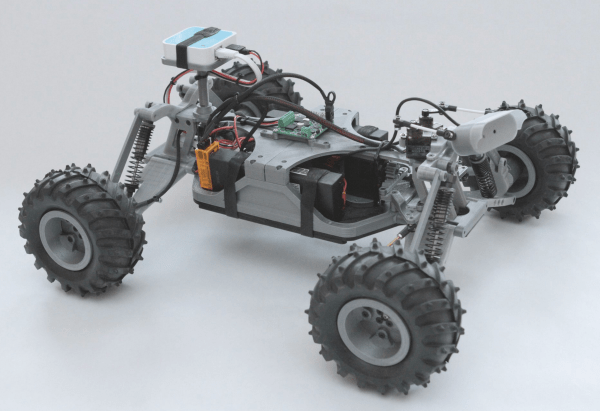
[Rick Winscott]’s RO-V Remotely Operated Vehicle instructable shows you how to make this cool-looking and capable robot. The rover, a 1/10th scale truggy, sports a chassis printed in silver and black PLA. It’s got a wireless router mounted on the back, and a webcam in a 2-servo gimbal up front. [Rick] made his own steering rack and pinion out of 3D printed parts and brass M3-threaded rods which he tapped himself.

The simplified drive system nixes the front, rear, and center differentials, thereby saving [Rick] on printing time, complexity, and weight — he was able to include a second 4000 mAH battery. A TReX Jr motor controller runs a pair of Pololu gear motors. All of this is controlled by a Beaglebone Black alongside a Spektrum DX6i 2.4Ghz transmitter and an OrangeRx 6-channel receiver. The DX6i [Rick] employs typically finds use as an airplane/quad controller, but he reconfigured it to steer the rover—the left stick controls direction and the right stick (elevator and aileron) control the webcam servos.

Enough talking technicals. We think this rover is pretty in the face. Much of this attraction owes to the set of Dagu Wild Thumper wheels (an entirely reasonable name) and the awe-inspiring 100mm shocks that jack up this whip so pleasingly. However, [Rick]’s elegant chassis and the silver-and-black color scheme doesn’t hurt one bit. The wheels are mostly for the cool factor, however—[Rick] recommends swapping out the relatively modest Pololu 20D gear motors in favor of higher-torque models if you’re planning any actual off-road extremeness. If you’re interested in making your own you can download the chassis files from Tinkercad or the BeagleBone code from Github.

If it’s other drone projects you’re after, check out the duct rover and solar wifi rover we published recently.

Drone Takes Off With A Flick Of The Wrist

One of the companion technologies in the developing field of augmented reality is gesture tracking. It’s one thing to put someone in a virtual or augmented world, but without a natural way to interact inside of it the user experience is likely to be limited. Of course, gestures can be used to control things in the real world as well, and to that end [Sarah]’s latest project uses this interesting human interface device to control a drone.

The project uses a Leap Motion sensor to detect and gather the gesture data, and feeds all of that information into LabVIEW. A Parrot AR Drone was chosen for this project because of a robust API that works well with this particular software suite. It seems as though a lot of the grunt work of recognizing gestures and sending commands to the drone are taken care of behind-the-scenes in software, so if you’re looking to do this on your own there’s likely to be quite a bit more work involved. That being said, it’s no small feat to get this to work in the first place and the video below is worth a view.

To some, gestures might seem like a novelty technology with no real applications, but they do have real-world uses for people with disabilities or others with unusual workflow that require a hands-free approach. So far we’ve seen hand gesture technologies that drive cars, help people get around in the physical world, and even play tetris.

Continue reading “Drone Takes Off With A Flick Of The Wrist”

Harrier-like Tilt Thrust In Multirotor Aircraft

A traditional quadcopter is designed to achieve 6 degrees of freedom — three translational and three rotational — and piloting these manually can prove to be a challenge for beginners. Hexacopters offer better stability and flight speed at a higher price but the flight controller gets a bit more complex.

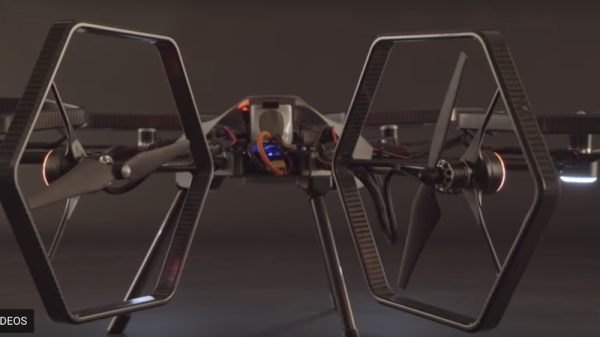
Taking this to a whole new level, the teams at the Swiss Federal Institute of Technology (ETH Zürich) and Zurich University of the Arts (ZHDK) have come together to present a hexacopter with 6 individually tiltable axes. The 360-degree tilt in rotors allows for a whopping 12-degrees of freedom in flight and allows the UAV to fly in essentially any direction including parallel to walls.

In addition to the acrobatic capabilities of the design, the team has done some testing with autonomous control using external cameras. Their blog contains videos of their testing at various stages and it interesting to see the project evolve over a short span of nine months. Check out the video below of the prototype in action.

With Amazon delivering packages via drone and getting patents for parachute labels, UAV design is evolving faster now than ever. We can’t wait to see where this 12 DOF takes the state of the art. Continue reading “Harrier-like Tilt Thrust In Multirotor Aircraft”

Automate The Freight: Maritime Drone Deliveries

Ships at sea are literally islands unto themselves. If what you need isn’t on board, good luck getting it in the middle of the Pacific. As such, most ships are really well equipped with spare parts and even with raw materials and the tools needed to fabricate most of what they can’t store, and mariners are famed for their ability to make do with what they’ve got.

But as self-sufficient as a ship at sea might be, the unexpected can always happen. A vital system could fail for lack of a simple spare part, at best resulting in a delay for the shipping company and at worst putting the crew in mortal danger. Another vessel can be dispatched to assist, or if the ship is close enough ashore a helicopter rendezvous might be arranged. Expensive options both, which is why some shipping companies are experimenting with drone deliveries to and from ships at sea. Continue reading “Automate The Freight: Maritime Drone Deliveries”