Free Falling Quadcopter Experiments End With Splat

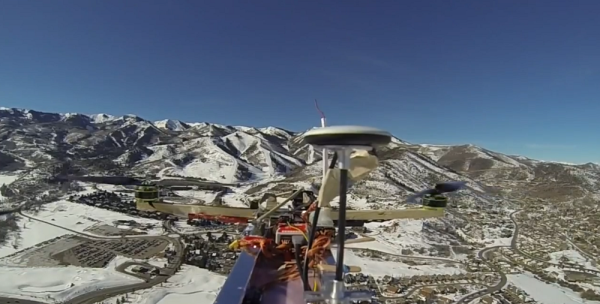
Don’t get too attached to the great picture up above, as the quad shooting it was in a death plunge when the frame was snapped. There’s just something tempting about free fall. Nearly every tri/quad/hex/multicopter pilot has the impulse to chop the throttle while flying around. Most quadcopters are fixed pitch, which means that as power drops, so does control authority. When power is cut, they fall like stones. A quick throttle chop usually results in a few feet of lost altitude and a quickened pulse for the pilot. Cut power for much longer than that, and things can get really interesting.  [RcTestFlight] decided to study free fall in depth, and modified a test bed quadcopter just for this purpose.

First, a bit of a primer on free-falling quadcopters and their power systems.  Quadcopters always have two motors spinning clockwise, and two spinning counterclockwise. This configuration counters torque and allows for yaw control. Most large quads these days use sensorless brushless motors, which can be finicky about startup conditions. Brushless controllers are generally programmed to kick a motor into spinning in the proper direction. If a motor is spinning in reverse at several hundred RPM, things can get interesting. There will often be several seconds of stuttering before the motor starts up, if it starts at all. The controller MOSFETS can even be destroyed in cases like this.

When a quadcopter loses power, the motors slow down and thrust drops off. The quad begins to drop. As the falling quadcopter picks up speed, the propellers begin to spin (windmill) due to the air rushing up from below. If the quadcopter started its fall in a normal attitude, all four of  the propellers will rotate reverse of its normal direction.  The now spinning props will actually act as something of an air brake, slowing the fall of the quad. This is similar to a falling maple seed, or autorotation in a helicopter.  The spinning blades will also act as gyroscopes, which will add some level of stabilization to the falling quadcopter. Don’t get us wrong – the quadcopter can still be unstable as it falls, generally bobbing and weaving through the air. None of this is a guarantee that the quad won’t tip over onto its back – which will reverse the entire process.  Through all of this bobbing, weaving, and falling the flight controller has been along for the ride. Most flight controllers we’ve worked with have not been programmed with free fall in mind, so there is no guarantee that they will come back on-line when the throttle is rolled on. Thankfully many controllers are open source, so testing and changes are only a matter of risking your quadcopter.

Continue reading “Free Falling Quadcopter Experiments End With Splat”

Weaponized Quadrotor Upgrades

Today we’re looking at a few fun hacks, although they are perhaps a bit ill-advised. What’s the craziest thing you could strap to a quadrotor? Rockets? Lasers? Turns out… they’ve both been done already.

First up is [Ramicaza’s] firework launching quadrotor. The drone is stabilized using the ArduPilot Mega 2.6, and it carries a pair of “rockets” which are ignited by a pair of steel elements. An ATtiny analyzes the auxiliary radio channel’s PWM signal which controls the relays that power the elements. He’s tested it high up in the sky, so he’s actually being pretty safe about it.

Next is [JLaservideo’s] laser quadrotor. He’s taken a RC controller of a cheap toy to add wireless capabilities to his Arduino Uno. He’s re-routed the original RC toy’s motor wires to an input on the Arduino which in turn activates a 5V relay that powers the 1W laser. It looks awesome thanks to the bright beam — we just really hope he’s wearing proper eye protection, as a laser of that power can do some serious damage to your retinas!

Stick around after the break to see both quadrotors in action!

Continue reading “Weaponized Quadrotor Upgrades”

Autonomous Quadcopter Fits In The Palm Of Your Hand

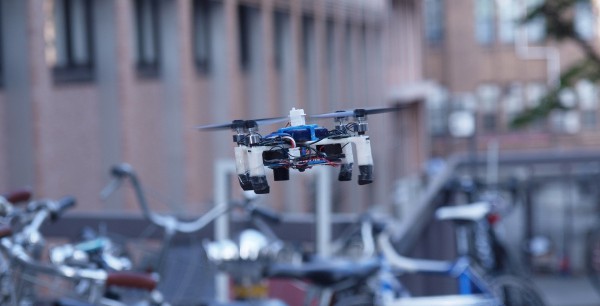
[Horiken Engineering], which is made up of engineering students at the department of aerospace at the University of Tokyo have developed an autonomous quadcopter that requires no external control — and its tiny. By using two cameras and a sonar sensor, the quadcopter is capable of flying by itself due to its ability to process the data from the on-board sensors. To do the complex data processing fast enough to fly, it is using a Cortex-M4 MCU, a Spartan-6 FPGA, and 64MBs of DDRSDRAM. It also has the normal parts of a quadcopter, plus gyros, a 3D printed frame and a 3-axis compass. The following video demonstrates the quadcopter’s tracking ability above a static image (or a way point). The data you see in real-time is only the flight log, as the quadcopter receives no signal — it can only transmit data.

Continue reading “Autonomous Quadcopter Fits In The Palm Of Your Hand”

The World’s First Autonomous Flapping MAV

Screen Shot 2013-12-22 at 7.57.23 PM

[Ferdinand] sent in a tip about the very cool DelFly Explorer, built by researchers at Netherlands’ Delft University of Technology, which is claimed to be the world’s first autonomous, flapping micro air vehicle. While it doesn’t fly like a typical ornithopter, the specs will convince you not to care. It has an 28 cm wingspan and weighs 20 grams, which includes motors, a battery, two cameras, and an autopilot. The autopilot uses accelerometers and a gyroscope, plus a barometer for altitude measurement. You can see the on-board video at the 35-second mark on the video (after the break). They are incredibly noisy images, but apparently the researchers have come up with some algorithms that can make sense of it.

Put it all together, and you have a machine that can take off, maintain altitude, avoid obstacles, and fly for nine minutes. We’ve seen a cool ornithopter design before, and even a thrust vectoring plane, but this surpasses both projects. It’s pretty incredible what they have been able to fit into such a small design.

Continue reading “The World’s First Autonomous Flapping MAV”

Battlebots In The Sky

Here’s one of those ideas that makes us wonder: “Why didn’t we come up with that?” The LVL1 in Louisville, Kentucky is hosting an event they call the Quadcopter Ultimate Aerial Combat Competition (QUACC). Kudos to them on coming up with a very professional name for the event. At risk of drawing cease-and-desist orders from the defunct TV program, we’ll always think of this as Battlebots in the Sky. (Lawyers: please don’t make us take that down… it’s an homage to the awesomeness that was at least the first few seasons of the show).

So why are we publicizing local events on Hackaday? It’s not the event, but the idea that’s spectacularly worth sharing! You’ve got to check out their contest rules as well as the Q&A list. Registration is closed, but the lucky ones who claimed a spot for the low price of $40 will be issued a regulation quadcopter today. They have a week to play around with it, testing out different ideas for disabling their enemy. A match ends when either one competitor defeats the other, or when a competitor’s battery runs dry. A new battery is the issued to the winner for use in the next round.

We’d love to hear your ideas for weaponizing (or adding countermeasures to) these delicate, lightweight aircraft. Aerosol accelerant and a BBQ igniter? How about shielding and a type of EMP, or some other system that will disrupt controller commands of your opponent? Obviously if you launch a similar competition at your hackerspace we want to hear about it!

[Thanks Gerrit]

SkyJack: A Drone To Hack All Drones

Quadcopters are gradually becoming more affordable and thus more popular; we expect more kids will unwrap a prefab drone this holiday season than any year prior. [Samy’s] got plans for the drone-filled future. He could soon be the proud new owner of his own personal army now that he’s built a drone that assimilates others under his control.

The build uses a Parrot AR.Drone 2.0 to fly around with an attached Raspberry Pi, which uses everybody’s favorite Alfa adapter to poke around in promiscuous mode. If the SkyJack detects an IEEE-registered MAC address assigned to Parrot, aircrack-ng leaps into action sending deauthentication requests to the target drone, then attempts to take over control while the original owner is reconnecting. Any successfully lassoed drone doesn’t just fall out of the sky, though. [Samy] uses node-ar-drone to immediately send new instructions to the slave.

You can find all his code on GitHub, but make sure you see the video below, which gives a thorough overview and a brief demonstration. There are also a few other builds that strap a Raspberry Pi onto a quadcopter worth checking out; they could provide you with the inspiration you need to take to the skies.

Continue reading “SkyJack: A Drone To Hack All Drones”

A Collective Pitch Quadcopter

Quadcopters aren’t a new thing, but for all the advances in multi-rotor craft, they all still fall into the paradigm of, ‘stick a prop on a motor and repeat three more times. [Curtis Youngblood], one of the top RC heli pilots in the world, came up with a very cool drive system for a quad, requiring only one motor and granting each blade collective pitch that allows for absolutely insane acrobatic ability.

There’s only one motor inside the Stingray 500, as [Curtis] calls his new toy. It’s at the rear of this quad’s H-frame, attached to a shaft running down the spine with a pair of pulleys. All four rotors are driven by this spinning shaft.

Because [Curtis] is an acrobatic pilot, he needed a way to control his ‘copter in more than one direction. To do this, he added four servos on each arm of the quad, giving each rotor collective pitch, just like the tail rotor of a real helicopter. The result is a quadcopter that can fly upside-down with the greatest of ease, perform barrel rolls, and all the other maneuver a true 3D RC ‘copter can do.

The awesome guys at Flite Test had [Curtis] visit their hangar and had him do an awesome demo flight. You can check out that video below.

Continue reading “A Collective Pitch Quadcopter”