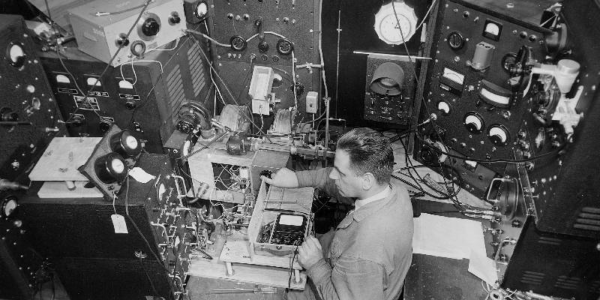
Remembering The MIT Radiation Laboratory

Back in the late 80s, our company managed to procure the complete 28 volume MIT Radiation Laboratory (Rad Lab) series, published in 1947, for the company library. To me, these books were interesting because I like history and old technology, but I didn’t understand why everyone was so excited about the acquisition. Only a cursory glimpse at the volumes would reveal that the “circuits” these books described used vacuum tubes and their “computers” were made from mechanical linkages. This was the 1980s, and we worked with modern radar and communications systems using semiconductors, integrated circuits, and digital computers. How could these old musty books possibly be of any practical use? To my surprise, it turned out that indeed they could, and eventually I came to appreciate the excitement. I even used several of them myself over the years.

Radiation Lab? Nuclear Radar?

In the years leading up to WW2, the idea of a civilian organization of scientists that would operate independently of the military and government bureaucracies was being championed by Dr. Vannevar Bush. The military and scientists had not worked well together during the first World War, and it looked like science and technology would be playing a much bigger role in the future.

It seemed certain that America would enter the conflict eventually, and Dr Bush and others believed that a new organizational framework was called for. To that end, the National Defense Research Committee (NDRC), which later became the Office of Scientific Research and Development (OSRD) was pitched to President Roosevelt and he approved it in June of 1940.

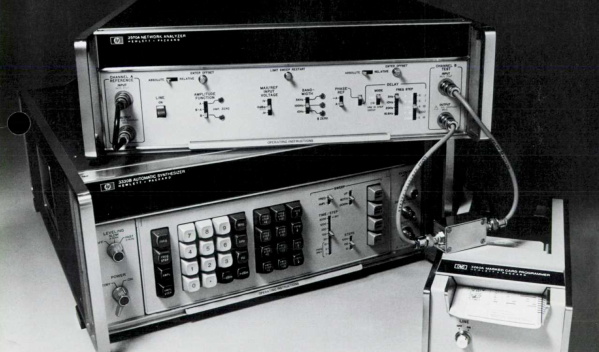
Almost immediately, a gift fell in the lap of the new organization — the Tizard Mission which arrived in the states from the UK in Sep 1940. They brought a literal treasure chest of technical innovations from the British, who hoped that US industry’s cooperation could help them survive what looked like certain and imminent invasion. One of those treasures was the cavity magnetron, which our own Dan Maloney wrote about a few years ago.

Within a few weeks, under the guidance of young Welshman “Taffy” Bowen, they had reviewed the design and gathered up the necessary equipment to fire it up. A 10 kV anode power supply and a 1,500 gauss electromagnet were procured, and the scientists gathered at the Bell Radio Laboratories in Whippany New Jersey on Sunday, Oct. 6, 1940. They powered up the cavity magnetron and were blown away by the results — over 10 kW of RF at 3 GHz (10 cm) from something the size of a bar of soap. Continue reading “Remembering The MIT Radiation Laboratory”
Copyright, What You Need To Know

Last week brought the story of a group of crypto enthusiasts who paid well over the going rate for a rare sci-fi book, then proposed encoding scans of all its pages in a blockchain before making and selling NFTs of them. To guarantee their rarity the book was then to be burned. Aside from the questionable imagery surrounding book burning in general, one of the sources of mirth in the story was their mistaken idea that in buying a copy of a rare book they had also acquired its copyright rather than simply paying too much for a book.

It’s an excuse for a good laugh, but it’s also an opportunity to talk about copyright as it affects our community. I’m not a lawyer and I’m not here to give legal advice. Instead this is based on the working knowledge gathered over decades working in the content publishing industries. Continue reading “Copyright, What You Need To Know”

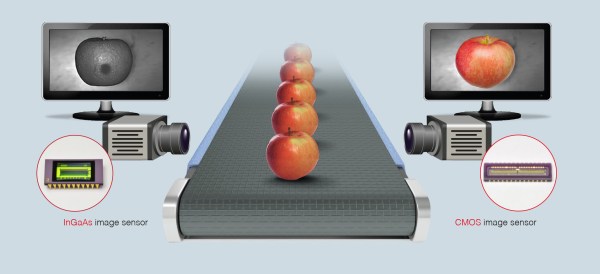
As apples travel down the conveyor belt, they are scanned using InGaAs and CMOS cameras. The InGaAs camera will show defects beginning to form under the skin that a human eye cannot see; the CMOS camera will show visible defects. (Credit: Hamamatsu)

Shining A Different Light On Reality With Short-Wave Infrared Radiation

As great as cameras that operate in the visual light spectrum are, they omit a lot of the information that can be gleaned from other wavelengths. There is also the minor issue that visibility is often impacted, such as when it’s raining, or foggy. When this happens, applications such as self-driving cars which rely on this, have a major issue. Through the use of sensors that are sensitive to other wavelengths, we can however avoid many of these issues.

Short-wave infrared radiation (SWIR) is roughly the part of the electromagnetic spectrum between 1.4 μm – 3 μm, or 100 THz – 214 THz. This places it between visible light and microwaves, and above long-wave IR at 20 THz – 37 THz. LWIR is what thermal cameras use, with LWIR also emitted by warm objects, such as the human body.

SWIR is largely unaffected by water in the atmosphere, while also passing through materials that are opaque to visible light. This allowing SWIR to be used for the analysis and inspection of everything from PCBs and fruit to works of art to capture details that are otherwise invisible or very hard to see.

Unfortunately, much like thermal camera sensors, SWIR sensors are rather expensive. Or they were, until quite recently, with the emergence of quantum-dot-based sensors that significantly decrease the costs of these sensors.

Continue reading “Shining A Different Light On Reality With Short-Wave Infrared Radiation”

Underwater Tanks Turn Energy Storage Upside-Down

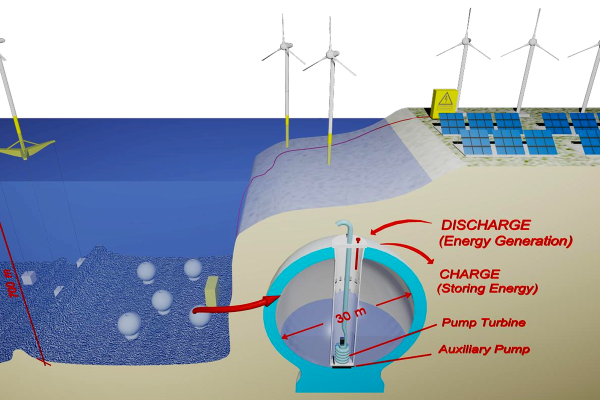
Pumped hydro storage is one of the oldest grid storage technologies, and one of the most widely deployed, too. The concept is simple – use excess energy to pump a lot of water up high, then run it back through a turbine when you want to get the energy back later.

With the rise in renewable energy deployments around the world, there is much interest in finding ways to store energy from these often-intermittent sources. Traditional pumped hydro can help, but there is only so much suitable land to work with.

However, there could be a solution, and it lurks deep under the waves. Yes, we’re talking about underwater pumped hydro storage!

Continue reading “Underwater Tanks Turn Energy Storage Upside-Down”

How The Hunga Tonga Volcano Eruption Was Felt Around The World

On the 14th of January, 2022, the Hunga Tonga-Hunga Ha’apai volcano began a gigantic eruption that would go on to peak in ferocity the next day. The uninhabited island volcano would quickly make headlines as the country of Tonga was cut off the world and tsunamis bore out from the eurption zone.

In a volcanic event of this size, the effects can be felt around the world. With modern instruments, they can be properly understood too. Let’s take a look at how the effects of the Hunga Tonga eruption were captured and measured across the globe.

Continue reading “How The Hunga Tonga Volcano Eruption Was Felt Around The World”

Save Money And Have Fun Using IEEE-488

A few months ago, I was discussing the control of GPIB equipment with a colleague. Based on only on my gut feeling and the briefest of research, I told him that the pricey and proprietary GPIB controller solutions could easily be replaced by open-source tools and Linux. In the many weeks that followed, I almost abandoned my stance several times out of frustration. With some perseverance, breaking the problems into bite-sized chunks, and lots of online searching to learn from other people’s experiences, my plan eventually succeeded. I haven’t abandoned my original stance entirely, I’ve taken a few steps back and added some qualifiers.

What is GPIB?

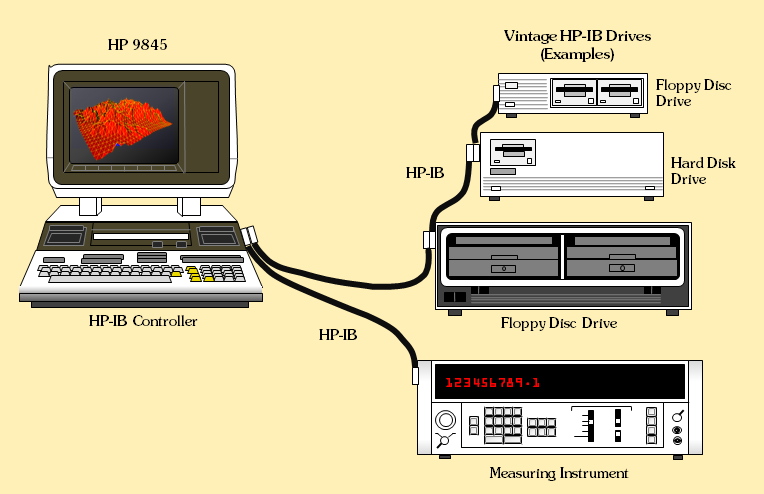
Example of HP-IB block diagram from the 1970s, from hp9845.net

Back in the 1960s, if test equipment was interconnected at all, there weren’t any agreed-upon methods for doing so. By the late 60s, the situation was made somewhat better by card-cage controller systems. These held a number of interface cards, one per instrument, presenting a common interface on the backplane. Although this approach was workable, the HP engineers realized they could significantly improve the concept to include these “bridging circuit boards” within the instruments and replacing the card cage backplane with passive cables. Thus began the development of what became the Hewlett-Packard Interface Bus (HP-IB). The October 1972 issue of the HP Journal introduced HP-IB with two main articles: A Practical Interface System for Electronic Instruments and A Common Digital Interface for Programmable Instruments: The Evolution of a System. Continue reading “Save Money And Have Fun Using IEEE-488”

Shelf Actualization

If you are old enough, you may remember that, for a time, almost every year was the year that home video was going to take off. Except it never was, until VHS tape machines appeared. We saw something similar with personal computers. Nowadays, we keep hearing about the home robot, but it never seems to fully materialize or catch on. If you think about it, it could be a problem of expectations.

What we all want is C3PO or Rosie the Robot that can do all the things we don’t want to do. What we usually get is something far less than that. You either get something hideously expensive that does a few tasks or something cheap that is little more than a toy.

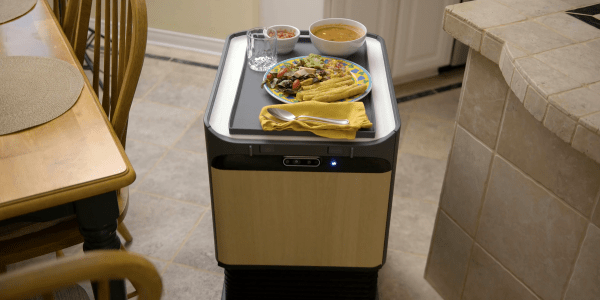
Labrador Systems is trying to hit the middle ground. While no one would confuse their Caddie and Retriever robots with C3PO, they are useful but also simple, presumably to keep the cost down which are expected to cost about $1,500. The robots have been described as “self-driving shelves.” You can watch a video about the devices below.

Continue reading “Shelf Actualization”