Polaroid In An Instant

Edwin Land, were he alive, would hate this post. He wanted to be known for this scientific work and not for his personal life. In fact, upon his death, he ordered the destruction of all his personal papers. However, Land was, by our definition, a hacker, and while you probably correctly associate him with the Polaroid camera, that turns out to be only part of the story.

Land in 1977

It was obvious that Land was intelligent and inquisitive from an early age. At six, he blew all the fuses in the house. He was known for taking apart clocks and appliances. When his father forbade him from tearing apart a phonograph, he reportedly replied that nothing would deter him from conducting an experiment. We imagine many Hackaday readers have similar childhood stories.

Optics

He was interested in optics, and at around age 13, he became interested in using polarized light to reduce headlight glare. The problem was that one of the best polarizing crystals known — herapathite — was difficult to create in a large size. Herapathite is a crystalline form of iodoquinine sulfate studied in the 1800s by William Herapath, who was unable to grow large sizes of the crystal. Interestingly, one of Herapath’s students noticed the crystals formed when adding iodine to urine from dogs that were given quinine.

Land spent a year at Harvard studying physics, but he left and moved to New York. He continued trying to develop a way to make large, practical, light-polarizing crystals. At night, he would sneak into labs at Columbia University to conduct experiments.

Continue reading “Polaroid In An Instant”

Undersea Cable Repair

The bottom of the sea is a mysterious and inaccessible place, and anything unfortunate enough to slip beneath the waves and into the briny depths might as well be on the Moon. But the bottom of the sea really isn’t all that far away. The average depth of the ocean is only about 3,600 meters, and even at its deepest, the bottom is only about 10 kilometers away, a distance almost anyone could walk in a couple of hours.

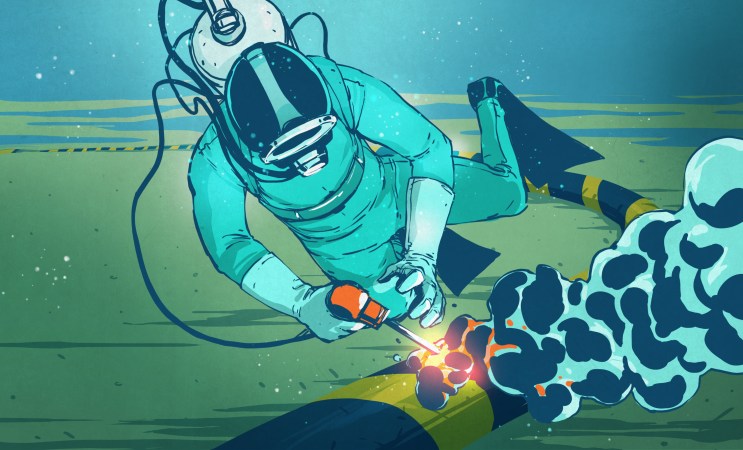
Of course, the problem is that the walk would be straight down into one of the most inhospitable environments our planet has to offer. Despite its harshness, that environment is home to hundreds of undersea cables, all of which are subject to wear and tear through accidents and natural causes. Fixing broken undersea cables quickly and efficiently is a highly specialized field, one that takes a lot of interesting engineering and some clever hacks to pull off.

Continue reading “Undersea Cable Repair”

An Antenna To Throw You For A Loop

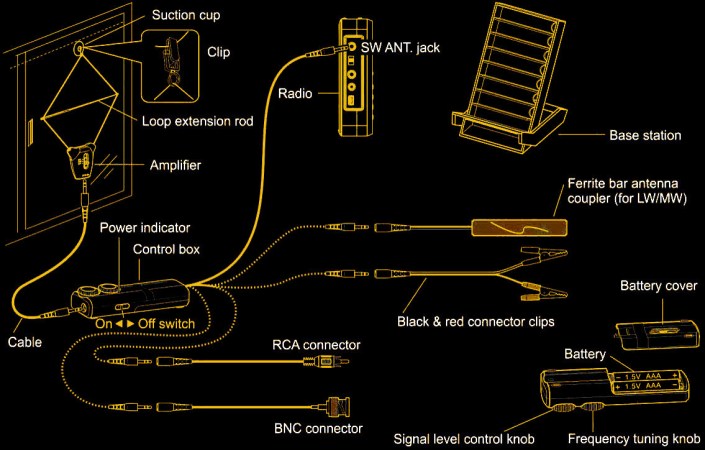
It is one of Murphy’s laws, we think, that you can’t get great things when you need them. Back in the heyday of shortwave broadcasting, any of us would have given a week’s pay for even a low-end receiver today. Digital display? Memory? Digital filtering? These days, you have radios, and they aren’t terribly expensive, but there isn’t much to listen to. Making matters worse, it isn’t easy these days to string wires around in your neighborhood for a variety of reasons. Maybe you don’t have a yard, or you have deed restrictions, or your yard lacks suitable space or locations. This problem is so common that there are a crop of indoor antennas that seem attractive. Since I don’t often tune in shortwave and I don’t want to have to reset my antenna after every storm, I decided to look at the Tecsun AN-48X along with a YouLoop clone from China. Let’s start with the Tecsun. Continue reading “An Antenna To Throw You For A Loop”

Ask Hackaday: Is Shortwave On Life Support?

A QSL Card from Radio Moscow probably got many 14-year-olds on government watch lists. (Public domain)

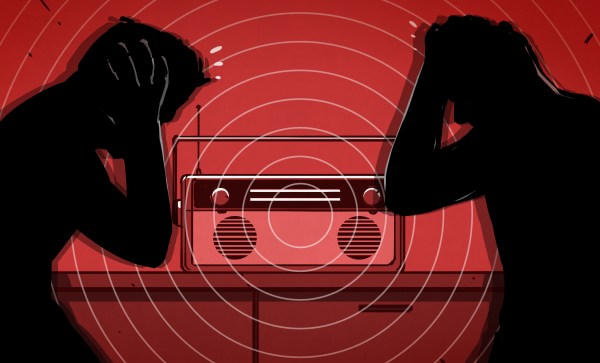
Between World War II and Y2K, shortwave listening was quite an education. With a simple receiver, you could listen to the world. Some of it, of course, was entertainment, and much of it was propaganda of one sort or another. But you could learn a lot. Kids with shortwave radios always did great in geography. Getting the news from a different perspective is often illuminating, too. Learning about other cultures and people in such a direct way is priceless. Getting a QSL card in the mail from a faraway land seemed very exciting back then.

Today, the shortwave landscape is a mere shadow of itself. According to a Wikipedia page, there are 235 active shortwave broadcasters from a list of 414, so nearly half are defunct. Not only are there many “dead” shortwave outlets, but many of the ones that are left are either not aimed at the world market or serve a niche group of listeners.

You can argue that with the Internet, you don’t need radio, and that’s probably correct in some ways but misses a few important points. Indeed, many broadcasters still exist as streaming stations or a mix of radio and streaming. I have to admit I listen to the BBC often but rarely on the air. My computer or phone plays it in crystal clarity 24 hours a day.

A future Hackaday author in front of an Eico shortwave radio

So, while a 14-year-old in 1975 might be hunched over a radio wearing headphones, straining to hear NHK World Radio, these days, they are likely surfing the popular social media site of the week. You could easily argue that content on YouTube, Instagram, and the like can come from all over the world, so what’s the problem?

The problem is information overload. Faced with a shortwave radio, there were a limited number of options available. What’s more, only a small part of the band might be “open” at any given time. It isn’t like the radio could play games or — unless you were a ham — allow you to chat with your friends. So you found radio stations from Germany to South Africa. From China and Russia, to Canada and Mexico. You knew the capital of Albania. You learned a little Dutch from Radio Nederlands.

Continue reading “Ask Hackaday: Is Shortwave On Life Support?”

End Of An Era: Sony Cuts Production Of Writable Optical Media

The 1990s saw a revolution occur, launched by the CD burner. As prices of writeable media and drives dropped, consumers rushed to duplicate games, create their own mix CDs, and backup their data on optical disc. It was a halcyon time.

Fast forward to today, and we’re very much on downward curve when it comes to optical media use. Amidst ever-declining consumer interest, Sony has announced it will cut production of writeable optical media. Let’s examine what’s going on, and explore the near future for writable optical discs.

Continue reading “End Of An Era: Sony Cuts Production Of Writable Optical Media”

The Rise Of The Disappearing Polymorphs

Science and engineering usually create consistent results. Generally, when you figure out how to make something, you can repeat that at will to make more of something. But what if, one day, you ran the same process, and got different results? You double-checked, and triple-checked, and you kept ending up with a different end product instead?

Perhaps it wasn’t the process that changed, but the environment? Or physics itself? Enter the scary world of disappearing polymorphs.

Continue reading “The Rise Of The Disappearing Polymorphs”

You Can Use LEDs As Sensors, Too

LEDs are a wonderful technology. You put in a little bit of power, and you get out a wonderful amount of light. They’re efficient, cheap, and plentiful. We use them for so much!

What you might not have known is that these humble components have a secret feature, one largely undocumented in the datasheets. You can use an LED as a light source, sure, but did you know you can use one as a sensor?

Continue reading “You Can Use LEDs As Sensors, Too”