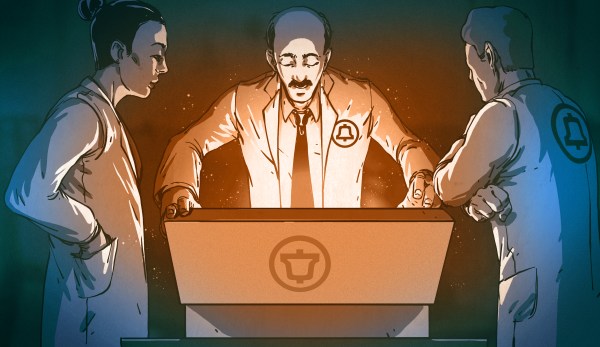
How Hard Could It Be To Get Millions Of Phone Bills Right?

It may be a foreign concept to anyone who has never paid a dime for a phone call over and above the monthly service charge, but phone calls were once very, VERY expensive — especially long-distance calls, which the phone company ungenerously defined as anything more than a few towns away. Woe betide the 70s teen trying to talk to out-of-town friends or carry on a romance with anyone but the guy or girl next door when that monthly phone bill came around; did anyone else try to intercept it from the mailbox before the parents could see it?

While it seems somewhat quaint now, being charged for phone calls was not only a big deal to the customers, but to the phone company itself. The Bell System, which would quickly become a multi-billion dollar enterprise, was built on the ability to accurately meter the use of their service and charge customers accordingly. Like any engineered system, it grew and changed over time, and it had to adapt to the technologies and economic forces at the time.

One of the most interesting phases of its development was the development of Automatic Message Accounting (AMA), which in a very real way paved the way for the wide-open, worldwide, too-cheap-to-meter phone service we enjoy today.

Continue reading “How Hard Could It Be To Get Millions Of Phone Bills Right?”
FOSDEM 2023: An Open-Source Conference, Literally

Every year, on the first weekend of February, a certain Brussels university campus livens up. There, you will find enthusiasts of open-source software and hardware alike, arriving from different corners of the world to meet up, talk, and listen. The reason they all meet there is the conference called FOSDEM, a long-standing open-source software conference which has been happening in Belgium since 2000. I’d like to tell you about FOSDEM because, when it comes to conferences, FOSDEM is one of a kind.

FOSDEM is organized in alignment with open-source principles, which is to say, it reminds me of an open-source project itself. The conference is volunteer-driven, with a core of staff responsible for crucial tasks – yet, everyone can and is encouraged to contribute. Just like a large open-source effort, it’s supported by university and company contributions, but there’s no admission fees for participants – for a conference, this means you don’t have to buy a ticket to attend. Last but definitely not least, what makes FOSDEM shine is the community that it creates.

FOSDEM’s focus is open software – yet, for hackers of the hardware world, you will find a strong hardware component to participate in, since a great number of FOSDEM visitors are either interested in hardware, or even develop hardware-related things day-to-day. It’s not just that our hardware can’t live without software, and vice-versa – here, you will meet plenty of pure software, a decent amount of pure hardware, and a lot of places where the two worlds are hard to distinguish. All in all, FOSDEM is no doubt part of hacker culture in Europe, and today, I will tell you about my experience of FOSDEM 2023. Continue reading “FOSDEM 2023: An Open-Source Conference, Literally”

Supercon 2022: Selling Your Company And Not Your Soul

Haddington Dynamics is a particular company. After winning the 2018 Hackaday Prize with an open-source robotic arm, we’ve covered their micro-factories and suction cup end-effectors for making face shields during 2020. They’ve been laser-focused on their mission of creating a fantastic robot arm at a small price tag with open-source software and design. So how does a company with such a hacker ethos get bought by a much larger company, and why? They came to SuperCon 2022 to share their story in a panel discussion.

Haddington Dynamics started with two clever inventions: optical encoders that used analog values instead of digital values and an FPGA that allowed them to poll those encoders and respond rapidly. This allowed them to use cheaper motors and rely on the incredibly sensitive encoders to position them. After the Hackaday prize, they open-sourced the HD version of the robot and released the HDI version. But in 2020, they were bought by a group called Ocado. As to why the somewhat practical but not exciting answer is that they needed money. Employees needed to be paid, and they needed capital to keep the doors open.

So this leads to the next tricky question, how do you sell your company without changing it? The fine folks at Haddington Dynamics point out in their panel discussion that a company is a collection of people. The soul of that company is the collective soul of those people coming together. A company being bought can be akin to stopping working for yourself and going to work for someone else. Working alone, you have values and principles that you can easily stick to. But once you start working for someone else, they will value different things, and while the people that make up the company might not change, the company’s decisions might become unrecognizable.

As the panel points out, looking for a buyer with the same values is critical. Ocado was a great fit as their economic interests and culture matched Haddington’s. However, it’s not all roses, as Ocadao tends to be a very closed-source group. However, Haddington Dynamics still supports its open-source initiatives. It’s a fascinating look into a company’s life cycle and how they navigate the waters of open-source, funding, acquisitions, innovation, and invention. Despite the fairytale-like nature of inventing a revolutionary robot arm in your garage and winning many awards, it turns out there is quite a lot that happens after the happily ever after.

We look forward to seeing more of Haddington Dynamics and where they go next. Video after the break.

Continue reading “Supercon 2022: Selling Your Company And Not Your Soul”

Repurposing Old Smartphones: When Reusing Makes More Sense Than Recycling

When looking at the specifications of smartphones that have been released over the past years, it’s remarkable to see how aspects like CPU cores, clockspeeds and GPU performance have improved during this time, with even new budget smartphones offering a lot of computing power, as well as a smattering of sensors. Perhaps even more remarkable is that of the approximately 1.5 billion smartphones sold each year, many will be discarded again after a mere two years of use. This seems rather wasteful, and a recent paper by Jennifer Switzer and colleagues proposes that a so-called Computational Carbon Intensity (CCI) metric should be used to determine when it makes more sense to recycle a device than to keep using it.

What complicates the decision of when it makes more sense to reuse than recycle is that there are many ways to define when a device is no longer ‘fit for purpose’. It could be argued that the average smartphone is still more than good enough after two years to be continued as a smartphone for another few years at least, or at least until the manufacturer stops supplying updates. Beyond the use as a smartphone, they’re still devices with a screen, WiFi connection and a capable processor, which should make it suitable for a myriad of roles.

Unfortunately, as we have seen with the disaster that was Samsung’s ‘upcycling’ concept a few years ago, or Google’s defunct Project Ara, as promising as the whole idea of ‘reuse, upcycle, recycle’ sounds, establishing an industry standard here is frustratingly complicated. Worse, over the years smartphones have become ever more sealed-up, glued-together devices that complicate the ‘reuse’ narrative.

Continue reading “Repurposing Old Smartphones: When Reusing Makes More Sense Than Recycling”

Laptop Motherboard? No, X86 Single-Board Computer!

Sometimes a Raspberry Pi will not cut it – especially nowadays, when the prices are high and the in-stock amounts are low. But if you look in your closet, you might find a decently-specced laptop with a broken screen or faulty hinges. Or perhaps someone you know is looking to get rid of a decent laptop with a shattered case. Electronics recycling or eBay, chances are you can score a laptop with at least some life left in it.

Let’s hack! I’d like to show you how a used laptop motherboard could be the heart of your project, and walk you through some specifics you will want to know.

And what a great deal it could be for your next project! Laptop motherboards can help bring a wide variety of your Linux- and Windows-powered projects to life, in a way that even NUCs and specialized SBCs often can’t do. They’re way cheaper, way more diverse, and basically omnipresent. The CPU can pack a punch, and as a rule PCIe, USB3, and SATA ports are easily accessible with no nonsense like USB-throttled Ethernet ports.

Continue reading “Laptop Motherboard? No, X86 Single-Board Computer!”

Hackaday Links Column Banner

Hackaday Links: February 26, 2023

It’s probably safe to say that most of us have had enough of the Great Balloon Follies to last the rest of 2023 and well beyond. It’s been a week or two since anything untoward was spotted over the US and subsequently blasted into shrapnel, at least that we know of, so we can probably put this whole thing behind us.

But as a parting gift, we present what has to be the best selfie of the year — a photo by the pilot of a U-2 spy plane of the balloon that started it all. Assuming no manipulation or trickery, the photo is remarkable; not only does it capture the U-2 pilot doing a high-altitude flyby of the balloon, but it shows the shadow cast by the spy plane on the surface of the balloon.

The photo also illustrates the enormity of this thing; someone with better math skills than us could probably figure out the exact size of the balloon from the apparent size of the U-2 shadow, in fact.

Continue reading “Hackaday Links: February 26, 2023”

Hackaday Podcast 207: Modular Furniture, Plastic Prosthetics, And Your Data On YouTube

Join Editor-in-Chief Elliot Williams and Managing Editor Tom Nardi as they explore the best and most interesting stories from the last week. The top story if of course the possibility that at least some of the unidentified flying objects the US Air Force valiantly shot down were in fact the work of amateur radio enthusiasts, but a quantitative comparison of NASA’s SLS mega-rocket to that of popular breakfast cereals is certainly worth a mention as well.

Afterwards the discussion will range from modular home furnishings to the possibility of using YouTube (or maybe VHS tapes) to backup your data and AI-generated Pong. Also up for debate are cheap CO2 monitors which may or may not be CO2 monitors, prosthetic limbs made from locally recycled plastic, and an answer to Jenny’s Linux audio challenge from earlier this month.

Check out the links below if you want to follow along, and as always, tell us what you think about this episode in the comments!

Download it your own bad self!

Continue reading “Hackaday Podcast 207: Modular Furniture, Plastic Prosthetics, And Your Data On YouTube”