What’s Special About Fifty Ohms?

If you’ve worked with radios or other high-frequency circuits, you’ve probably noticed the prevalence of 50 ohm coax. Sure, you sometimes see 75 ohm coax, but overwhelmingly, RF circuits work at 50 ohms.

[Microwaves 101] has an interesting article about how this became the ubiquitous match. Apparently in the 1930s, radio transmitters were pushing towards higher power levels. You generally think that thicker wires have less loss. For coax cable carrying RF though, it’s a bit more complicated.

First, RF signals exhibit the skin effect–they don’t travel in the center of the conductor. Second, the dielectric material (that is, the insulator between the inner and outer conductors) plays a role. The impedance is also a function of the dielectric material and the diameter of the center conductor.

Continue reading “What’s Special About Fifty Ohms?”

Open Source Solar

What’s the size of a standard euro-palette, goes together in 15 minutes, and can charge 120 mobile phones at one time? At least one correct answer is Sunzilla, the open source solar power generator. The device does use some proprietary components, but the entire design is open source. It contains solar panels, of course, as well as storage capacity and an inverter.

You can see a video about the project below. The design is modular so you can pick and choose what you want. It also is portable, stackable, and easy to transport. The team claims they generate 900W of solar power and can store 4 kWh. Because of the storage device, the peak power out is 1600W and the output is 230V 50Hz AC.

Continue reading “Open Source Solar”

A Jailbreak For Every Kindle

[Geekmaster] wrote in to tell us about a new hack for the Amazon Kindle. It’s a jailbreak. Universal jailbreak for almost every eInk Kindle eReader eOut eThere.

This jailbreak is a pure software jailbreak for the Kindle Paperwhite 2, the Kindle Paperwhite 3, Kindle Touch, Kindle Voyage, and Kindle Oasis. If you’re keeping track, that’s any 6th, 7th, or 8th generation device, running any firmware version. Already the jailbreak has been tested by over one thousand people, after the cloud served up half a Terabyte of jailbreak image downloads. That’s extraordinarily popular for a device that hasn’t seen much action of late.

Several years ago, [Geekmaster] made a name for himself – and for [NiLuJe], [KNC1], and other developers over at the Mobileread forums – for jailbreaking the Kindle Paperwhite. This jailbreak was, and is extremely simple; just upload a file to the root directory, restart, and the Kindle is jailbroken. The latest development extends this to nearly all Kindle models, while still being as easy to deploy as the original hack from four years ago.

If you’re looking for something to do with a neat jailbroken device with an eInk screen, they make a great serial consolethermostat, and wallpaper.

Neural Network Targets Cats With A Sprinkler System

It’s overkill, but it’s really cool. [Bob Bond] took an NVIDIA Jetson TX1 single-board computer and a webcam and wirelessly combined them with his lawn sprinklers. Now, when his neighbors’ cats come to poop in his yard, a carefully trained neural network detects them and gets them wet.

It is absolutely the case that this could have been done with a simple motion sensor, but if the neural network discriminates sufficiently well between cats and (for instance) his wife, this is an improved solution for sure. Because the single-board computer he’s chosen for the project has a ridiculous amount of horsepower, he can afford to do a lot of image processing, so there’s a chance that everyone on two legs will stay dry. And the code is up on GitHub for you to see, if you’re interested.

[Bob] promises more detail about the neural network in the future. We can’t wait. (And we’d love to see a sentry-turret style build in the future. Think of the water savings!)

Via the NVIDIA blog, and thanks [Jaqen] for the tip!

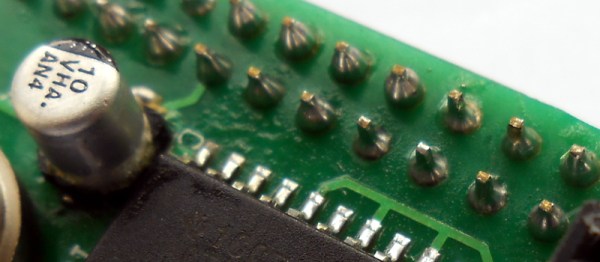
Ask Hackaday: How Hard Is It To Make A Bad Solder Joint?

When you learn to solder, you are warned about the pitfalls of creating a solder joint. Too much solder, too little solder, cold joints, dry joints, failing to “wet” the joint properly, a plethora of terms are explained  if you read one of the many online guides to soldering.

Unsurprisingly it can all seem rather daunting to a novice, especially if they are not used to the dexterity required to manipulate a tool on a very small-scale at a distance. And since the soldering iron likely to be in the hands of a beginner will not be one of the more accomplished models with fine temperature control and a good tip, it’s likely that they will experience most of those pitfalls early on in their soldering career.

As your soldering skills increase, you get the knack of making a good joint. Applying just the right amount of heat and supplying just enough solder becomes second nature, and though you still mess up from time to time you learn to spot your errors and how to rework and fix them. Your progression through the art becomes a series of plateaux, as you achieve each new task whose tiny size or complexity you previously thought rendered it impossible. Did you too recoil in horror before your first 0.1″ DIP IC, only to find it had been surprisingly easy once you’d completed it?

A few weeks ago we posted a Hackaday Fail of the Week, revolving around a soldering iron failure and confirmation bias leading to a lengthy reworking session when the real culprit was a missing set of jumpers. Mildly embarrassing and something over which a veil is best drawn, but its comments raised some interesting questions about bad solder joints. In the FoTW case I was worried I’d overheated the joints causing them to go bad, evaporating the flux and oxidising the solder. This was disputed by some commenters, but left me with some curiosity over bad solder joints. We all know roughly how solder joints go wrong, but how much of what we know is heresay? Perhaps it is time for a thorough investigation of what makes a good solder joint, and the best way to understand that would surely be to look at what makes a bad one.

Continue reading “Ask Hackaday: How Hard Is It To Make A Bad Solder Joint?”

Tissue-Engineered Soft Robot Swims Like A Stingray

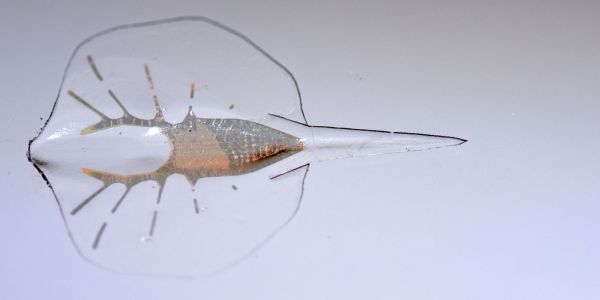
We’re about to enter a new age in robotics. Forget the servos, the microcontrollers, the H-bridges and the steppers. Start thinking in terms of optogenetically engineered myocytes, microfabricated gold endoskeletons, and hydrodynamically optimized elastomeric skins, because all of these have now come together in a tissue-engineered swimming robotic stingray that pushes the boundary between machine and life.

In a paper in Science, [Kevin Kit Parker] and his team at the fantastically named Wyss Institute for Biologically Inspired Engineering describe the achievement. It turns out that the batoid fishes like skates and rays have a pretty good handle on how to propel themselves in water with minimal musculoskeletal and neurological requirements, and so they’re great model organisms for a tissue engineered robot.

The body is a laminate of silicone rubber and a collection of 200,000 rat heart muscle cells. The cardiomyocytes provide the contractile force, and the pattern in which they are applied to the 1/2″ (1.25cm) body allows for the familiar undulating motion of a stingray’s wings. A gold endoskeleton with enough stiffness to act as a spring is used to counter the contraction of the muscle fibers and reset the system for another wave. Very clever stuff, but perhaps the coolest bit is that the muscle cells are genetically engineered to be photosensitive, making the robofish controllable with pulses of light. Check out the video below to see the robot swimming through an obstacle course.

This is obviously far from a finished product, but the possibilities are limitless with this level of engineering, especially with a system that draws energy from its environment like this one does. Just think about what could be accomplished if a microcontroller could be included in that gold skeleton.

Continue reading “Tissue-Engineered Soft Robot Swims Like A Stingray”

Modding The Monoprice MP Mini Printer

Two weeks after my review of the MP Select Mini 3D printer, Monoprice’s own website has said this printer has been out of stock, in stock, and out of stock again several times. This almost unimaginably cheap 3D printer is proving to be exceptionally popular, and is in my opinion, a game-changing machine for the entire world of 3D printing.

With the popularity of this cheap printer that’s more than halfway decent, there are bound to be improvements. Those of us who have any experience with 3D printers aren’t going to be satisfied with a machine with any shortcomings, especially if it means we can print enhancements and mods for our printers.

Below are the best mods currently available for this exceptional printer. Obvious problems with the printer are corrected, and it’s made a little more robust. There are mods to add a glass build plate, and a few people are even messing around with the firmware on this machine. Consider this volume one of the MP Mini hacks; with a cheap printer that’s actually good, there are bound to be more improvements.

Continue reading “Modding The Monoprice MP Mini Printer”